
Note
Bacteriostatic Water vs. Sterile Water
The difference between bacteriostatic and sterile water for laboratory use: preservatives, multi-dose vials, and assay compatibility.
Bacteriostatic water and sterile water differ by a single component: bacteriostatic water contains 0.9% benzyl alcohol as a preservative; sterile water contains no additives whatsoever. That one difference determines how many times the same vial can be accessed without compromising sample integrity, and which assays each diluent supports without altering results.
What bacteriostatic water is
Bacteriostatic water for injection — BWFI — is purified water that has been sterilized and formulated with 0.9% w/v benzyl alcohol. The sterilization step eliminates microorganisms present at manufacture; the benzyl alcohol prevents them from re-establishing between one puncture of the vial and the next.
The name describes exactly what the preservative does: *bacteriostatic* means the compound inhibits bacterial multiplication rather than killing bacteria outright. For typical laboratory work, where vial contents are consumed within a defined period after first use, inhibition is sufficient.
A BWFI vial can be punctured multiple times. Reference pharmacopeias set limits based on volume and elapsed time after first puncture, but the underlying rationale is consistent: the preservative maintains the contents in a protected state between withdrawals. The US Pharmacopeia publishes reference standards for BWFI that include sterility, endotoxin and pH requirements alongside the specified benzyl alcohol concentration.
What sterile water is
Sterile water for injection — SWFI — is purified, sterilized water with no additives. No preservatives, no pH adjusters, no tonicity agents.
That absence is simultaneously its defining technical property and its primary constraint in laboratory work. Once the vial is opened, nothing prevents bacterial contamination if handling or equipment introduces it. Standard practice treats SWFI as single-dose: contents not consumed in the same session are discarded.
For certain assays, however, the absence of additives is an advantage rather than a limitation. Benzyl alcohol — the preservative in bacteriostatic water — interferes with some protein quantification methods, particularly the BCA and Bradford colorimetric assays, and can alter the measured activity of enzymes sensitive to the compound. In those contexts, sterile water is the technically correct choice.
How the two differ in practice
Composition. Bacteriostatic water carries 0.9% benzyl alcohol. Sterile water carries nothing beyond water meeting injection-grade specifications for sterility and endotoxins.
Vial use. Bacteriostatic water is multi-dose: the same vial can be accessed across multiple sessions over days or weeks without bacterial contamination progressing between extractions, provided storage conditions are maintained. Sterile water is single-dose: whatever is not used in the current session is discarded.
Assay compatibility. Benzyl alcohol at the concentration present in BWFI can interfere with BCA and Bradford protein quantification methods. Published work on preservative interference with colorimetric protein assays documents absorbance shifts at concentrations introduced even by partial BWFI dilution into samples. If a protocol includes either method, sterile water is the appropriate diluent. The same applies to enzyme activity assays where the target enzyme has documented sensitivity to benzyl alcohol.
Reconstituted compound stability. For lyophilized peptides used in research, bacteriostatic water offers a practical advantage: the preservative extends the usable life of a reconstituted vial stored refrigerated when material is withdrawn across multiple experiments over days or weeks.
Osmolarity. Both are hypotonic. The benzyl alcohol in bacteriostatic water contributes negligibly to total osmolarity in most protocols, but tonicity-controlled experimental designs should account for it explicitly.
Choosing between them in the laboratory
Two questions drive the selection: how many times will the same vial be accessed, and does the preservative conflict with what is being measured?
Use bacteriostatic water when the protocol calls for multiple withdrawals from the same vial across sessions, when working with lyophilized research peptides where preserving reconstituted material between experiments matters, or when bacterial contamination between openings is a genuine risk and the preservative does not conflict with the assay system.
Use sterile water when the protocol is single-use and the vial is discarded at session end, when the assay is sensitive to benzyl alcohol — BCA or Bradford quantification, enzyme activity where the enzyme reacts to the preservative — or when introducing any additive into the diluent would create an uncontrolled variable in the experimental design.
If a single experiment involves multiple compounds, verifying preservative compatibility across all of them before selecting a diluent prevents results that are difficult to interpret after the fact. The PeptoClinic catalog lists both bacteriostatic water and a preservative-free diluent option for protocols where benzyl alcohol exclusion is a requirement.
Storage after opening
Opened bacteriostatic water is stored refrigerated, between 2 and 8°C, and used within the period the laboratory's protocol specifies. The preservative extends vial life after first puncture but does not maintain the contents indefinitely or under all storage conditions.
Opened sterile water, if not consumed in the same session, is discarded. There is no preservative to sustain its integrity between openings.
In both cases: inspect the vial visually before each use. Turbidity, visible particles or any change in color are grounds for discarding the contents rather than proceeding with the protocol.
What the certificate of analysis should document
For any diluent entering a research protocol, the relevant document is the certificate of analysis (CoA). It records what was measured, who measured it and what was found. A vial without a verifiable CoA has no documented technical history.
Minimum parameters a research-grade diluent CoA should include: endotoxins, sterility, pH, and — when a preservative is present — its measured concentration, not only the nominal label claim. Specifying a target without confirming it analytically is not quality documentation.
PeptoClinic documents diluent lots under the same framework as peptide lots. The quality documentation page explains how batch records are structured and what accompanies an order from PeptoClinic.
For laboratory research only
PeptoClinic supplies bacteriostatic water and sterile water strictly as laboratory research materials for in vitro and laboratory use.
Nothing in the PeptoClinic catalog is approved or intended for human or veterinary consumption, diagnosis or treatment. These materials are not medicines and not supplements. No regulatory authority — the FDA, ANMAT or any equivalent — has evaluated their therapeutic or diagnostic use.
Requests for administration protocols in people or animals are not addressed. PeptoClinic serves researchers and laboratory technicians operating within research use only (RUO) frameworks.
PeptoClinic supplies to Argentina as laboratory reference material. Shipping logistics and import documentation details are on the Argentina page.
Frequently asked questions
What is the main difference between bacteriostatic water and sterile water?
Bacteriostatic water contains 0.9% benzyl alcohol as a preservative. Sterile water contains no additives. That single difference determines how many times the same vial can be accessed without contamination risk, and which assays are compatible with each diluent.
Can the same vial of bacteriostatic water be used more than once?
Yes. The 0.9% benzyl alcohol inhibits bacterial growth between punctures, making bacteriostatic water suitable for multi-dose use when stored correctly. Sterile water carries no preservative and is treated as single-dose: contents not used in the current session are discarded.
Does benzyl alcohol in bacteriostatic water interfere with protein assays?
It can. BCA and Bradford assays are sensitive to benzyl alcohol at the concentrations introduced by BWFI. If a protocol includes protein quantification by either method, sterile water without additives is the appropriate diluent.
When is sterile water the better choice?
When the protocol is single-use, when the assay is sensitive to benzyl alcohol — protein quantification by BCA or Bradford, or enzyme activity where the enzyme reacts to the preservative — or when introducing any additive into the diluent would create an uncontrolled variable in the experimental design.
How should bacteriostatic water be stored after the vial is first opened?
Refrigerated, between 2 and 8°C. The preservative extends vial life after first puncture but does not preserve the contents indefinitely or under all storage conditions. Inspect the vial visually before each use; turbidity or visible particles are grounds for discarding.
Are sterile water and distilled water the same thing?
No. Distilled water is purified by distillation but is not necessarily sterilized or formulated to the endotoxin specifications required for research-grade materials. Sterile water for injection meets sterility and endotoxin standards that conventional distilled water does not guarantee.
What should a certificate of analysis for a research diluent include?
At minimum: sterility, endotoxins, pH, and — when a preservative is present — its measured concentration, not only the nominal claim. A vial whose CoA does not report those parameters lacks the documented technical information needed to evaluate it for a research protocol.
Does PeptoClinic supply bacteriostatic water and sterile water to Argentina?
Yes. PeptoClinic supplies research diluents with shipments to Argentina as laboratory reference material. Quotes are requested directly at [email protected].
Compounds mentioned
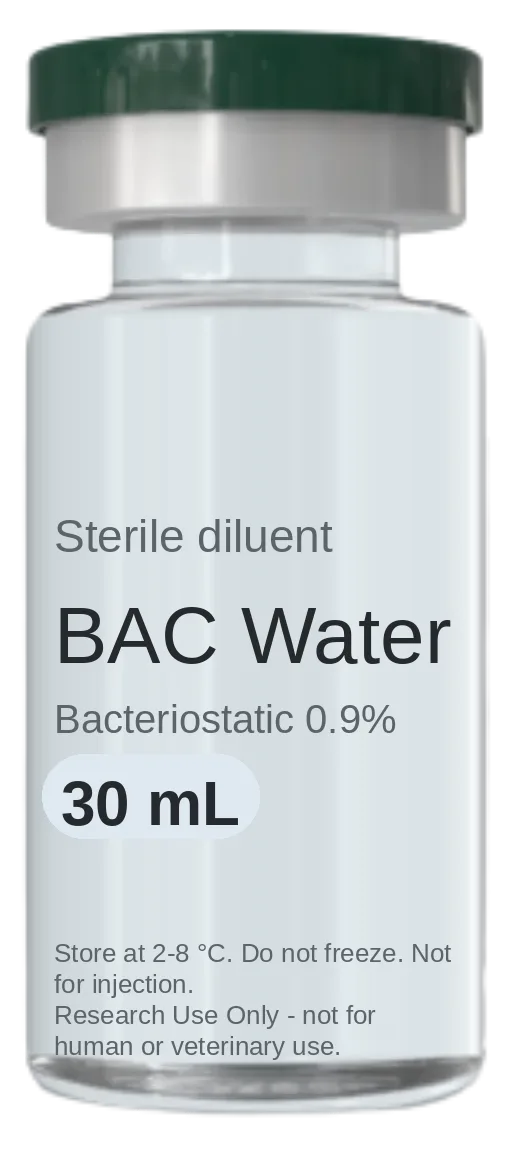
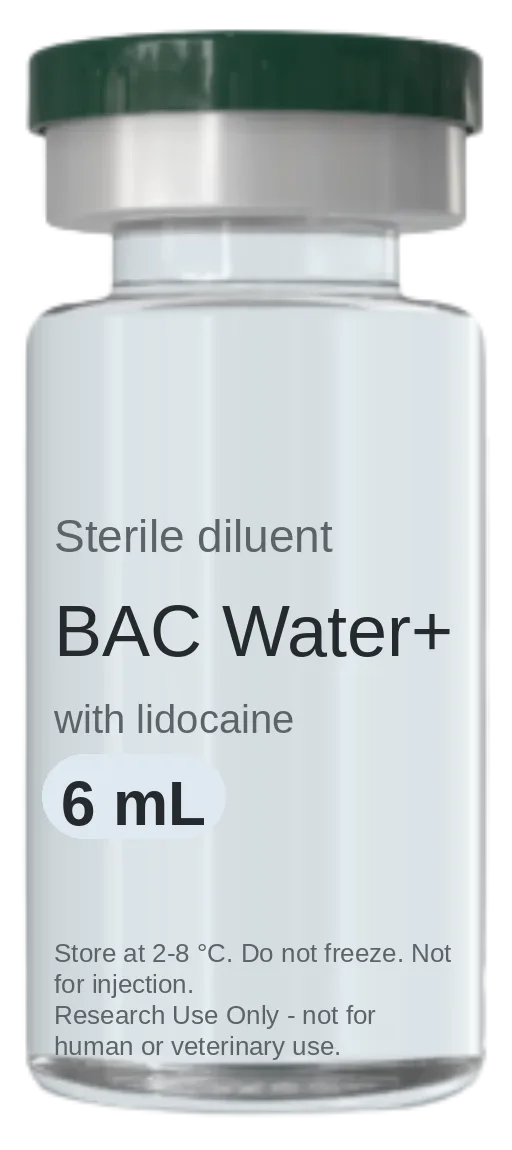
BAC Water+ (6mL con Lidocaína)
Bacteriostatic water with lidocaine, 6 mL, for laboratory reconstitution.
- Purity:
- USP grade
- Sizes available:
- 6 mL
The consultation
One intake that settles goals, history and contraindications alongside compound, quantity, documentation and route — reviewed by a physician before anything ships.
More notes
-
Retatrutide vs BPC-157: Key Differences
Retatrutide and BPC-157 are research peptides with different mechanisms, families, and study objectives. Here's why they're not interchangeable.
-
Paying Argentina's Customs Duty on Peptides
How the import duty on a research peptide shipment is paid when it arrives in Argentina, and who actually collects it.
-
No Batch Number on the Invoice: Customs
If a peptide shipment's invoice skips the batch number, Argentine customs can hold it and request supporting documents.