
Note
Retatrutide: The Triple Agonist Explained
By the PeptoClinic editorial team · Medically reviewed by Nayana Ambardekar, MD
What retatrutide is, which receptors it activates, and why research literature calls it a triple GLP-1/GIP/glucagon agonist.
Retatrutide is a research peptide that activates three distinct hormone receptors at once: GLP-1, GIP, and the glucagon receptor. That is exactly why the scientific literature classifies it as a "triple agonist" — it doesn't mimic a single digestive hormone, it mimics three simultaneously. It is the most-cited research molecule in this family, and researchers specifically search for it because of that three-receptor mechanism. The full compound profile is on the retatrutide Argentina page.
What "agonist" actually means
An agonist is a molecule that binds to a receptor and switches it on, the way a key turns a specific lock. The human body already makes its own keys: GLP-1, GIP, and glucagon are naturally occurring hormones, released mainly in the gut and pancreas, that participate in how the body processes glucose and regulates appetite. A synthetic research agonist is designed to bind the same receptor as the natural hormone and produce a comparable effect, but with a modified molecular structure built to stay active in the body longer than the native hormone does.
Most peptides in this class studied over the last decade activate a single receptor (simple agonists, like GLP-1 analogues) or two receptors (dual agonists, combining GLP-1 and GIP). Retatrutide goes a step further: it was engineered to activate all three receptors within a single molecule.
The three receptors, one at a time
- GLP-1 (glucagon-like peptide-1): the best-studied of the three receptors. It is involved in glucose-dependent insulin secretion and in satiety signaling at the level of the central nervous system.
- GIP (glucose-dependent insulinotropic polypeptide): its role is more debated in the literature. Some studies associate it with improved insulin sensitivity when combined with GLP-1 activation, rather than acting alone.
- Glucagon receptor: the one that sets retatrutide apart from dual agonists. Glucagon is traditionally associated with raising blood glucose, but in the context of coactivation alongside GLP-1 and GIP, preclinical studies investigate its role in energy expenditure, not isolated glucose elevation.
The hypothesis driving this three-receptor design, as it appears in the research literature, is that combined, simultaneous action on all three systems produces a different — and potentially greater — metabolic effect than activating any single receptor on its own. That remains a hypothesis under investigation, not a settled conclusion.
How retatrutide compares with other research agonists
| Aspect | Single agonist (GLP-1) | Dual agonist (GLP-1/GIP) | Retatrutide (triple) |
|---|---|---|---|
| Receptors activated | 1 (GLP-1) | 2 (GLP-1 and GIP) | 3 (GLP-1, GIP, and glucagon) |
| Position in the literature | First generation, most studied | Second generation | Most recent generation |
| Distinguishing added mechanism | — | GIP coactivation | Adds the glucagon receptor |
| Reported clinical development phase | Varies by molecule | Varies by molecule | Phase 3 |
| FDA approval | Varies by specific molecule | Varies by specific molecule | Not approved |
| ANMAT approval | No | No | No |
The table compares receptor mechanisms, not outcomes or promises — what each molecule activates, not what happens to a person who uses it.
What the literature reports about its development
Retatrutide was originally developed by Eli Lilly and appears in clinical trial registries at phase 3, according to the available literature on the compound. Phase 3 means the trial measures efficacy and safety in a larger population than earlier phases, but it still does not imply regulatory approval: a molecule can sit in phase 3 for years before a regulator decides to approve it, reject it, or request more data.
Published studies on retatrutide, both preclinical and clinical, investigate its effect on combined metabolic markers — glucose, lipid profile, body weight — compared against placebo or against single-receptor agonists. That comparative design is a large part of why the compound generated so much interest in the research community: it lets investigators isolate, within the same molecular scaffold, what each additional receptor contributes to the overall mechanism.
Regulatory status: none of this is approved
No compound in PeptoClinic's catalogue, retatrutide included, is approved by ANMAT or by the FDA. Retatrutide appears in phase 3 trial literature, which places it at an advanced stage of clinical research, but phase 3 is not synonymous with approval — it is the stage where the evidence a regulator will later evaluate gets collected, and that evaluation can take years or may never arrive for a specific formulation.
Any claim describing retatrutide as "approved," "safe," or a "treatment" does not match the compound's actual status as of this writing. What exists is a growing body of research, with some results already published and others still underway.
Why batch purity matters more in a triple agonist
The more receptors a molecule activates, the more sensitive a research result becomes to small variations in peptide purity: an impurity that barely registers for a single-receptor agonist can introduce noise in a three-receptor design, because three distinct biological systems are responding at once. That is why, for research with retatrutide, what matters is the third-party laboratory report for the specific batch — not a generic "high purity" label.
PeptoClinic publishes laboratory reports from Janoshik Analytical for the batches it analyzes, including one retatrutide report with a found purity of 99.893%. You can see how to read those certificates on the quality and certificates of analysis page.
Where it fits in a research catalogue
Retatrutide is part of PeptoClinic's research peptide catalogue, available as a lyophilized powder vial. You can see the full compound profile or browse the rest of the catalogue if you're comparing molecules with related mechanisms.

Medical review
Nayana Ambardekar, MD

Reviews every consultation as it comes in
Emory University
Frequently asked questions
What makes a triple agonist different from a dual agonist?
A dual agonist activates two receptors, typically GLP-1 and GIP, while a triple agonist like retatrutide adds a third receptor — glucagon — within the same molecule. The difference isn't just one of count: the glucagon receptor introduces an additional mechanism tied to energy expenditure that dual agonists don't cover.
Does retatrutide replace already-known GLP-1 agonists?
It doesn't replace anything in a clinical-use sense, since neither is approved as a treatment. What the literature does is compare them as distinct molecular designs: retatrutide represents a later generation that adds mechanisms on top of simple GLP-1 agonists.
Who developed retatrutide?
According to available literature, retatrutide was developed by Eli Lilly and is documented in phase 3 clinical trial registries.
Is retatrutide approved anywhere?
It does not appear as approved by the FDA or by ANMAT as of this writing. It remains in phase 3 of clinical research, meaning it is still being evaluated ahead of any regulatory decision.
Why would the glucagon receptor be activated if glucagon raises glucose?
Because the effect of activating the glucagon receptor depends on context: when coactivated alongside GLP-1 and GIP, preclinical studies investigate its role in energy expenditure rather than as an isolated glucose-raising mechanism. That interaction between the three receptors is precisely what the triple-agonist literature studies.
How do I know a retatrutide batch is what it claims to be?
By asking for a certificate of analysis (COA) from a third-party laboratory for that specific batch, with a task number and, where possible, a direct verification link to the laboratory. The [quality page](/en/quality/) explains how to read one.
Are GLP-1, GIP, and glucagon synthetic hormones?
No, they are hormones the body produces naturally, mainly in the gut and pancreas. Retatrutide is the synthetic research molecule designed to bind the receptors for those three hormones.
Are there other metabolism-related research peptides in the catalogue?
Yes, beyond retatrutide the catalogue includes other research compounds tied to metabolic and hormonal processes, each with a distinct mechanism documented on its own profile page.
Compounds mentioned
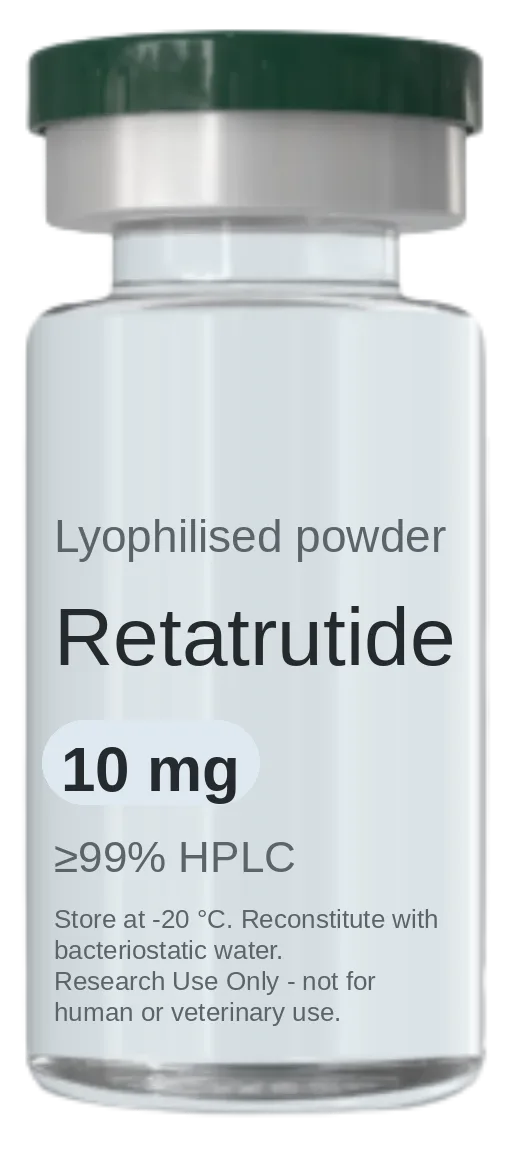
Retatrutide
Triple-agonist metabolic research peptide targeting GLP-1, GIP and glucagon receptors.
- Purity:
- ≥99% HPLC
- Sizes available:
- 10 mg
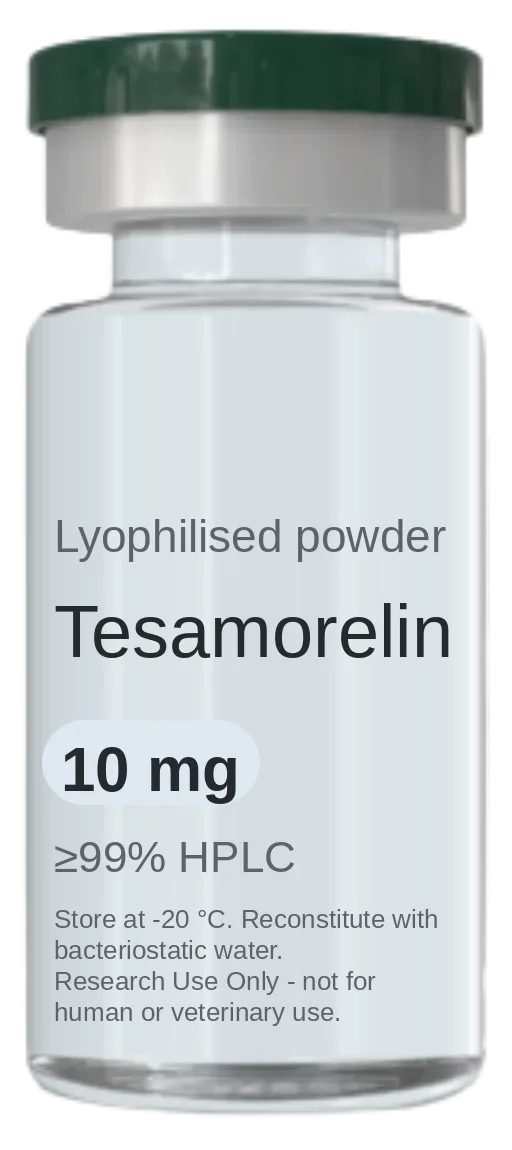
Tesamorelin
Stabilised GHRH(1-44) analogue studied in adipose tissue distribution research.
- Purity:
- ≥99% HPLC
- Sizes available:
- 10 mg – 20 mg
BPC-157 + TB-500
BPC-157 and TB-500 in a single vial — the pairing most studied together in tissue-repair research.
- Purity:
- ≥99% HPLC
- Sizes available:
- 5 mg + 5 mg
The consultation
One intake that settles goals, history and contraindications alongside compound, quantity, documentation and route — reviewed by a physician before anything ships.
More notes
-
How to Tell If Retatrutide Is Original
The only real proof is the batch's certificate of analysis. What to check, what proves nothing, and how PeptoClinic documents it.
-
Storing Retatrutide Before and After Mixing
How lyophilized retatrutide is stored before reconstitution, and what changes once it's dissolved in solution.
-
Retatrutide: Pills or Injectable Only?
Retatrutide exists only as an injectable — no pill form appears in published clinical trials or in PeptoClinic's catalog.