
Note
Selank: What It Is and What Science Shows
Selank is a synthetic heptapeptide derived from tuftsin. Its structure, origin, and what the published literature studies about it.
Selank is a synthetic heptapeptide with the sequence Thr-Lys-Pro-Arg-Pro-Gly-Pro, developed at the Institute of Molecular Genetics of the Russian Academy of Sciences from tuftsin, an endogenous tetrapeptide. Published research studies it primarily for its effects on the central nervous system in laboratory models, and to a lesser degree for its relationship to immune regulation.
How Selank Was Developed
Tuftsin is the tetrapeptide Thr-Lys-Pro-Arg that the body produces by enzymatic cleavage of the heavy chain of serum immunoglobulin G. Its immunostimulant activity has been documented in the literature since the 1970s. The problem with tuftsin as a research tool is its low plasma stability: serum peptidases degrade it rapidly, making it difficult to use in experimental protocols that require sustained exposure.
The team at the Institute of Molecular Genetics addressed that problem by extending the sequence with the tripeptide Pro-Gly-Pro to obtain a compound more resistant to enzymatic degradation. The result was Selank. That extension was not chosen arbitrarily: the sequence Pro-Gly-Pro already appeared in the period's literature as a fragment with documented central nervous system activity in its own right.
The development took place within the institute's neuropharmacology program during the 1980s and 1990s, the same context in which Semax and other centrally acting peptides were worked on. The first papers on Selank in internationally accessible publications appeared in the late 1990s. A significant portion of the primary literature is in Russian and is not always available in English.
What the Published Literature Studies About Selank
Anxiety and Stress Response in Animal Models
The most extensive line of research examines the effects of Selank on behavioral markers of anxiety in rodents. The most commonly used models are the elevated plus maze, the open field test, and the forced swim test. Papers published in Bulletin of Experimental Biology and Medicine report that Selank reduces anxiety-associated behaviors in these models without producing the sedation characteristic of benzodiazepine-type anxiolytics applied under the same conditions.
Voronina and collaborators described this profile as "anxiolytic without sedation" in work from the early 2000s. The most frequently cited proposed mechanism involves modulation of the GABAergic system, though other papers point to the serotonergic system. The question remains open: available studies do not agree on which of the two mechanisms carries more weight in the observed profile.
One characteristic noted across several papers is the absence of indicators of physical dependence in the animal models evaluated. Interpreting those results requires care: rodent dependence models do not perfectly predict behavior in other species or under conditions different from the experiment's.
BDNF, Neurotrophins, and Memory
A second line examines Selank's effect on the expression of brain-derived neurotrophic factor (BDNF). Uchakina and collaborators (2008) recorded an increase in BDNF gene expression in rat hippocampus and correlated it with improvements in spatial memory tasks in the same animals. The relationship between BDNF and memory consolidation is an active area of neuroscience, and translating results between rodent models and other experimental conditions is not straightforward.
Later studies from the same group explored whether that BDNF regulation might mediate the behavioral effects observed in the anxiety models. The hypothesis is consistent with the general literature on the role of neurotrophins in synaptic plasticity, but the design of available studies does not allow causality to be established.
Monoamine Metabolism
Some papers measured dopamine, serotonin, and their metabolites in rodent brain tissue after exposure to Selank. Results point to changes in serotonin turnover, particularly in the ratio of 5-hydroxyindoleacetic acid (5-HIAA) to free serotonin in certain brain regions. Interpretation varies among groups, and no consensus mechanistic model exists linking those changes to the described anxiolytic profile.
Immune Modulation
Because of its structural kinship with tuftsin, several groups investigated whether Selank shares its immunostimulant activity. Results are heterogeneous. Some papers in viral infection models report changes in cytokine profiles, with increases in interferons and certain lymphocyte subpopulations. Other papers do not replicate those results with the same magnitude. The body of literature in this area is considerably smaller than that on central nervous system effects, and conclusions are more tentative.
Selank, Semax, and the Institute of Molecular Genetics
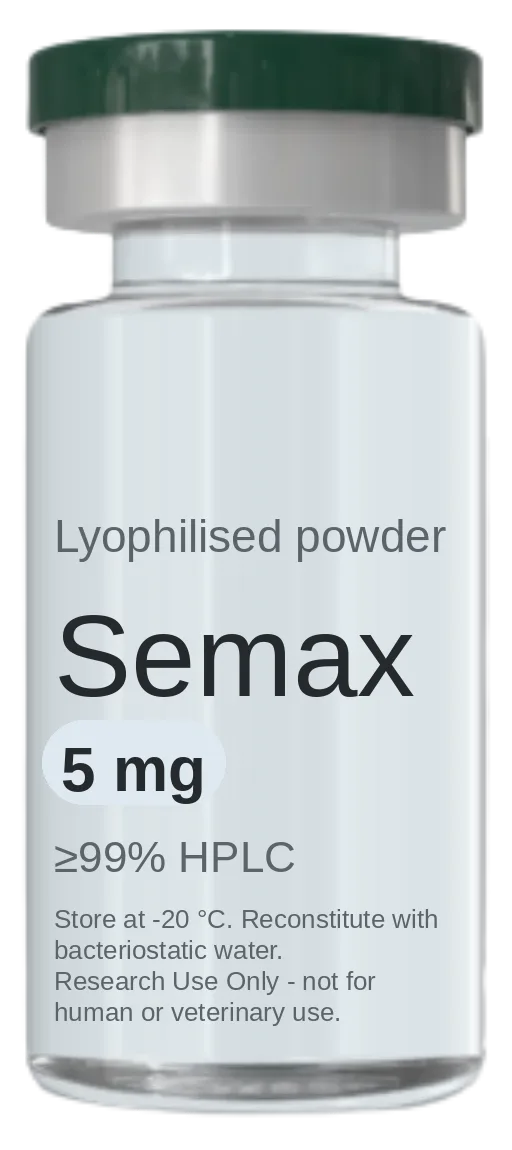
Semax is another compound developed by the same group. It also derives from an endogenous peptide sequence — in that case, the 4-10 fragment of adrenocorticotropin (ACTH 4-10) — and published research lines also center on the central nervous system. However, the two compounds have different sequences, different precursors, and different experimental profiles. Sharing an institutional origin does not mean they act through the same mechanisms, nor that evidence on one transfers to the other.
The PeptoClinic catalog lists both compounds with their product pages.
Available Literature
Most of the published literature on Selank is indexed at PubMed. Papers from Voronina, Uchakina, and other groups from the institute appear there alongside research from independent groups. Studies published exclusively in Russian before 2000 are not always available in full text outside Russia.
Research Material — Laboratory Use Only
Selank, like all compounds in the PeptoClinic catalog, is supplied exclusively as Research Use Only (RUO) material: in vitro and laboratory research.
This material is not a medicine, not a supplement, and is not approved or intended for human or veterinary consumption, diagnosis, or treatment of any condition. No claims about this compound have been evaluated by ANMAT, the FDA, or any equivalent regulatory authority.
PeptoClinic does not provide administration protocols, dosing guidance, or any information about use in people. Requests of that kind are declined.
Purity standards and the documentation that accompanies each lot are described on the quality page. Certificates of analysis are prepared by Janoshik Analytical, an independent laboratory with online verification.
Regulatory Status
Selank has no approval as a medicine in Argentina, the United States, or the European Union. In Russia there is a registration for investigative use under that name, but that local approval does not equal an international approval and does not authorize use outside the protocols for which it was registered in that specific context.
For the regulatory status applicable to a specific destination, the sources are ANMAT for Argentina, the FDA for the United States, and the EMA for the European Union.
How to Request a Selank Quote from PeptoClinic
PeptoClinic operates as a technical supply consultancy for research peptides. There is no published price and no cart: a researcher describes what their program needs — compound, purity specification, quantity, lot documentation, and destination — and the technical team returns a written quote, normally within one business day.
Selank is available in the PeptoClinic catalog as lyophilized powder in vial form. Diluents are available separately.
PeptoClinic supplies to Argentina, the United States, Uruguay, Chile, Paraguay, Bolivia, Peru, Brazil, Mexico, and Colombia. Details on logistics and import documentation are on the shipping page.
Frequently asked questions
Are Selank and tuftsin the same compound?
No. Tuftsin is the natural tetrapeptide Thr-Lys-Pro-Arg, which the body produces by enzymatic cleavage of serum IgG. Selank is a synthetic heptapeptide that extends that sequence with the tripeptide Pro-Gly-Pro to increase its stability against plasma peptidases. They have different sequences and different research profiles and are not interchangeable as laboratory tools.
What is the difference between Selank and Semax?
Both are peptides developed at the Institute of Molecular Genetics of the Russian Academy of Sciences, but they have different precursors: Selank derives from tuftsin and Semax from the 4-10 fragment of ACTH. Published research shows distinct effect profiles in laboratory models. Sharing an institutional origin does not imply equivalence of mechanisms or experimental outcomes.
Does the research on Selank include human studies?
The majority of published literature uses rodent models. Some studies of Russian origin included human participants, but the volume, design, and independent peer review of that evidence are not comparable to the standards required for an international regulatory approval by the FDA, EMA, or ANMAT.
Does Selank have approval for use in people?
Selank has no approval as a medicine in Argentina, the United States, or the European Union. In Russia there is a registration for investigative use, but that registration does not equal an international approval and does not authorize use outside locally regulated protocols.
Does PeptoClinic supply Selank to Argentina?
Yes. Argentina is among the destinations to which PeptoClinic quotes research material. The compound ships with documentation prepared for import as laboratory reference material. Details on logistics and documentation are on the shipping page.
What documentation comes with a Selank lot?
Each lot includes a certificate of analysis prepared by Janoshik Analytical, detailing HPLC purity, vial weight, and the laboratory task number. The quality policy and documentation standards applied to the entire catalog are described on the quality page of the site.
What is the minimum purity PeptoClinic specifies for its research peptides?
PeptoClinic specifies ≥99% HPLC for the research peptides in its catalog. The lowest purity figure published in available certificates is 99.669%, corresponding to a MOTS-c lot analyzed by Janoshik Analytical on April 13, 2026.
How do I request a Selank quote?
Describe your research program — compound, quantity, purity specification, required documentation, and destination — through the contact form or by writing to [email protected]. PeptoClinic's technical team returns a written quote normally within one business day.
Compounds mentioned
The consultation
One intake that settles goals, history and contraindications alongside compound, quantity, documentation and route — reviewed by a physician before anything ships.
More notes
-
No Certificate of Analysis, No Peptides
What it means when a research peptide supplier can't produce the batch-specific certificate of analysis, and why that gap alone is disqualifying.
-
Bonded Warehouse Deadline Before Abandonment
Argentine customs gives importers roughly 90 days to clear research peptides from bonded storage before the lot is declared abandoned.
-
What Is Argentina's Statistics Fee?
Argentina's statistics fee adds to the cost of importing a research peptide: what it taxes, how it's calculated, and what paperwork matters.