
Note
Thymosin Alpha 1 vs Selank: How They Differ
Thymosin Alpha 1 and Selank sit in different research families—one studied in immunomodulation, the other in the anxiolytic-cognitive axis.
Thymosin Alpha 1 and Selank are not variants of the same family: they are two research peptides with different origins, different structures, and different biological systems under study. Thymosin Alpha 1 is a 28-amino-acid fragment derived from a thymic prohormone, studied mainly in immunomodulation. Selank is a synthetic heptapeptide, an analog of tuftsin, and the literature investigates it in the anxiolytic and cognitive axis. They share the label "research peptide" and little else.
What is Thymosin Alpha 1 in the research literature
Thymosin Alpha 1 was originally isolated from bovine thymus extracts and corresponds to the first 28 amino acids of prothymosin alpha. It is one of the most studied immunomodulatory peptides since the 1970s, with research lines centered on T-lymphocyte maturation, response to infection, and immune system behavior in in vitro models. The literature available on PubMed covers decades of preclinical studies on its role in dendritic cell signaling and cytokine modulation.
Structurally it's a long chain: 28 residues, with a sequence rich in acidic residues that gives it a marked net negative charge. That alone sets it apart from any short peptide like Selank.
What is Selank in the research literature
Selank is a synthetic heptapeptide (seven amino acids) designed as a stable analog of tuftsin, a natural tetrapeptide with immunomodulatory activity that degrades very quickly in the body. By extending and modifying the sequence, the original developers aimed to prolong the molecule's usable lifetime. Published research, also searchable on PubMed, concentrates on two axes: anxiolytic behavior in animal models and modulation of BDNF (brain-derived neurotrophic factor) expression, which places it closer to neuroscience than to pure immunology.
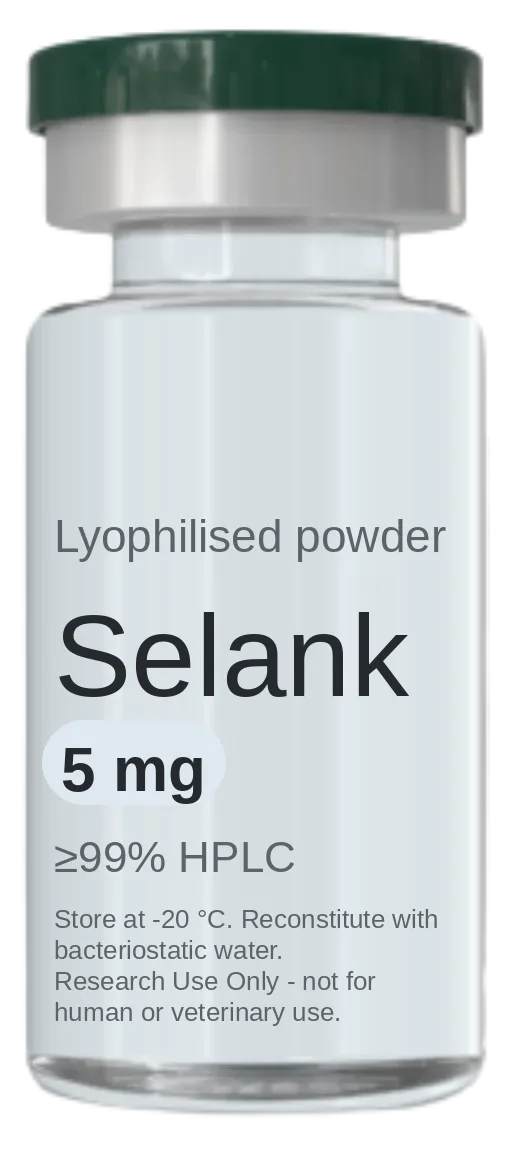
You can review the specification and batch documentation for Selank in the catalog.
Differences in structure and origin
- Chain length: 28 amino acids in Thymosin Alpha 1 versus 7 in Selank. That difference in scale affects stability, solubility, and the peptide's behavior in solution.
- Origin: Thymosin Alpha 1 derives from an endogenous thymic prohormone; Selank is a synthetic design built from tuftsin as a template, not a fragment isolated directly from a natural source.
- Chemical family: they share no structural motif. They are not isomers or variants of the same parent chain, unlike, for example, Selank and Semax, which do share the same design derived from ACTH(4-10).
Differences in the systems each one is studied in
This is the point that causes most of the confusion in searches: both sometimes appear tagged "immunomodulators" in some generic summary, but the primary literature separates them clearly.
Thymosin Alpha 1 is studied in:
- Maturation and differentiation of T lymphocytes in in vitro models.
- Models of immune response against infectious challenges.
- Interaction with toll-like receptors on antigen-presenting cells.
Selank is studied in:
- Models of anxiolytic behavior (open field test, elevated plus maze).
- BDNF expression and its relationship to synaptic plasticity.
- Modulatory effects on the serotonergic axis, alongside a residual immunomodulatory action inherited from tuftsin.
In other words: if the research question concerns cellular immunity, Thymosin Alpha 1 has the specific bibliography. If the question points at behavior, cognition, or the anxiolytic axis, Selank is the one that appears in that body of literature.
Are they ever studied together?
It's uncommon to find published protocols that combine both peptides in the same experimental design, because they answer two distinct research questions and rarely share a working hypothesis. Where they do turn up in the same paragraph of a review is in general listings of "immunomodulatory peptides of interest," which group distinct mechanisms under one broad category. That's where much of the confusion behind this search originates.
What purity and documentation to expect from a batch
Regardless of which of the two compounds is in the working hypothesis, what doesn't change is the documentation standard that should accompany the batch: a laboratory report with an analytical method (HPLC), declared content versus measured content, and a way to verify the batch. The quality section covers what a certificate of analysis should contain and how to read one before treating a purity figure as valid.
Thymosin Alpha 1 or Selank: which fits which research question
The simplest way to resolve the doubt is to reframe the research question. If the experimental design measures immunological parameters — lymphocyte counts, cytokine profile, response to an infectious challenge in the model — the compound with direct bibliography is Thymosin Alpha 1. If the design measures behavior, anxiety, memory, or BDNF expression, Selank is the one with the corresponding primary literature. They are not substitutes for one another, nor alternatives within the same line of study: they are two tools for two different questions.
The full catalog, including the peptides currently part of the offering, is listed in the complete catalog. Material is quoted as laboratory reference for destinations that include Argentina, with the import file prepared for that use.
Exclusively for laboratory research use
All material described in this note is strictly for Research Use Only (RUO): in vitro and laboratory studies. It is not a medicine, not a supplement, and not approved for human or veterinary consumption, diagnosis, or treatment. None of the statements in this article have been evaluated by ANMAT, the FDA, or any equivalent regulatory authority.
Frequently asked questions
Are Thymosin Alpha 1 and Selank part of the same peptide family?
No. Thymosin Alpha 1 is a 28-amino-acid fragment derived from thymic prothymosin alpha, while Selank is a synthetic heptapeptide designed from tuftsin. They share no parent sequence or structural motif.
Which of the two has more published literature on immunity?
Thymosin Alpha 1 has a more extensive and specific bibliography in immunomodulation, with decades of studies on T-lymphocyte maturation and infection response in preclinical models. Selank retains some of that activity inherited from tuftsin, but its main body of research sits in the anxiolytic-cognitive axis.
Is Selank a variant of Semax?
It shares a design family with Semax because both derive from the ACTH(4-10) fragment, but not with Thymosin Alpha 1, which has a completely different molecular origin.
Can the purity of both peptides be compared using the same criteria?
Yes, the criteria for reading a certificate of analysis (HPLC method, declared versus measured content, batch verification path) are the same regardless of the peptide. What changes is the sequence and molecular weight of each one, not how the report is audited.
Which of the two fits an experimental design focused on behavior?
The primary literature on anxiolytic behavior models and BDNF expression corresponds to Selank, not Thymosin Alpha 1.
Which of the two fits an experimental design focused on cellular immune response?
There the specific bibliography belongs to Thymosin Alpha 1, with studies on T-lymphocyte maturation and cytokine modulation.
Does the length of the amino acid chain affect the stability of the lyophilized peptide?
Yes, generally a longer chain like that of Thymosin Alpha 1 behaves differently in solution than a short peptide like Selank, although both, in sealed lyophilized format, remain stable at room temperature before reconstitution.
Are both peptides available with the same type of batch documentation?
The documentation standard — a laboratory report with measured purity and a verification path — applies equally to any peptide in the catalog, regardless of whether it's Thymosin Alpha 1, Selank, or any other compound.
Compounds mentioned
The consultation
One intake that settles goals, history and contraindications alongside compound, quantity, documentation and route — reviewed by a physician before anything ships.
More notes
-
Temporary Import Regime & Peptides
Temporary import covers goods that leave the country again; a research peptide shipment stays and gets used up.
-
Retatrutide vs GHK-Cu: What's the Difference
Retatrutide and GHK-Cu are different molecules studied for different reasons. Here's what each investigates and what documentation backs a batch.
-
Epitalon vs. Hexarelin: What's the Difference
Epitalon and Hexarelin belong to different peptide families with different mechanisms — what the research literature covers for each, and what's in stock.