
Note
Epitalon vs. Hexarelin: What's the Difference
Epitalon and Hexarelin belong to different peptide families with different mechanisms — what the research literature covers for each, and what's in stock.
Epitalon and Hexarelin share one thing: both are short synthetic peptides studied in laboratory research. Past that, they have almost nothing in common. Epitalon is a synthetic tetrapeptide (Ala-Glu-Asp-Gly) that the literature associates with pineal gland regulation and telomerase activity. Hexarelin is a hexapeptide from the GHRP (growth hormone-releasing peptide) family, studied as an agonist of the GHS-R1a receptor. One doesn't substitute for the other because they don't target the same biological pathway.
The spelling "Epithalon," with the extra "h," is a transliteration of the Russian Эпиталон, where the molecule was originally developed. PeptoClinic's catalog lists it as Epitalon, without the h, which is the spelling most recent English-language literature uses.
What the literature studies about Epitalon
Epitalon was developed at the Institute of Bioregulation and Gerontology in St. Petersburg, and much of the published research on the molecule comes out of that same group. The three most-cited research lines are:
- Its effect on telomerase activity in cell cultures, with studies documenting relative telomere elongation in treated cell lines compared to controls.
- Its role in regulating melatonin and circadian rhythm, in models evaluating pineal gland function.
- Studies in animal models on markers associated with cellular aging, without direct extrapolation to human outcomes.
None of these studies is proof that the molecule produces an equivalent effect outside the experimental context in which it was measured. This is basic research, and it should be read that way.
What the literature studies about Hexarelin
Hexarelin belongs to a completely different family: the GHRPs, synthetic peptides designed to activate the ghrelin receptor (GHS-R1a). The literature on Hexarelin concentrates on two axes:
- Its capacity to stimulate growth hormone release in in vitro and in vivo models, compared against other secretagogues in the same family such as GHRP-2 or GHRP-6.
- A research line more specific to Hexarelin than to the rest of its own family: studies in animal models on cardiac tissue, evaluating its interaction with receptors present in the myocardium, independent of the GH pathway.
That second line is what most distinguishes Hexarelin from the rest of its own family — it isn't just "another GHRP," it's the one most studied outside the growth-hormone axis.
The mechanism difference, concretely
This is the point that actually answers the search behind this query: Epitalon and Hexarelin don't compete, because they aren't interchangeable even within the same category of study.
Epitalon doesn't act on a membrane receptor characterized with the same clarity as Hexarelin. Its proposed mechanism runs through modulation of gene expression linked to telomerase and through its action on the pineal gland — that is, intracellular processes and long-cycle endocrine regulation.
Hexarelin, by contrast, is a receptor agonist: it binds GHS-R1a (the same receptor that recognizes endogenous ghrelin) and triggers a well-characterized signaling cascade, which is what later translates into the GH release reported in studies. It's a fast, measurable mechanism of action, entirely different from Epitalon's.
If someone is searching "Epitalon or Hexarelin" assuming they're alternatives for the same research objective, the short answer is that they're not: they belong to two separate branches of peptide literature, one tied to cellular senescence and circadian rhythm, the other to the somatotropic axis.
Format and documentation
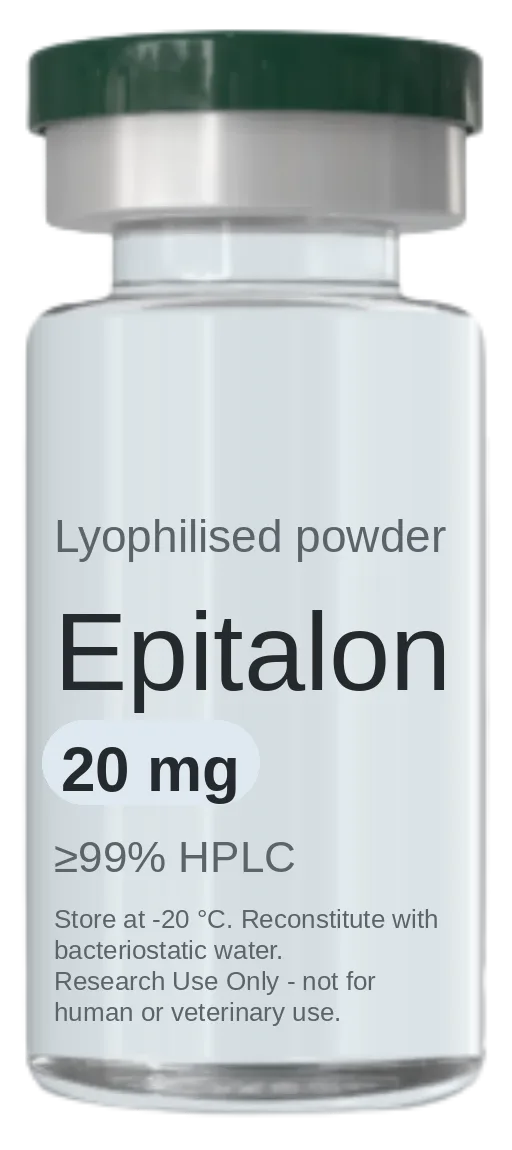
In PeptoClinic's catalog, Epitalon ships as lyophilized powder in a sealed vial, with the technical sheet and the corresponding batch report available for review. As with the rest of the catalog, the purity standard PeptoClinic states in its laboratory reports is at least 99% by HPLC, verifiable in the Janoshik Analytical report for each batch analyzed. Argentina-specific sourcing details for Epitalon are covered on the Epitalon Argentina page.
Hexarelin is not part of PeptoClinic's current catalog. If a research program needs a documented GH secretagogue at the same purity standard, the catalog's available alternatives are other molecules in the same functional family, such as CJC-1295 no DAC or Sermorelin, which are also studied on the growth hormone axis, though with distinct receptor mechanisms from each other.
Research use only
Both Epitalon and Hexarelin are supplied strictly for laboratory research use (Research Use Only). Neither molecule is approved for human or veterinary use, neither is a drug or a supplement, and no regulatory body — not ANMAT, not the FDA, nor any equivalent — has evaluated any claims that may be found about them. Nothing published here constitutes a usage indication, an administration guide or a clinical recommendation.
Frequently asked questions
Can Epitalon and Hexarelin be compared on potency?
No, because they measure different things: Epitalon is studied in relation to telomerase activity and circadian regulation, while Hexarelin is studied as an agonist of a specific receptor tied to growth hormone release. There's no shared potency scale between the two molecules.
Why isn't Hexarelin in PeptoClinic's catalog?
The catalog is defined by the availability of material with verifiable batch documentation at the standard PeptoClinic maintains. Hexarelin isn't part of that selection as of today; that can change, but the current list is what appears on the [catalog page](/en/catalog/).
Are Epitalon and GHK-Cu the same thing?
No. GHK-Cu is a copper-coordinated tripeptide studied in a completely different context (tissue repair in experimental models). They share only the fact of being short research peptides, the same way Epitalon and Hexarelin do.
What does it mean that Hexarelin is a GHRP?
GHRP stands for growth hormone-releasing peptide, the family of synthetic peptides that act on the ghrelin receptor (GHS-R1a) in research models related to growth hormone release. Hexarelin, GHRP-2 and GHRP-6 all belong to that same family, with differences between them in how the studies approach each one.
Does Epitalon relate to melatonin?
The literature on Epitalon includes studies on its effect on pineal gland regulation, which is the gland that produces melatonin, and on circadian rhythm in the models evaluated. It is not the same as melatonin, nor does it act through the same mechanism as that compound.
Do Epitalon batches come with a purity report?
Yes, every batch of Epitalon that PeptoClinic supplies has its own laboratory report. The purity standard the company states in its published reports is at least 99% by HPLC, and details on how to read those reports are on the [quality page](/en/quality/).
Can Epitalon be shipped to Argentina?
Yes, Argentina is one of the destinations PeptoClinic quotes shipments to for research material, including Epitalon, with the customs documentation prepared for its entry as laboratory reference material. Details are on the [Epitalon Argentina page](/en/argentina/epitalon/).
Is there any study that directly compares Epitalon with Hexarelin?
There is no literature that compares them directly, because they aren't studied under the same experimental paradigm or with the same measurement criteria. A comparison makes sense at the level of mechanism and chemical family, which is what this article covered, but not as a head-to-head trial.
Compounds mentioned
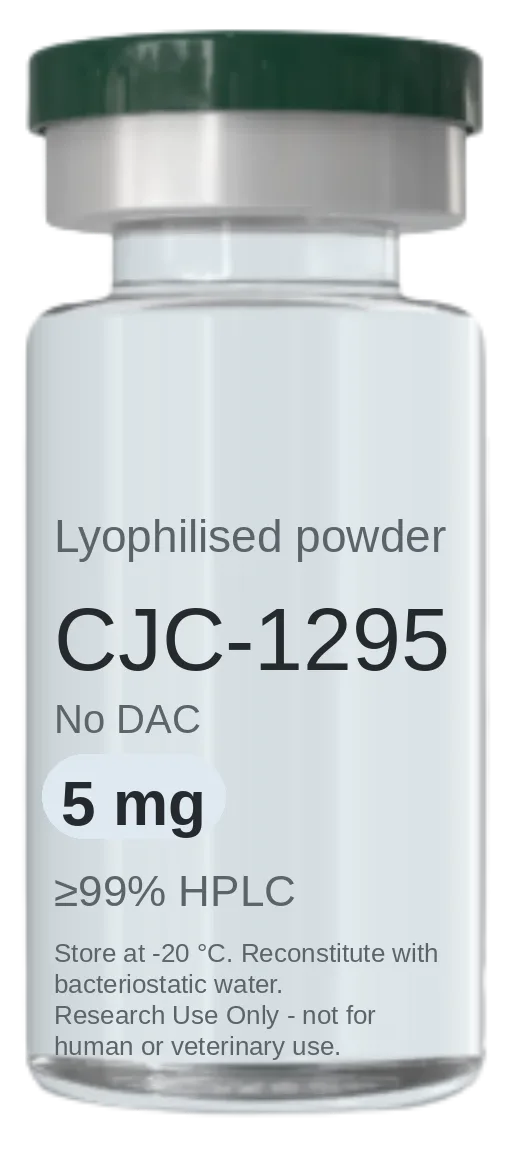
CJC-1295 (sin DAC)
Modified GRF(1-29) tetrasubstituted analogue without drug affinity complex.
- Purity:
- ≥99% HPLC
- Sizes available:
- 5 mg – 20 mg
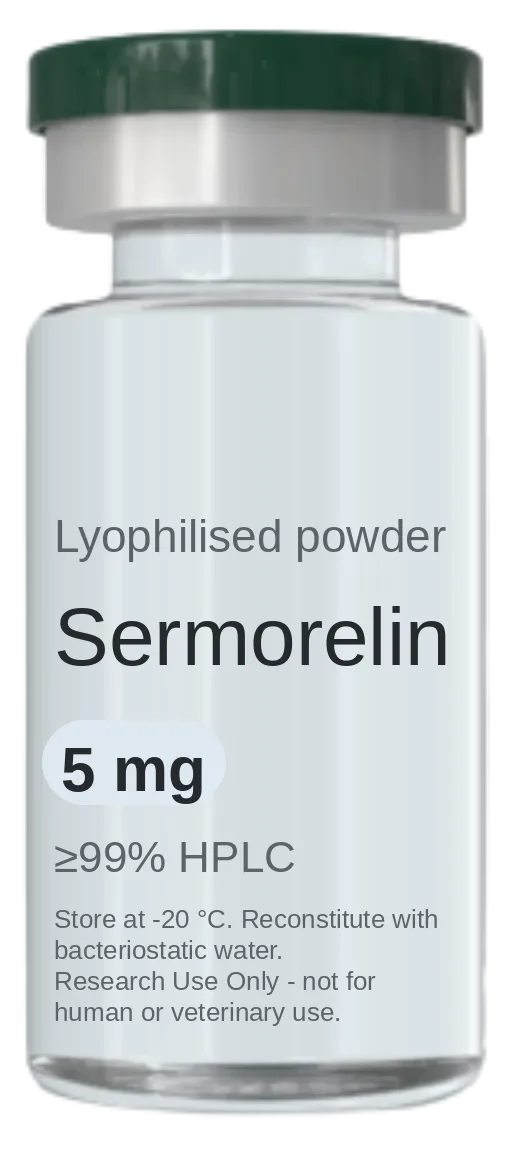
Sermorelin
Growth hormone-releasing hormone analogue used in endocrine signalling research.
- Purity:
- ≥99% HPLC
- Sizes available:
- 5 mg – 20 mg
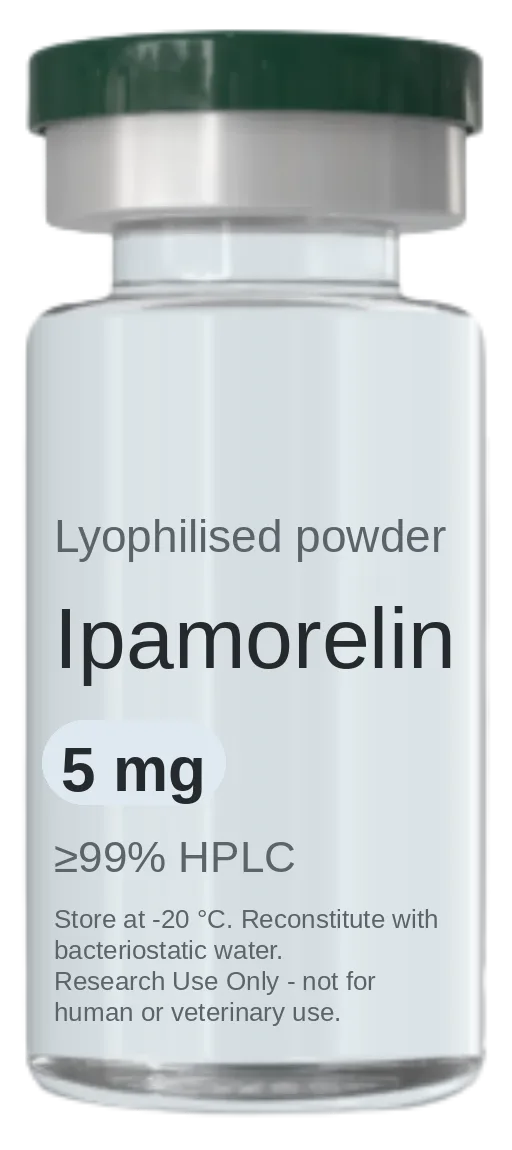
Ipamorelin
Selective ghrelin receptor (GHS-R1a) agonist pentapeptide.
- Purity:
- ≥99% HPLC
- Sizes available:
- 5 mg – 20 mg
The consultation
One intake that settles goals, history and contraindications alongside compound, quantity, documentation and route — reviewed by a physician before anything ships.
More notes
-
Temporary Import Regime & Peptides
Temporary import covers goods that leave the country again; a research peptide shipment stays and gets used up.
-
Retatrutide vs GHK-Cu: What's the Difference
Retatrutide and GHK-Cu are different molecules studied for different reasons. Here's what each investigates and what documentation backs a batch.
-
Invoiced vs. Unbilled Peptide Suppliers
What changes when a research peptide supplier invoices the transaction versus one that takes payment and leaves no paper trail.