
Note
GHK-Cu vs. Tesamorelin: Key Differences
GHK-Cu and tesamorelin are structurally unrelated peptides studied in separate research lines — what distinguishes them.
GHK-Cu and tesamorelin are not chemical relatives, and the research literature studies them in completely separate lines of inquiry. GHK-Cu is a tripeptide (glycine-histidine-lysine) bound to a copper ion, investigated mostly in skin, collagen and tissue-repair models. Tesamorelin is a 44-amino-acid peptide, a synthetic analogue of growth hormone-releasing hormone (GHRH), studied within the growth hormone axis. They do not compete for the same research target, so "which one is better" has no single answer — it depends on what the protocol is trying to measure.
What is GHK-Cu?
GHK-Cu is a copper-binding peptide, first described in human plasma in the 1970s. Since then it has appeared in in vitro studies on fibroblasts, collagen synthesis and matrix metalloproteinase activity. It is a small molecule — three amino acids — which simplifies both its synthesis and its HPLC analysis compared to longer peptides.
In PeptoClinic's catalogue, GHK-Cu is supplied as a lyophilised vial, with an independent laboratory report (Janoshik Analytical) accompanying the batch. How to read that kind of report is explained on the quality page.
What is tesamorelin?
Tesamorelin belongs to the family of GHRH analogues, alongside sermorelin and CJC-1295. Its structure mimics the active fragment of human GHRH, and the published research concentrates on how it stimulates pulsatile growth hormone release from the pituitary. It is a much longer chain than GHK-Cu — 44 residues against 3 — and that difference changes both its stability and its behavior during laboratory reconstitution.
While GHK-Cu acts at a local tissue level, tesamorelin acts on a central endocrine axis. That is the first distinction to settle before comparing anything else.
The structural differences that matter
- Size: GHK-Cu is a low-molecular-weight tripeptide; tesamorelin is a 44-amino-acid chain with a much higher molecular weight.
- Coordinating metal: GHK-Cu carries a copper ion complexed to the molecule, which gives it both its name and a characteristic color in solution. Tesamorelin carries no metal.
- Biological family: GHK-Cu does not belong to the growth hormone secretagogue family. Tesamorelin does, alongside sermorelin, CJC-1295 and ipamorelin.
- Research target: the literature on GHK-Cu centers on extracellular matrix, collagen and wound-healing models. The literature on tesamorelin centers on the GHRH–pituitary–growth hormone axis.
- Stability as lyophilised powder: both ship lyophilised and remain stable at room temperature before reconstitution, but once in solution each molecule has its own distinct stability window.
Which research lines does each one appear in?
GHK-Cu appears frequently in experimental dermatology and extracellular matrix biology literature: studies measuring type I collagen expression, metalloproteinase activity, or fibroblast behavior in culture. It is also used as a reference molecule in comparative copper-chelation studies, since its affinity for the metal is well characterized.
Tesamorelin, by contrast, is documented mainly in studies of the somatotropic axis: growth hormone release, its relationship to IGF-1, and the behavior of that axis across different models. These are research lines that barely overlap, except in protocols designed to compare distinct signaling pathways within the same experimental design.
For anyone comparing catalogues, it's also worth looking at other peptides in tesamorelin's own family, such as BPC-157, which is studied in tissue repair but through a biochemical pathway entirely different from GHK-Cu's.
Purity and documentation: what to ask for every time
Comparing two peptides by structure is only half the job. The other half is verifying that the material reaching the lab is what the label says it is. An HPLC analysis report — ideally from an independent laboratory, with a verifiable batch identifier — is the only document that answers that question with more than a promise.
At PeptoClinic every batch is analyzed by Janoshik Analytical. The lowest purity figure published across our catalogue — not the best one, the floor — is 99.669%. That is the number to ask for as a benchmark when comparing suppliers, because an isolated "maximum purity" claim with no report attached cannot be verified. The full catalogue shows which compounds have a report available.
Can both be included in the same experimental design?
Yes, and it's common in protocols that aim to compare parallel signaling pathways: on one side the local tissue response (GHK-Cu), on the other the systemic response of the growth hormone axis (tesamorelin). They are independent molecules with no known chemical interaction described in the literature, which simplifies designing a protocol that includes them as separate variables. Whether to include one, the other, or both depends entirely on the study's objective and the methodological framework behind it.
Research use only
The GHK-Cu and tesamorelin that PeptoClinic supplies are reference material strictly for research use (RUO — Research Use Only), intended for laboratory and in vitro use. Neither is approved for human or veterinary consumption, nor for the diagnosis or treatment of any condition. None of the statements in this article have been evaluated by the FDA, ANMAT or any equivalent authority. No prescription is provided or filled, and no guidance on dosing, routes of administration or use protocols in people is given.
Frequently asked questions
Can GHK-Cu and tesamorelin be mixed in the same vial?
There is no published literature describing the co-formulation of both peptides in a single vial, and each has its own reconstitution and stability requirements. The common practice in research protocols that use both is to keep them as separate vials and separate variables.
Which of the two has more published analytical reports?
It depends on the supplier. In PeptoClinic's catalogue, GHK-Cu has a Janoshik Analytical report available for review; tesamorelin, depending on the batch, may or may not have a report published at a given time. The correct way to verify this is to request the report for the specific batch before any decision.
Why does GHK-Cu contain copper and tesamorelin does not?
Because they belong to different peptide families. GHK-Cu originated as a copper-binding peptide identified in human plasma, and that affinity for the metal is part of its chemical identity. Tesamorelin is a GHRH analogue designed to mimic a hormonal fragment, with no metallic component in its structure.
Do both come in the same format?
Yes, both ship as lyophilised powder in a sealed vial, with no cold chain during transport because the powder is stable at room temperature. Cold storage becomes relevant only after reconstitution into solution at the destination laboratory.
Which of the two has the greater molecular weight?
Tesamorelin, by far: 44 amino acids against GHK-Cu's 3. That size difference also explains why their behavior in solution and their stability profiles differ.
Is there any study that directly compares GHK-Cu and tesamorelin?
There is no literature comparing them head to head, because they study different biological axes: one local and tissue-based, the other central and endocrine. What does exist separately is extensive literature on each peptide within its own research line.
How do I know if a batch I'm offered is reliable?
By requesting the analytical report for that specific batch, naming the laboratory that performed it and, where available, a verifiable identifier. PeptoClinic's [quality page](/en/quality/) walks through how to read that kind of report before accepting any batch.
Does tesamorelin belong to the same family as CJC-1295?
Yes, both are GHRH analogues studying the same hormonal axis, though with structural differences between them. GHK-Cu falls entirely outside that family, since it is not a growth hormone secretagogue.
Compounds mentioned
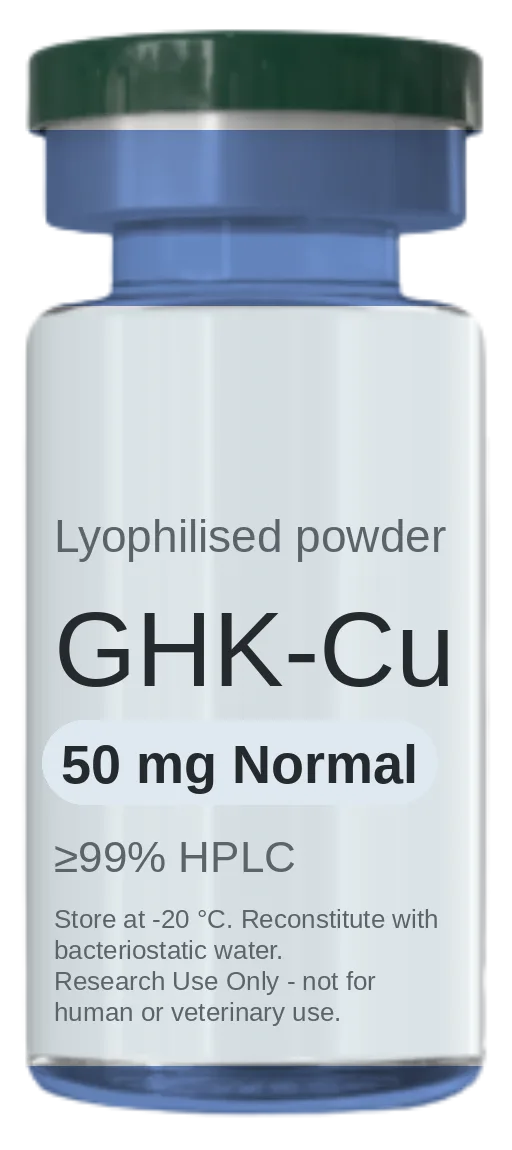
GHK-Cu (Copper Peptide)
Copper-binding tripeptide studied in extracellular matrix and dermal research models.
- Purity:
- ≥99% HPLC
- Sizes available:
- 50 mg Normal – 50 mg Plus
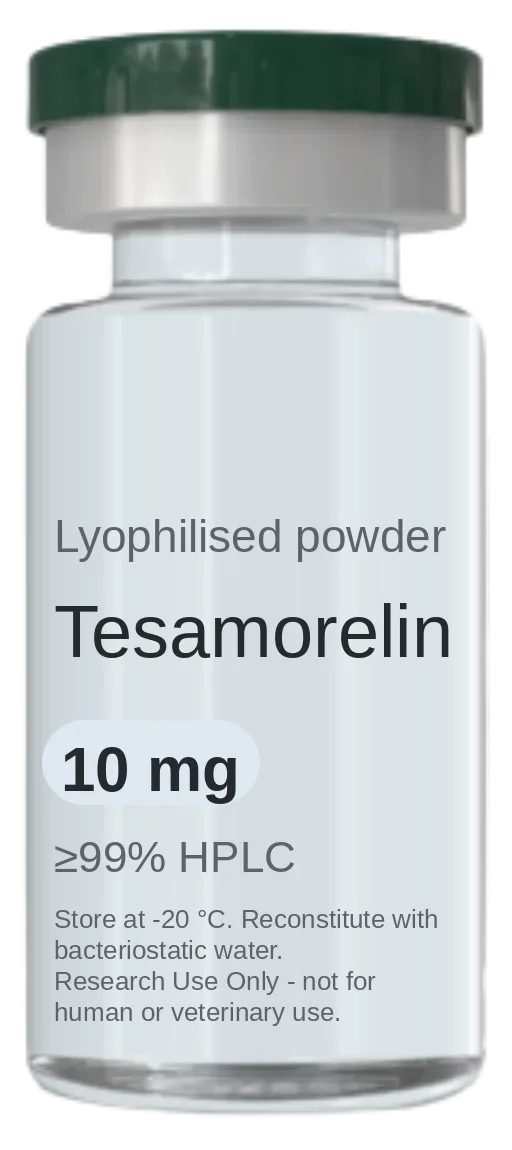
Tesamorelin
Stabilised GHRH(1-44) analogue studied in adipose tissue distribution research.
- Purity:
- ≥99% HPLC
- Sizes available:
- 10 mg – 20 mg
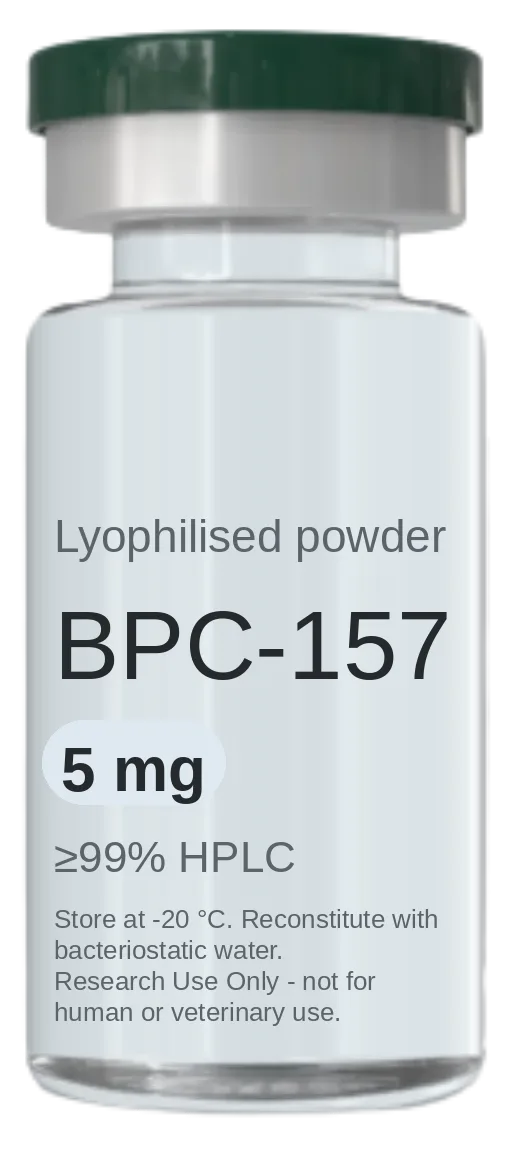
BPC-157 + TB-500
BPC-157 and TB-500 in a single vial — the pairing most studied together in tissue-repair research.
- Purity:
- ≥99% HPLC
- Sizes available:
- 5 mg + 5 mg
The consultation
One intake that settles goals, history and contraindications alongside compound, quantity, documentation and route — reviewed by a physician before anything ships.
More notes
-
Retatrutide vs CJC-1295: Key Differences
Retatrutide and CJC-1295 no DAC are different research peptide classes, with different mechanisms and different purity reports behind them.
-
Retatrutide vs BPC-157: Key Differences
Retatrutide and BPC-157 are research peptides with different mechanisms, families, and study objectives. Here's why they're not interchangeable.
-
Paying Argentina's Customs Duty on Peptides
How the import duty on a research peptide shipment is paid when it arrives in Argentina, and who actually collects it.