
Note
GHK-Cu: What Is This Copper Complex
GHK-Cu is a copper-chelated tripeptide studied for its activity in tissue remodeling. PeptoClinic supplies it as research material.
GHK-Cu is a tripeptide formed by glycine, L-histidine, and L-lysine, chelated with a divalent copper ion (Cu²⁺). The compound occurs naturally in human plasma, saliva, and urine. Biochemist Loren Pickart first isolated it in 1973. The scientific literature studies it primarily for its role in tissue remodeling, collagen synthesis, and gene expression modulation in cellular and animal models.
The structure of the complex
The tripeptide GHK (Gly-His-Lys) has a high affinity for the copper (II) ion. The bond between the two forms the GHK-Cu complex, which is the form that appears in the majority of published studies. The amino acid sequence allows it to coordinate the metal ion with precision — a property that researchers consider relevant for understanding how copper participates in extracellular matrix remodeling.
The molecular formula of the complex is C₁₄H₂₂CuN₆O₄. The molecular weight of the free tripeptide (without counterion) is 340.38 g/mol. The compound is supplied as lyophilized powder and is soluble in water.
Plasma concentrations and age-related variation
Plasma levels of GHK vary with age. Pickart documented concentrations near 200 ng/mL in young individuals and a decline to around 80 ng/mL by age sixty. That observation prompted research lines investigating whether the variation relates to the changes in tissue remodeling processes observed in laboratory models.
Those data come from observational studies. They do not imply causality or any clinical outcome. The relationship between plasma concentration and biological phenotypes remains an active area of investigation.
What the scientific literature studies
Most of the published work uses cellular and animal models. Four areas account for the bulk of the literature:
- Collagen synthesis: in vitro studies report that GHK-Cu stimulates the production of type I and type III collagen in fibroblast cultures, along with elastin and glycosaminoglycans.
- Extracellular matrix remodeling: experiments with in vitro matrices show the complex acting on metalloproteinase (MMP) activity and their inhibitors (TIMP), modifying the structure of the extracellular scaffold.
- Gene expression: Pickart and Margolina (2018) analyzed the effect of GHK-Cu on the expression of more than 4,000 genes in cellular models. The authors document activation of pathways linked to energy metabolism and protein synthesis, and suppression of inflammation-associated genes in that experimental context. The study was published in International Journal of Molecular Sciences and is available on PubMed.
- Animal wound healing models: experiments with skin wounds in rats showed different closure rates between groups treated with GHK-Cu and control groups. These results do not translate directly to conclusions about human use.
GHK-Cu and skin research
The area with the most publications is experimental dermatology. In vitro studies document effects on collagen synthesis, TGF-β growth factor activation, and fibroblast proliferation in culture. In animal models, some studies describe changes in dermal thickness and collagen fiber density between study groups.
That bibliographic base is what justifies GHK-Cu as a subject of study in biomaterials and experimental dermatology laboratories. Controlled clinical trials in humans are sparse and have small sample sizes.
One distinction worth stating clearly: cosmetic topical formulations containing GHK-Cu have entirely different concentrations, vehicles, and regulatory frameworks from research-grade lyophilized powder. They are not comparable in their conditions or their purposes.
The difference between GHK and GHK-Cu
The two terms are sometimes used interchangeably, but they are not the same compound. GHK is the free tripeptide, without a metal. GHK-Cu is the complex chelated with copper (II). The biological activity documented in in vitro studies corresponds to the complex, not to the free peptide. When specifying material for a research protocol, it is important to verify that the supplier identifies the exact form in the certificate of analysis.
Research use only: regulatory context
All material supplied by PeptoClinic is strictly for Research Use Only (RUO): in vitro assays and laboratory work.
GHK-Cu is not a drug, not a supplement, and is not approved or intended for human or veterinary use. No statement on this site has been evaluated by the FDA, ANMAT, or any equivalent authority. PeptoClinic is not a pharmacy, not a clinic, does not issue or manage prescriptions, and does not supply administration protocols for people.
The studies cited in this post are published research in peer-reviewed journals. They do not constitute evidence of efficacy or safety for any clinical application. Anyone with an interest in medical applications should consult a licensed professional.
PeptoClinic's lot
PeptoClinic supplies GHK-Cu as research material. The lot was analyzed by Janoshik Analytical, a laboratory specializing in peptide analysis. The analysis task number is 204977, performed on April 13, 2026. The certificate is verifiable online through the laboratory's site.
All lots are delivered with analysis documentation before shipment is confirmed. Details on the standards applied to each analysis are on the quality page. The product datasheet is on the GHK-Cu product page.
Other peptides with related research lines
GHK-Cu is part of the catalogue alongside other peptides studied in the context of tissue remodeling and gene modulation. Two with published literature in adjacent areas:
- BPC-157: a fifteen-amino-acid peptide derived from gastric binding protein, with publications in models of connective tissue and gastrointestinal mucosa repair.
- Epitalon: a synthetic tetrapeptide with research published in the area of epigenetic regulation and telomerase activity in cellular models.
Each has a distinct proposed mechanism of action and its own bibliographic base. They are not interchangeable in experimental design.
How to request GHK-Cu
PeptoClinic has no online store and no published prices. The process is a technical consultation: the researcher describes the compound, the required purity specification, the quantity, and the destination; the team reviews shipment viability and returns a written quote. For Argentina, material is dispatched with import documentation as laboratory reference material. Details of the process are on the shipping page.
Contact: [email protected].
Frequently asked questions
What does GHK-Cu stand for?
GHK are the initials of the three amino acids in the tripeptide: Glycine (G), L-Histidine (H), and L-Lysine (K). Cu is the chemical symbol for copper. GHK-Cu designates the complex formed by the tripeptide chelated with a divalent copper ion (Cu²⁺).
Are GHK-Cu and "copper peptide" the same thing?
Yes. "Copper peptide" is the common English-language name for the compound. In the scientific literature, both terms refer to the same molecule: the Gly-His-Lys tripeptide chelated with copper (II). What matters when specifying research material is the exact form, declared purity, and molecular weight on the certificate of analysis.
What analysis does PeptoClinic's GHK-Cu lot carry?
The lot was analyzed by Janoshik Analytical (task 204977, April 13, 2026). The certificate is verifiable online at the laboratory's site. For the exact analysis result, consult the quality page or request the complete COA by email at [email protected].
Can GHK-Cu be ordered to Argentina?
Yes. PeptoClinic supplies to Argentina. Material is dispatched with import documentation as laboratory reference material. Details of the process and available destinations are on the shipping page.
How much published literature exists on GHK-Cu?
The bibliographic base is substantial for a research peptide. PubMed lists more than 150 publications on GHK-Cu in contexts ranging from experimental dermatology to neurobiology. The most cited review in recent years is Pickart and Margolina (Int J Mol Sci, 2018), which analyzes the effect of the complex on gene expression in cellular models.
What storage conditions does it require?
As lyophilized powder, the material is more stable than in solution, but requires storage at controlled temperature (generally −20 °C) and protection from humidity and UV light. The exact conditions are specified in the lot's certificate of analysis. During shipment the material travels sealed and lyophilised: as a powder it tolerates ambient transit, so no cold chain is involved.
What is the difference between GHK-Cu and other copper peptides?
GHK-Cu is the metal-peptide complex with the largest body of published literature. Other copper-chelated peptides exist in research, but none carries the same bibliographic depth. If an experimental design calls for a specific copper peptide, the material's certificate of analysis must identify the exact sequence and form of the complex.
Does PeptoClinic have stock available?
Stock availability can be checked through [email protected]. The process is a technical quote by consultation, not an online purchase.
Compounds mentioned
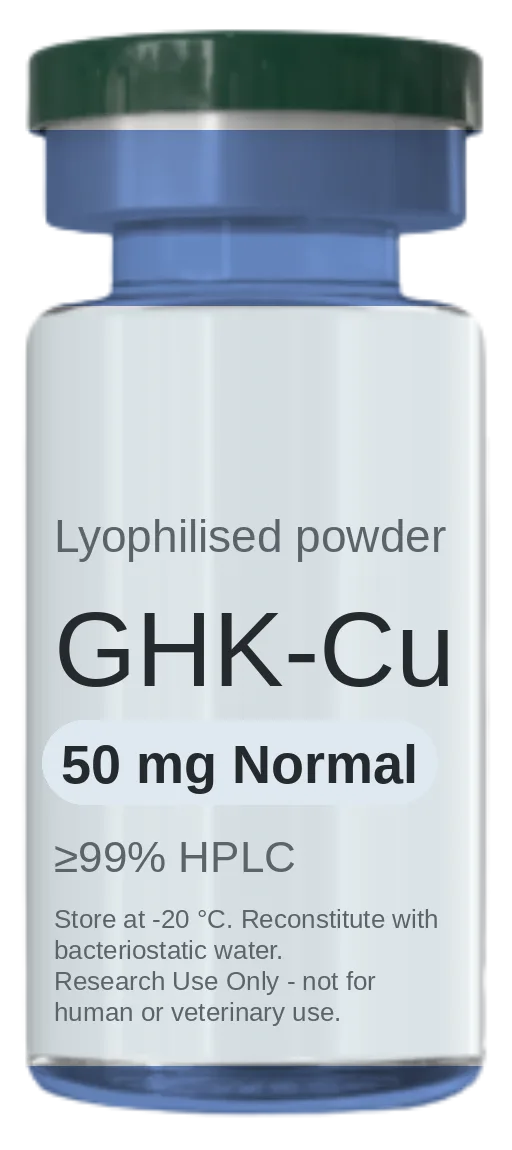
GHK-Cu (Copper Peptide)
Copper-binding tripeptide studied in extracellular matrix and dermal research models.
- Purity:
- ≥99% HPLC
- Sizes available:
- 50 mg Normal – 50 mg Plus
BPC-157 + TB-500
BPC-157 and TB-500 in a single vial — the pairing most studied together in tissue-repair research.
- Purity:
- ≥99% HPLC
- Sizes available:
- 5 mg + 5 mg
The consultation
One intake that settles goals, history and contraindications alongside compound, quantity, documentation and route — reviewed by a physician before anything ships.
More notes
-
Temporary Import Regime & Peptides
Temporary import covers goods that leave the country again; a research peptide shipment stays and gets used up.
-
Retatrutide vs GHK-Cu: What's the Difference
Retatrutide and GHK-Cu are different molecules studied for different reasons. Here's what each investigates and what documentation backs a batch.
-
Invoiced vs. Unbilled Peptide Suppliers
What changes when a research peptide supplier invoices the transaction versus one that takes payment and leaves no paper trail.