
Note
Growth Hormone Secretagogues: What They Are
Growth hormone secretagogues are peptides that trigger the pituitary to release its own GH. Two families, two mechanisms, one axis.
Growth hormone secretagogues are peptides that bind to specific receptors in the pituitary gland and trigger the release of GH that the pituitary itself produces. They are not synthetic growth hormone: they are signals that instruct the gland to secrete the hormone it already holds in reserve.
The term derives from Latin *secretio* (secretion) and Greek *agogos* (to lead, to provoke). A GH secretagogue leads the pituitary to release growth hormone.
The axis these peptides activate
Growth hormone does not circulate continuously. The pituitary releases it in pulses — peaks that occur mainly during deep sleep and high-intensity exercise. Two opposing hypothalamic signals govern that pulsatility:
- GHRH (growth hormone-releasing hormone): binds the GHRHR receptor on pituitary somatotroph cells and triggers GH synthesis and release.
- Somatostatin: suppresses release. The pituitary secretes GH when the GHRH signal exceeds somatostatin at a given moment.
Ghrelin — a peptide hormone produced mainly by the stomach — adds a third pathway: it binds the GHSR-1a receptor in the pituitary, potentiates the GHRH signal, and partially suppresses somatostatin. The result is an amplified GH pulse.
Synthetic secretagogues mimic one of these signals. GHRH analogs act on the GHRHR. Ghrelin receptor agonists — called GHRPs, growth hormone-releasing peptides — act on the GHSR-1a. Both families share the same downstream target: activating GH release from pituitary somatotrophs. The molecular routes that get them there are different.
The two families of secretagogues
GHRH analogs
Human GHRH contains 44 amino acids. The minimum fragment with biological activity covers the first 29. Synthetic analogs reproduce that sequence with modifications that increase resistance to plasma proteases and extend the time the compound remains active.
[Sermorelin](/en/product/sermorelin/) is that 29-amino-acid fragment. It was the first GHRH analog synthesized for research and remains the reference compound against which others in the family are compared, because its active sequence corresponds exactly to the minimum functional fragment of human GHRH.
Tesamorelin is the full 44-amino-acid GHRH conjugated at the N-terminus with a trans-3-hexenoic acid group. That modification increases the compound's stability without altering its receptor affinity. A study published in the *New England Journal of Medicine* documented the effects of tesamorelin on visceral abdominal fat in adults with HIV-associated lipodystrophy in a placebo-controlled design.
[CJC-1295 without DAC](/en/product/cjc-1295-no-dac/) incorporates four amino acid substitutions that increase resistance to enzymatic degradation. The absence of the Drug Affinity Complex (DAC) results in a shorter half-life compared to the DAC-carrying variant, because that complex binds covalently to plasma albumin and extends the compound's circulation time to several days.
GHRPs and ghrelin receptor agonists
GHRPs bear no sequence resemblance to either GHRH or natural ghrelin. They are synthetic peptides that the GHSR-1a receptor recognizes and responds to with the same signaling cascade that endogenous ghrelin would trigger.
Research studies them both alone and in combination with GHRH analogs, because simultaneous activation of GHRHR and GHSR-1a produces a GH pulse greater than the sum of either compound administered separately. That synergy is documented in the secretagogue literature in both in vitro and in vivo models.
[Ipamorelin](/en/product/ipamorelin/) is a pentapeptide — five amino acids — with high selectivity for the GHSR-1a. Research identified it as the first GH secretagogue with that level of selectivity: unlike GHRP-2 and GHRP-6, it does not raise cortisol or prolactin to the same degree in the studied models. That makes it useful in experimental protocols designed to isolate the effect on the GH axis without activating other hormonal axes.
Other GHRPs present in the literature include GHRP-2, GHRP-6, and hexarelin, with selectivity and potency profiles that in vitro and in vivo studies have characterized separately.
How secretagogues differ from recombinant HGH
Recombinant human growth hormone (rhGH) is a 191-amino-acid protein produced in expression systems — typically *E. coli* bacteria or mammalian cells — and administered exogenously. Secretagogues contain no GH and do not replace it: they are much smaller molecules that activate receptors so the pituitary generates and releases its own hormone.
The resulting release pattern is different. rhGH produces an acute supraphysiological peak that suppresses the axis for hours, because the negative feedback exerted by IGF-1 on the pituitary and hypothalamus is triggered by that external spike. Secretagogues, acting on the pituitary, preserve part of that regulation. The literature documents both profiles and their consequences for the IGF-1 axis across different experimental models.
That is not a claim that secretagogues are superior or inferior to rhGH: it is an observation that they produce a different pattern, one that researchers are working to characterize.
What the scientific literature examines
The questions that appear most frequently in research on these compounds include:
- How the magnitude of the GH pulse varies depending on which family combination is used and at what concentrations, in animal models.
- What happens to the hepatic IGF-1 axis when pulsatile secretion is stimulated versus when rhGH is administered directly.
- How different GHRH analogs affect bone density, body composition, and metabolic markers in rodent models.
- What the pharmacokinetic differences are between analogs in terms of plasma half-life, clearance, and relative potency at the receptor.
For laboratory research only
The material PeptoClinic supplies is exclusively for in vitro and laboratory research (Research Use Only, RUO). It is not approved or intended for human or veterinary consumption, diagnosis, or treatment of any medical condition. No regulator — the FDA, ANMAT, or any equivalent authority — has evaluated these compounds in the context of this operation.
PeptoClinic is not a pharmacy, a clinic, or a healthcare provider. Researchers who request a quote receive analytical documentation for the lot, including the certificate from the independent laboratory that verified the compound's identity and purity. The quality section of the site explains what that certificate contains and how to read it.
Anyone seeking guidance on the use of these substances in humans should consult a licensed healthcare professional.
Frequently asked questions
What exactly is a growth hormone secretagogue?
A GH secretagogue is a molecule that binds to receptors in the pituitary gland — either the GHRH receptor or the ghrelin receptor GHSR-1a — and triggers the release of GH that the gland already produces. It is not exogenous hormone; it is a signal that activates the pituitary's own secretion mechanism.
What are the two main families of GH secretagogues?
The literature divides them into GHRH analogs — such as sermorelin, tesamorelin, and CJC-1295 — and GHSR-1a agonists, also called GHRPs — such as ipamorelin, GHRP-2, and GHRP-6. They act on different receptors through different signaling cascades, but the final step in both cases is GH release from pituitary somatotrophs.
Do ipamorelin and sermorelin work the same way?
No. Sermorelin is a GHRH analog that binds the GHRHR receptor. Ipamorelin is a GHSR-1a agonist — a ghrelin receptor agonist. Both trigger GH release, but through distinct molecular pathways. Research combines them precisely because simultaneous activation of both receptors produces a greater effect than either compound administered alone.
What is the difference between CJC-1295 with DAC and without DAC?
The DAC-carrying version includes a reactive group that bonds covalently to plasma albumin, extending the compound's half-life to several days. The version without DAC lacks that group and has a much shorter half-life. Studies treat them as distinct compounds because their pharmacokinetic profiles differ and the research questions each one enables are not the same.
Does PeptoClinic ship growth hormone secretagogues to Argentina?
Yes. PeptoClinic supplies research material to Argentina and other destinations across South America. Shipping documentation is prepared for import as laboratory reference material. For details on shipments and customs documentation, see [the Argentina shipping page](/en/argentina/).
How do I verify that the compound I received is what it claims to be?
Every PeptoClinic lot ships with a certificate of analysis issued by an independent laboratory, reporting the compound's identity and HPLC-measured purity. The certificate includes the analysis task number, which allows the report to be verified directly with the issuing laboratory. The retatrutide lot analyzed on April 13, 2026 by Janoshik Analytical returned a purity of 99.893%.
What happens experimentally when a GHRH analog and a GHRP are combined?
The literature consistently reports that the combination produces a GH pulse greater than that of either compound administered alone. The proposed mechanism is simultaneous activation of two distinct signaling pathways: GHRHR and GHSR-1a. That synergy is documented in both in vitro and in vivo models, and is one of the most common experimental designs used to study the GH axis.
Does tesamorelin have regulatory approval?
Tesamorelin has FDA approval in the United States under the trade name Egrifta for the treatment of HIV-associated lipodystrophy in adults. That approval applies to pharmaceutical use with specific formulation, dosing, and medical supervision. The material PeptoClinic supplies is for laboratory research, independently of that regulatory approval.
Compounds mentioned
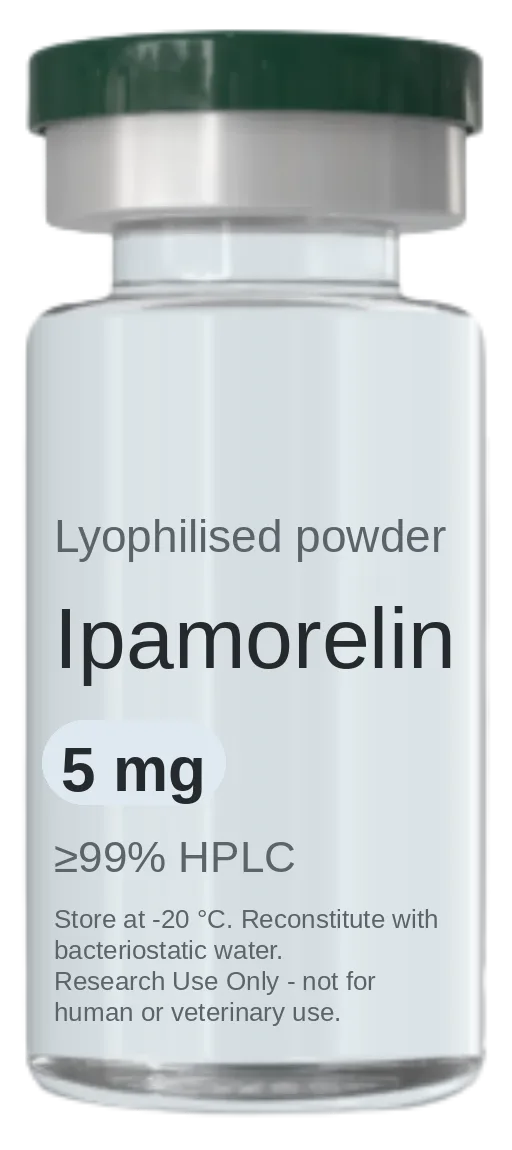
Ipamorelin
Selective ghrelin receptor (GHS-R1a) agonist pentapeptide.
- Purity:
- ≥99% HPLC
- Sizes available:
- 5 mg – 20 mg
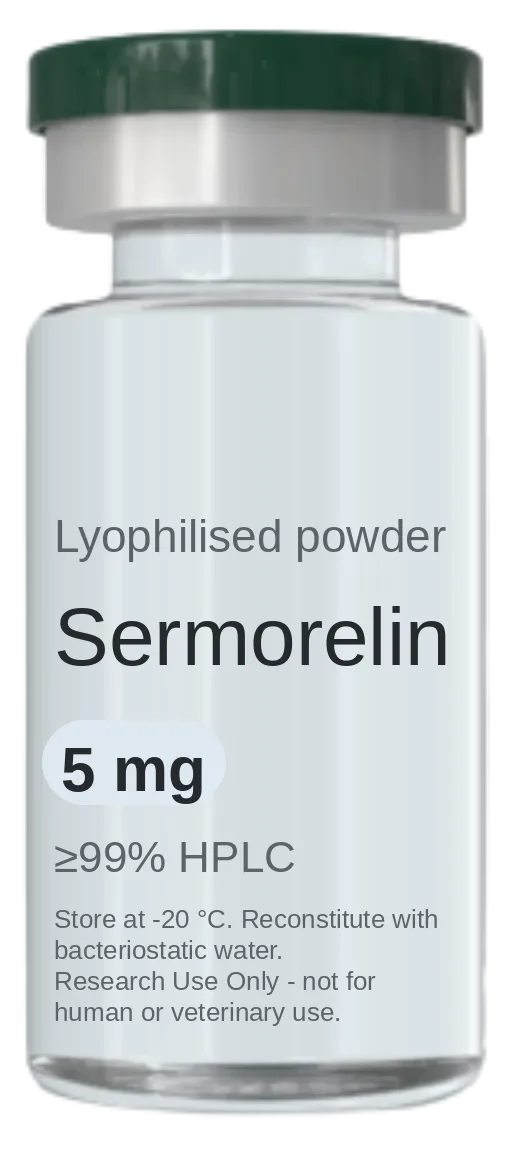
Sermorelin
Growth hormone-releasing hormone analogue used in endocrine signalling research.
- Purity:
- ≥99% HPLC
- Sizes available:
- 5 mg – 20 mg
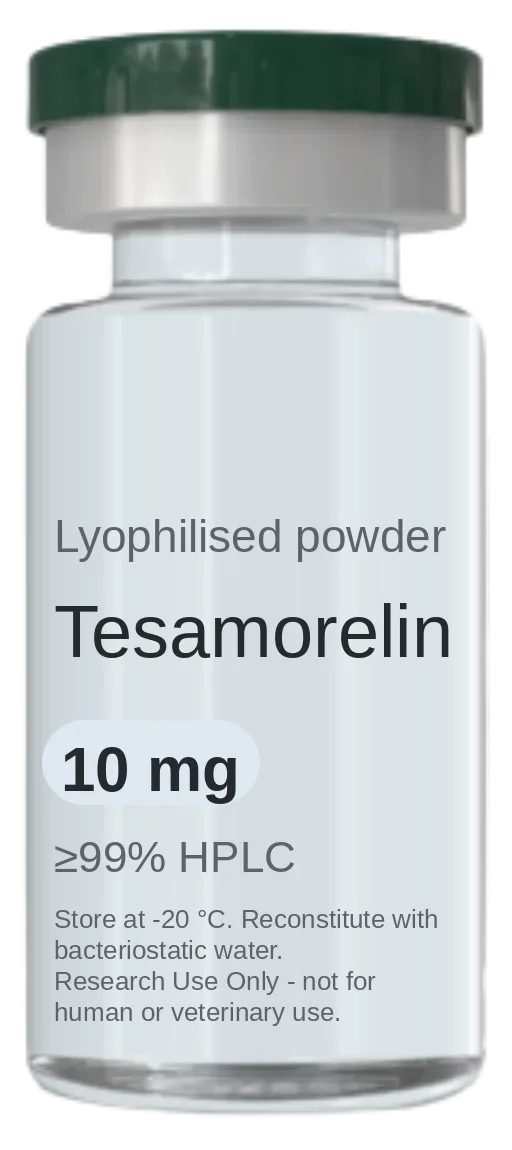
Tesamorelin
Stabilised GHRH(1-44) analogue studied in adipose tissue distribution research.
- Purity:
- ≥99% HPLC
- Sizes available:
- 10 mg – 20 mg
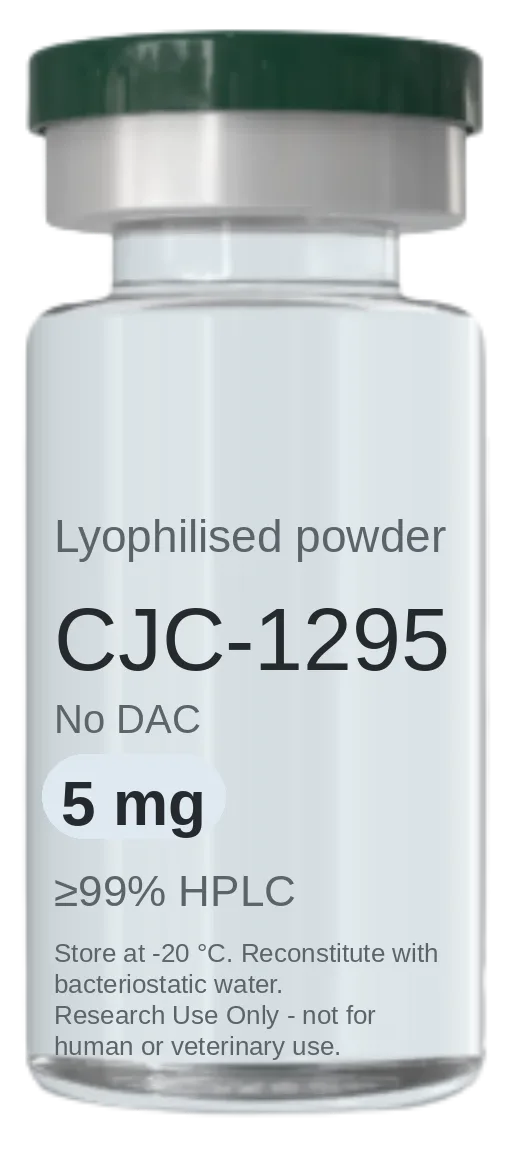
CJC-1295 (sin DAC)
Modified GRF(1-29) tetrasubstituted analogue without drug affinity complex.
- Purity:
- ≥99% HPLC
- Sizes available:
- 5 mg – 20 mg
The consultation
One intake that settles goals, history and contraindications alongside compound, quantity, documentation and route — reviewed by a physician before anything ships.
More notes
-
Peptide Shipments to Argentina: Annual Limit
What Argentina's postal shipment regime says about how many research peptide packages you can receive per year.
-
Retatrutide vs Epithalon: Key Differences
Retatrutide and Epithalon are research peptides from different classes, studied in different fields. Here's how they differ.
-
No Tax Address on File: Argentine Customs
What Argentine customs does with a research peptide shipment when the recipient has no registered tax address.