
Note
Hexarelin vs CJC-1295: The Differences
Hexarelin is a ghrelin-mimetic GHRP; CJC-1295 is a GHRH analog. What separates the two mechanisms and their documentation.
Hexarelin and CJC-1295 are studied for the same target — growth hormone (GH) secretion — but they belong to different peptide families, bind different receptors, and carry a different profile in the literature. Hexarelin is a hexapeptide that acts on the GH secretagogue receptor (GHSR), the same receptor ghrelin binds. CJC-1295 is a growth hormone-releasing hormone (GHRH) analog, a much longer chain, acting through a separate receptor. That receptor difference is what drives almost everything else: kinetics, the side-effect profile reported in the literature, and why the two compounds sometimes show up together in the same paper.
What hexarelin is
Hexarelin belongs to the GHRP family (growth hormone releasing peptides), alongside compounds such as GHRP-2 and GHRP-6. It is a six-amino-acid peptide that functions as an agonist of the GH secretagogue receptor, GHSR-1a. That is the same receptor activated by endogenous ghrelin, the hormone released by the stomach that — among other functions — triggers GH secretion from the pituitary.
Because it shares a receptor with ghrelin, the research literature on hexarelin is not confined to the GH axis. Preclinical studies have investigated effects on cardiac tissue and on the central nervous system, attributed to GHSR-1a expression in tissues beyond the pituitary. That is one reason hexarelin keeps getting studied as its own entity rather than treated as interchangeable with GHRP-2 or GHRP-6.
What CJC-1295 is
CJC-1295 is a synthetic analog of GHRH, the hormone that naturally signals the pituitary to release GH. Its sequence is based on the first 29 or 30 amino acids of human GHRH, with point substitutions that make it more resistant to enzymatic degradation than the native molecule.
This is where an important distinction sits inside the name itself: CJC-1295 exists in two variants that the literature treats as separate compounds.
- CJC-1295 without DAC (also cited as Mod GRF 1-29): the GHRH analog without the modification that extends circulating time. Its action profile is closer to that of endogenous GHRH.
- CJC-1295 with DAC: carries a chemical group (Drug Affinity Complex) designed to bind serum albumin, which extends its half-life considerably compared with the no-DAC variant.
When a publication simply says "CJC-1295" without specifying, it is worth checking the methods section: the reported half-life changes radically depending on which variant was used. PeptoClinic's catalogue carries the CJC-1295 without DAC variant, and the import reference for Argentina is at CJC-1295 no DAC · Argentina.
The core difference: GHRP versus GHRH analog
The simplest way to hold the distinction: hexarelin is not a GHRH analog, it is a ghrelin mimetic. CJC-1295 is a GHRH analog. They are two different routes to the same hormonal axis.
- Receptor: hexarelin activates GHSR-1a; CJC-1295 activates the GHRH receptor.
- Molecule size: hexarelin is a hexapeptide (6 amino acids); CJC-1295 is a chain of roughly 29–30 amino acids, far longer.
- Selectivity: GHRH and its analogs act relatively specifically on the GH axis; GHSR-1a, by contrast, has documented effects on other axes (cortisol, prolactin) in addition to GH, which is why hexarelin's profile in the studies is less "clean" than that of a GHRH analog.
- Desensitization: the literature on GHRPs in general, and on hexarelin in particular, describes an attenuated response with repeated exposure — the receptor becomes less sensitive over time — a phenomenon GHRH analogs like CJC-1295 report to a lesser degree.
None of these differences makes one compound "better" than the other in absolute terms: they are two distinct mechanisms of study, and which one is relevant depends on what a given experimental protocol is investigating.
Why they show up together in the literature
It is common to find publications that study a GHRH and a GHRP within the same experimental design, precisely because they act on different receptors, and the combined effect on GH release has, in several models, come out greater than the sum of each compound studied alone. That synergy between the two pathways — GHRH on one side, GHSR on the other — is one reason hexarelin and CJC-1295, or hexarelin and ipamorelin alongside a GHRH analog, are cited so often in the same body of literature.
This is a description of what the literature investigates, not a usage recommendation: PeptoClinic does not provide protocols, doses, or administration guidance for people. The material quoted is for laboratory research, and any experimental design — single-compound or combined — is the responsibility of the researcher and their institutional protocol.
Documentation and traceability
Every compound PeptoClinic quotes ships with its corresponding batch documentation, and the technical team reviews purity, quantity, and dispatch route before confirming a request. How to read that documentation — what a certificate of analysis states, which laboratory signed it, how to verify it — is explained on the quality page. For the full catalogue currently available, see PeptoClinic's catalogue.
PeptoClinic supplies research material to destinations across South America, including Argentina, with the customs file prepared as laboratory reference material. Dispatch details for the country are on the shipping page and the research material in Argentina page.
Research use only
Everything described in this article corresponds to in vitro and preclinical research literature. Neither hexarelin nor CJC-1295 is approved as a drug, supplement, or food; neither is intended for human or veterinary consumption, and no claim here has been evaluated by ANMAT, the FDA, or an equivalent authority. PeptoClinic is not a pharmacy, clinic, or telehealth provider, does not issue or fill prescriptions, and does not provide dosing or administration guidance for people.
Frequently asked questions
Do hexarelin and CJC-1295 act on the same receptor?
No. Hexarelin activates the GH secretagogue receptor (GHSR-1a), the same one recognized by endogenous ghrelin. CJC-1295 activates the GHRH receptor, a separate pathway within the same hormonal axis.
Which of the two is the larger peptide?
CJC-1295, with a sequence of roughly 29 to 30 amino acids. Hexarelin is a hexapeptide, just 6 amino acids, which is why it is grouped with other short GHRPs like GHRP-2 or GHRP-6.
Does "CJC-1295" always refer to the same molecule?
Not necessarily. The name is used for both the DAC variant (extended half-life via albumin binding) and the no-DAC variant. These are two distinct pharmacokinetic profiles, and it is worth identifying which one a given study is citing.
Why do some papers combine a GHRP with a GHRH analog?
Because they act through different receptors, and several models have reported a synergistic effect on GH release when the two are studied together, greater than either compound evaluated alone.
Does the literature describe effects of hexarelin outside the GH axis?
Yes. Because it shares a receptor with ghrelin, preclinical studies have examined hexarelin's effects on cardiac tissue and the central nervous system in addition to the GH axis, which sets it apart from a GHRH analog like CJC-1295.
Does PeptoClinic supply hexarelin?
Catalogue availability changes over time; the current list is on the [catalogue page](/en/catalog/), and the technical team can confirm on request whether a specific compound is available for quoting.
What documentation accompanies a batch of CJC-1295?
Each batch is quoted with its corresponding technical documentation, and the verification process — what to check on a certificate of analysis and how to confirm the issuing laboratory — is explained on the [quality page](/en/quality/).
Is this material approved for human use?
No. Both hexarelin and CJC-1295 are supplied strictly as laboratory research material (RUO), not approved for human or veterinary consumption, and none of their properties has been evaluated by ANMAT, the FDA, or an equivalent authority.
Compounds mentioned
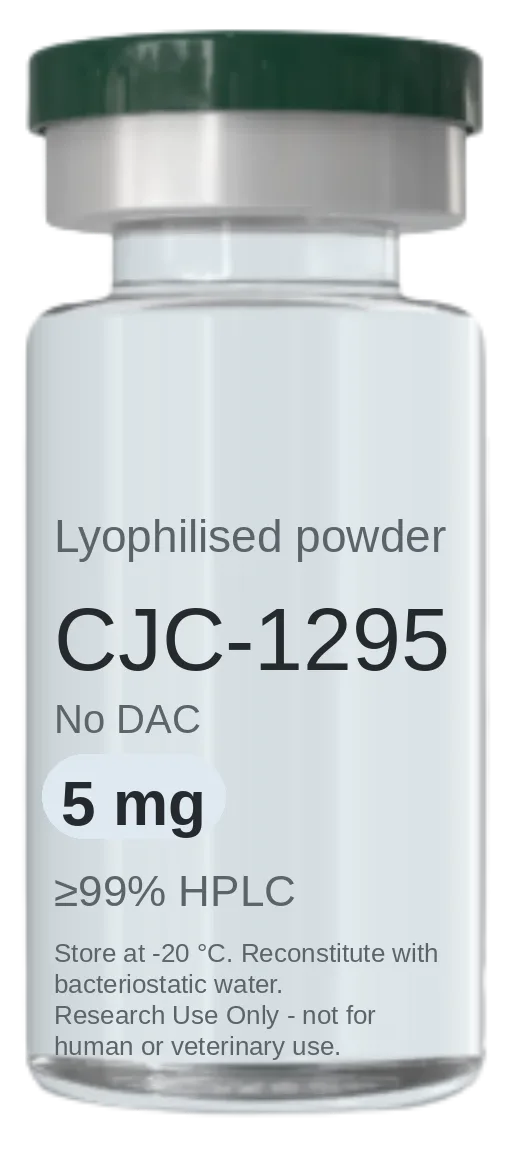
CJC-1295 (sin DAC)
Modified GRF(1-29) tetrasubstituted analogue without drug affinity complex.
- Purity:
- ≥99% HPLC
- Sizes available:
- 5 mg – 20 mg
Sermorelin
Growth hormone-releasing hormone analogue used in endocrine signalling research.
- Purity:
- ≥99% HPLC
- Sizes available:
- 5 mg – 20 mg
Ipamorelin
Selective ghrelin receptor (GHS-R1a) agonist pentapeptide.
- Purity:
- ≥99% HPLC
- Sizes available:
- 5 mg – 20 mg
Tesamorelin
Stabilised GHRH(1-44) analogue studied in adipose tissue distribution research.
- Purity:
- ≥99% HPLC
- Sizes available:
- 10 mg – 20 mg
The consultation
One intake that settles goals, history and contraindications alongside compound, quantity, documentation and route — reviewed by a physician before anything ships.
More notes
-
Peptide Invoice: What Argentine Customs Wants
What a research peptide invoice needs so Argentine customs releases the shipment instead of holding it in bonded storage.
-
Thymosin Alpha 1 vs Selank: How They Differ
Thymosin Alpha 1 and Selank sit in different research families—one studied in immunomodulation, the other in the anxiolytic-cognitive axis.
-
Temporary Import Regime & Peptides
Temporary import covers goods that leave the country again; a research peptide shipment stays and gets used up.