
Note
Humanin vs Epitalon: What Differs
Humanin and Epitalon differ in origin, size and research focus. A look at what each line of published literature actually studies.
Humanin and Epitalon show up together in longevity-peptide forums, but they differ in almost everything that matters: origin, molecular size, and the research line that studies each one. Humanin is a 24-amino-acid peptide encoded in the mitochondrial genome, studied in the literature for a cytoprotective, antiapoptotic role. Epitalon is a synthetic tetrapeptide of just 4 amino acids, derived from a natural pineal gland peptide, studied for its relationship to telomerase and circadian rhythms. They share no structure and no mechanism — the only real overlap is that popular culture files them under the same "longevity peptide" label.
That difference in origin and size is what explains everything else: how each one is produced, how stable it is, and what kind of assay is used to study it.
Where each peptide comes from
Humanin was not designed — it was discovered. In 2001, a research group identified a sequence inside the mitochondrial gene MT-RNR2 — the region that encodes part of the 16S ribosomal RNA — that translates into a 24-amino-acid peptide. This is what is now known as a mitochondrial-derived peptide (MDP): a small family of molecules the mitochondrial genome produces in addition to the respiratory-chain proteins. Humanin was the first MDP described.
Epitalon, by contrast, is synthetic from the start. It is based on a natural peptide extracted from the pineal gland called epithalamin, and it was reduced by Vladimir Khavinson's laboratory (Saint Petersburg Institute of Bioregulation and Gerontology) to its minimal active sequence: alanine-glutamic acid-aspartic acid-glycine (Ala-Glu-Asp-Gly). That synthesis dates to the 1980s and 1990s, with the stated goal of replicating in the lab what natural epithalamin did in animal models.
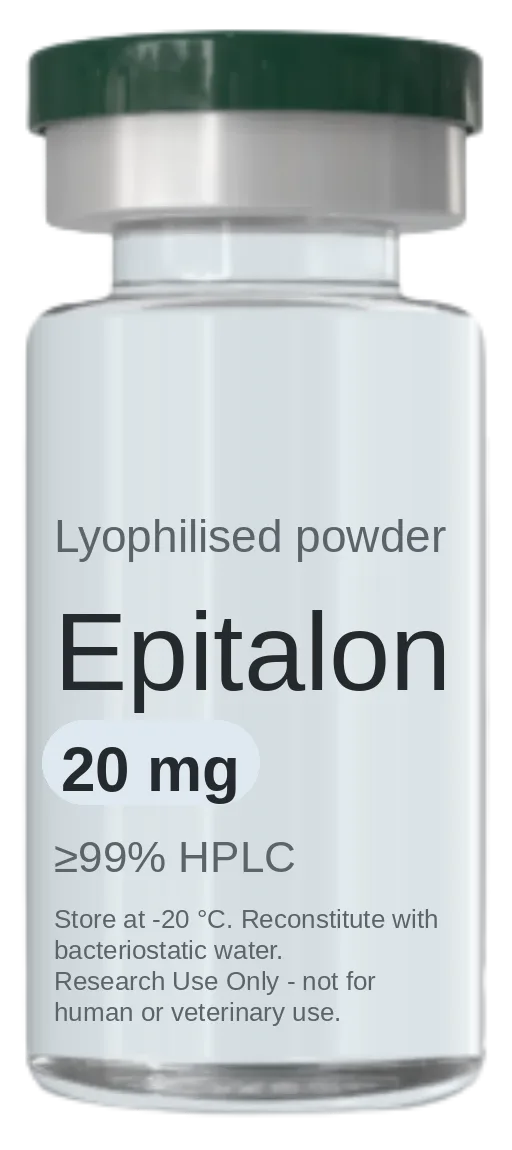
The /en/product/epitalon/ page has the technical specification for Epitalon as a research material, including the purity spec and what documentation ships with a lot. Humanin is not part of PeptoClinic's catalogue.
What the literature investigates about humanin
Most published work on humanin concentrates on its ability to protect cells against toxic stimuli — a mechanism referred to as cytoprotection. The earliest studies identified it in neurons resistant to effects associated with Alzheimer's disease, and from there the research expanded into models of apoptosis, mitochondrial oxidative stress, and metabolic regulation.
Humanin does not stand alone in its category: it belongs to the family of mitochondrial-derived peptides, alongside MOTS-c, which is encoded in a different region of mitochondrial DNA (the 12S rRNA gene) and is studied mainly in the context of energy metabolism and insulin sensitivity in animal models. Comparing humanin to MOTS-c makes more biological sense than comparing it to Epitalon: the first two share mitochondrial origin, even though the mechanisms under study differ.
The published work on humanin and its discovery can be reviewed on PubMed, where the original 2001 identification and the subsequent neurodegeneration research are documented.
What the literature investigates about Epitalon
Epitalon is studied in a different area: the relationship between the pineal gland, circadian rhythm, and cellular aging. The most cited finding from Khavinson's group is telomerase activation in cultured human fibroblasts, published in the early 2000s, which opened a line of study on telomere maintenance in in vitro models.
Other work from the same team investigated Epitalon in animal models of retinal aging and in the regulation of melatonin secretion, always within the frame of biological-clock research. It is a consistent, Russia-based research line, with decades of publications from the same laboratory — unlike humanin, which was taken up by multiple independent research groups in different countries after its discovery.
The literature on telomerase and Epitalon is also indexed on PubMed, useful for reading the original studies rather than a secondhand summary.
Size and stability: the most concrete difference
Beyond mechanism, there is a structural difference anyone can check just by looking at a spec sheet: humanin has 24 amino acids, Epitalon has 4. A long-chain peptide like humanin has more possible points of degradation — more peptide bonds to break, more surface exposed to oxidation — than a tetrapeptide does. That says nothing about biological efficacy, but it says a lot about how demanding the cold chain and batch handling are as a laboratory material.
On a certificate of analysis, a short peptide like Epitalon usually shows a cleaner, easier-to-read HPLC peak than a long-chain one, simply because there are fewer possible incomplete-sequence variants. The /en/quality/ page explains how to read a Janoshik Analytical certificate of analysis and what to check before accepting a lot's stated purity.
Why they get searched together
The search "humanin o epithalon en qué se diferencian" almost always comes from the same curiosity: someone read about longevity research, saw both names on the same list, and wants to know if they're interchangeable. They are not — not in structure, and not in the research question each one answers. PeptoClinic supplies research peptides to Argentina as laboratory reference material, with import documentation prepared for that category, and the full catalogue is listed at /en/catalog/.
The reverse point also holds: high search interest in a compound does not mean it is available. Humanin is not in the current catalogue, and this note is not a promise that it will be added.
Laboratory material, not for human or veterinary use
Both humanin and Epitalon, when available, are supplied strictly as research material (Research Use Only): for laboratory and in vitro study. Neither is a medicine, a supplement, or a product for human or veterinary consumption, and none of their properties has been evaluated by the FDA, ANMAT, or an equivalent authority. This article describes what published scientific literature investigates — it is not usage guidance or a protocol.
Frequently asked questions
Are humanin and Epitalon the same family of peptides?
No. Humanin is a peptide derived from the mitochondrial genome, 24 amino acids long, while Epitalon is a synthetic tetrapeptide of 4 amino acids based on a pineal gland peptide. They share popular interest as aging-research subjects, but not origin or structure.
Which one has more years of published research behind it?
Epitalon has a longer, more concentrated research line, with publications from Khavinson's laboratory going back to the 1980s. Humanin was only described in 2001, though since then it has been studied by a larger number of independent groups in different countries.
Is Epitalon available in PeptoClinic's catalogue?
Yes, as a research material with a purity specification and certificate of analysis. The page is at [/en/product/epitalon/](/en/product/epitalon/).
Is humanin available in the catalogue?
No, humanin is not part of PeptoClinic's current catalogue.
Why are they sometimes grouped as "longevity peptides"?
Because both appear frequently in popular articles about cellular aging. It's a marketing and popular-culture label, not a biochemical classification — the mechanism each one is studied for is different.
Is MOTS-c the same as humanin?
No, but the two are more closely related to each other than either is to Epitalon: both are mitochondrial-derived peptides, encoded in different regions of mitochondrial DNA. MOTS-c is studied mainly in energy metabolism; humanin, in cytoprotection and neurodegeneration models. The [MOTS-c page for Argentina](/en/argentina/mots-c/) has more detail.
Does peptide size affect how it's handled as a laboratory material?
Yes. A long-chain peptide like humanin has more possible degradation points than a tetrapeptide like Epitalon, which usually translates into a more demanding cold chain and a more complex HPLC peak to interpret on the certificate of analysis.
Is this article a usage recommendation?
No. It describes what published scientific literature investigates about each peptide as a laboratory material. It includes no dosing, protocol, or usage guidance for people or animals.
Compounds mentioned
The consultation
One intake that settles goals, history and contraindications alongside compound, quantity, documentation and route — reviewed by a physician before anything ships.
More notes
-
Temporary Import Regime & Peptides
Temporary import covers goods that leave the country again; a research peptide shipment stays and gets used up.
-
Retatrutide vs GHK-Cu: What's the Difference
Retatrutide and GHK-Cu are different molecules studied for different reasons. Here's what each investigates and what documentation backs a batch.
-
Invoiced vs. Unbilled Peptide Suppliers
What changes when a research peptide supplier invoices the transaction versus one that takes payment and leaves no paper trail.