
Note
KPV or BPC-157: How Do They Differ?
KPV and BPC-157 are distinct research peptides — different sequence, different research focus, and separate batch documentation.
KPV and BPC-157 are two distinct research peptides, with different amino acid sequences, different origins, and separate lines of study in the scientific literature. They share a catalogue and a sale format — vial, lyophilised powder — but they are not interchangeable, chemically or functionally. The confusion usually comes from both being mentioned in similar research contexts (inflammation, tissue repair), but that does not make them the same compound.
The amino acid sequence is different
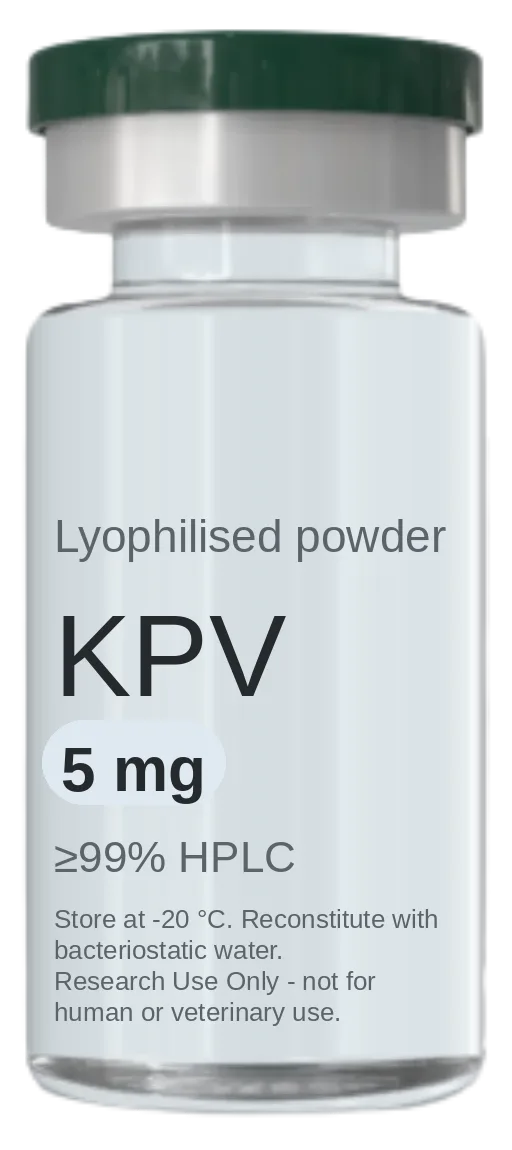
KPV is a tripeptide: three amino acids, Lysine-Proline-Valine. It is the C-terminal fragment of alpha-MSH (melanocyte-stimulating hormone), and the literature studies it in isolation because it retains part of the parent molecule's activity without the rest of the chain.
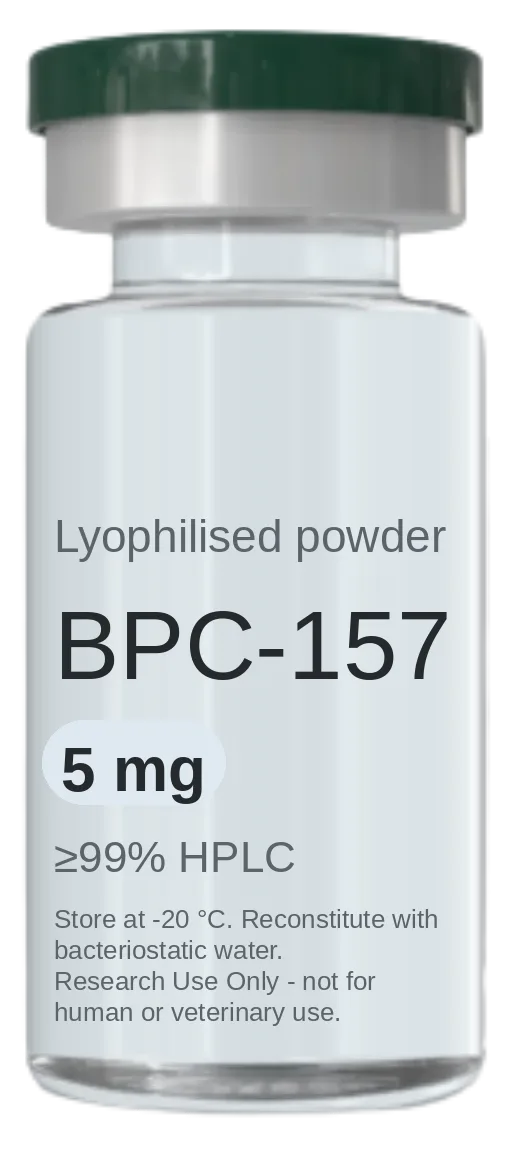
BPC-157 is a fifteen-amino-acid peptide — a pentadecapeptide — derived from a fragment of a protein identified in human gastric juice ("body protection compound," where the name comes from). The full sequence and the amino acid count are the simplest structural difference between the two: KPV is a small molecule, BPC-157 is five times longer.
That size difference is not a minor detail. It changes how stable the molecule is, how it goes into solution, and what kind of in vitro assay makes sense for each one.
What the published research looks at for each one
Published studies on KPV concentrate mostly on intestinal inflammation models and on the signalling pathway associated with the melanocortin receptor. It is one of the most cited tripeptides in experimental colitis research, and it appears frequently in papers trying to isolate the anti-inflammatory portion of alpha-MSH from the rest of the molecule.
BPC-157 has a broader and more varied literature: gastrointestinal tissue repair models, tendon and ligament models, and studies on angiogenesis (new blood vessel formation) in damaged tissue. Along with TB-500, it is one of the most requested peptides in animal-model tissue repair research.
Neither compound has approval from ANMAT, the FDA, or any equivalent regulatory authority, and neither is intended for human or veterinary consumption, diagnosis or treatment. What exists is research literature in vitro and in animal models, not clinical evidence in people.
Batch documentation: what comes with each lot
PeptoClinic quotes the research peptides in its catalogue — including KPV and BPC-157 — with the purity specification and batch documentation for each lot. The standard stated in the catalogue is ≥99% by HPLC.
As a concrete example of that documentation: Janoshik Analytical analysed a combined BPC-157 and TB-500 lot on 2026-04-13 (task 204975), with 10 mg total content split into 5 mg of each peptide. It is the same kind of report that accompanies the rest of the catalogue: an external laboratory, a dated analysis, and an identifiable task number, not a generic "guaranteed purity" label with nothing behind it.
The right way to read one of these reports — what to look for, what each field means — is explained on the quality page. It is worth reviewing before comparing two suppliers by their certificate of analysis, because not every report says the same thing or carries the same level of detail.
Format: where they are alike
Here they are identical. Both are supplied as a vial of lyophilised powder, intended for in vitro and laboratory research, with USP-grade diluents available separately for whoever needs them for their research protocol. A pen presentation is not yet available for any compound in the catalogue: it is announced but not something that can be quoted today.
For Argentina specifically, BPC-157 has its own reference page with the import logistics and the customs documentation that ships with the material as laboratory reference material. It is the starting point if the question is specifically about this compound and bringing it into the country.
For laboratory research only
Both KPV and BPC-157 are supplied strictly for research use (Research Use Only, RUO): in vitro and laboratory studies. Neither is a medicine, a supplement, or a food, and neither is approved or intended for human or veterinary consumption, diagnosis or treatment. No claims about these compounds have been evaluated by ANMAT, the FDA, or any equivalent regulatory authority. PeptoClinic is not a pharmacy, a clinic, or a telehealth provider, and does not offer dosing, administration, or usage-protocol guidance.
To see the rest of the catalogue and compare other compounds studied in similar research contexts, the full catalogue is available, and for the general shipping logistics to the region, see the Argentina page.
Frequently asked questions
¿KPV y BPC-157 son el mismo péptido con distinto nombre?
No. Son dos moléculas distintas: KPV es un tripéptido de tres aminoácidos derivado de la alfa-MSH, y BPC-157 es un pentadecapéptido de quince aminoácidos derivado de un fragmento identificado en jugo gástrico. Comparten catálogo pero no estructura ni origen.
¿Por qué a veces aparecen mencionados juntos en el mismo contexto de investigación?
Porque la literatura sobre ambos toca temas de inflamación y reparación de tejido, que son áreas de investigación cercanas. Eso los hace aparecer en búsquedas parecidas, pero la vía de acción estudiada y la secuencia molecular son distintas en cada caso.
¿Cuál de los dos tiene más estudios publicados?
BPC-157 tiene una literatura más amplia, con estudios en modelos de reparación de tendón, ligamento, tejido gastrointestinal y angiogénesis. KPV tiene una línea de investigación más acotada, concentrada mayormente en modelos de inflamación intestinal.
¿Los dos vienen con certificado de análisis?
El catálogo de PeptoClinic se cotiza con documentación de lote y especificación de pureza declarada (≥99 % por HPLC). Un ejemplo público es el informe de Janoshik Analytical sobre un lote combinado de BPC-157 y TB-500, analizado el 2026-04-13.
¿BPC-157 y TB-500 son el mismo compuesto?
No. Suelen cotizarse juntos porque comparten líneas de investigación sobre reparación tisular, pero son péptidos distintos. El lote de referencia documentado por Janoshik Analytical los incluye como dos compuestos separados dentro de un mismo vial.
¿Hay una presentación en pluma disponible para alguno de los dos?
No por el momento. Ambos se suministran como vial de polvo liofilizado. La presentación en pluma está anunciada para el catálogo en general pero todavía no es un formato que se pueda cotizar.
¿Este contenido sirve para decidir cuál usar en una persona?
No. Todo lo publicado acá describe qué investiga la literatura científica sobre cada compuesto en modelos de laboratorio, in vitro y animales. No es información de dosis, administración ni uso humano, y ninguno de los dos compuestos está aprobado para eso.
¿Cómo se pide una cotización de alguno de los dos?
Describiendo el compuesto, la cantidad y el destino de envío. El equipo técnico revisa especificación, documentación de lote y ruta logística, y responde con una cotización por escrito, normalmente dentro de un día hábil.
Compounds mentioned
BPC-157 + TB-500
BPC-157 and TB-500 in a single vial — the pairing most studied together in tissue-repair research.
- Purity:
- ≥99% HPLC
- Sizes available:
- 5 mg + 5 mg
The consultation
One intake that settles goals, history and contraindications alongside compound, quantity, documentation and route — reviewed by a physician before anything ships.
More notes
-
Temporary Import Regime & Peptides
Temporary import covers goods that leave the country again; a research peptide shipment stays and gets used up.
-
Retatrutide vs GHK-Cu: What's the Difference
Retatrutide and GHK-Cu are different molecules studied for different reasons. Here's what each investigates and what documentation backs a batch.
-
Invoiced vs. Unbilled Peptide Suppliers
What changes when a research peptide supplier invoices the transaction versus one that takes payment and leaves no paper trail.