
Note
KPV vs GHK-Cu: What's the Difference?
KPV and GHK-Cu are distinct research peptides with different sequences and mechanisms — how to tell them apart and verify batch purity.
KPV and GHK-Cu are two research peptides that share no mechanism, sequence or field of study: KPV is a tripeptide derived from the alpha-MSH hormone that laboratories investigate in relation to inflammatory pathways, while GHK-Cu is a copper-bound tripeptide complex that the literature associates with tissue-repair signaling and copper metabolism in skin. Neither substitutes for the other: each is studied in a different model, and confusing them means comparing results that were never comparable to begin with.
What is KPV, and what do laboratories study with it?
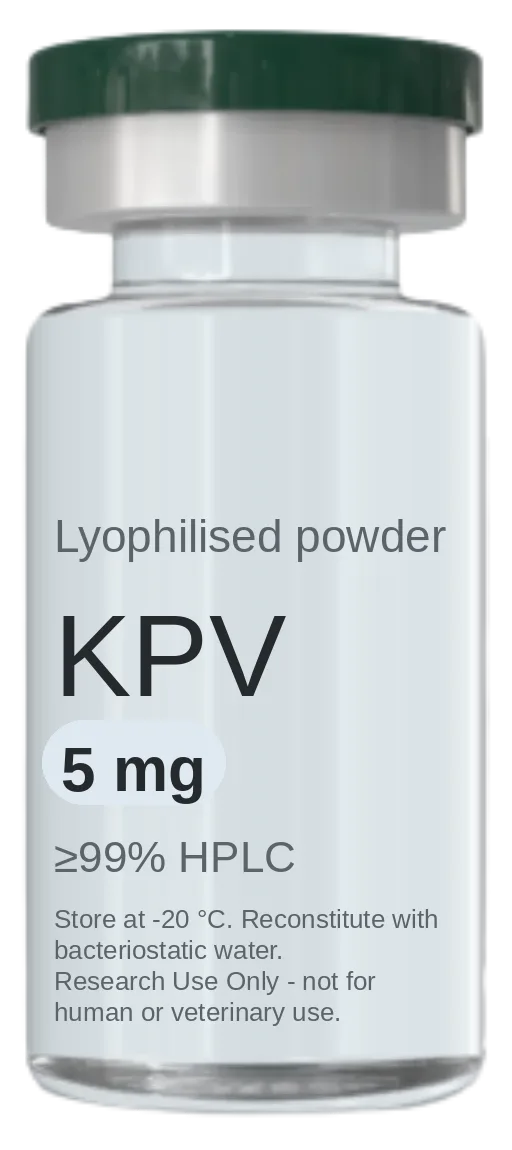
KPV is the sequence Lysine-Proline-Valine, the carboxyl-terminal fragment of alpha-MSH (alpha-melanocyte-stimulating hormone). Unlike the full hormone, KPV carries no pigmenting activity: it is isolated specifically because it retains interaction with melanocortin receptors without that effect. Most of the published research on KPV sits in models of intestinal and cutaneous inflammation, where its effect on NF-κB activity and proinflammatory cytokine production is studied. The indexed literature on the peptide can be reviewed on PubMed.
In PeptoClinic's catalogue, KPV is available as a lyophilized vial for laboratory use only.
What is GHK-Cu, and what do laboratories study with it?
GHK-Cu is the sequence Glycine-Histidine-Lysine bound to a copper ion (Cu2+). It was originally identified in human plasma, where its concentration declines with age, and research since then has concentrated on its role as a copper carrier to enzymes involved in extracellular matrix remodeling. Along with KPV, it is one of the most searched-for research peptides in the Argentine market, but for an entirely different reason: the pathway under study isn't inflammatory, it's copper metabolism and its effect on fibroblasts and collagen in cell-culture models. The available literature on PubMed for GHK-Cu is more extensive than for KPV, in part because it has been studied since the 1980s.
How do they differ structurally?
Both are tripeptides, and that's where the resemblance ends:
- KPV (Lys-Pro-Val) carries no associated metal and derives from a hormone fragment.
- GHK-Cu (Gly-His-Lys) is stably bound to a copper ion, and that binding defines its activity in assays: without the copper, free GHK behaves differently.
- The receptor pathways the literature postulates for each are distinct: KPV is linked to melanocortin receptors, GHK-Cu to its role as a copper chelator and transporter.
That structural difference is why it makes no sense to treat them as interchangeable in a research design: these are two molecules with their own history, sequence and postulated mechanism.
Are they studied in the same laboratory models?
Not necessarily. Designs that use KPV tend to be oriented toward mucosal or skin inflammation, while those that use GHK-Cu tend toward tissue repair, cell-culture wound healing and skin aging. Some publications study both peptides in the same tissue — skin — but asking different questions: one measures inflammation, the other measures matrix remodeling. Two research peptides sitting in the same catalogue category doesn't mean they answer the same scientific question.
If the project's interest is tissue repair specifically, it's also worth reviewing BPC-157, another research peptide common in that same field of study, with a postulated mechanism distinct from GHK-Cu's.
How is the purity of a KPV or GHK-Cu batch verified?
The purity standard PeptoClinic states for its catalogue is ≥99% by HPLC, verifiable against the laboratory report that accompanies each batch. The way to confirm it isn't to trust a spec sheet — it's to open an external laboratory's report and read the chromatogram. Janoshik Analytical is the laboratory that analyzes the batches PeptoClinic publishes, and how to read one of those reports correctly — which columns to look at, what the area-under-curve percentage means — is explained on the quality page.
For GHK-Cu there is an independent laboratory report that does not state the purity percentage as an isolated figure in the document, but it is verifiable against the corresponding batch. Before accepting any percentage that appears only in marketing copy, it's worth asking for the document.
Can both be requested in the same consultation?
Yes: because this is a quote-based technical consultancy and not a store, each request is quoted according to what the research program needs, and nothing prevents a single quote from including KPV, GHK-Cu and any other compound in the catalogue. What changes is the documentation accompanying each vial, since every peptide has its own laboratory report. For sourcing either compound to a specific destination, see the Argentina page for how quoting and import documentation work there.
How does the material travel until it reaches the laboratory?
KPV and GHK-Cu both ship as lyophilized powder in a sealed vial, with desiccant and protected from light. That format is stable at room temperature for weeks, so the shipment doesn't need a cold chain, gel packs or dry ice: that only becomes relevant after the peptide is reconstituted into solution, when it requires constant refrigeration. Packaging and storage details are on the shipping page.
Research material only — not for human or veterinary use
Both KPV and GHK-Cu are supplied strictly as research material (Research Use Only). They are not medicines, not supplements, not approved for human or veterinary consumption, and none of the claims in this article have been evaluated by the FDA, ANMAT or any equivalent authority. The literature cited corresponds to in vitro or cell-model studies, not clinical research in people, and PeptoClinic does not provide doses, administration routes or usage protocols: it quotes material and the laboratory documentation that backs it.
Frequently asked questions
Are KPV and GHK-Cu the same type of peptide?
Both are tripeptides, but their sequence, postulated mechanism and the field of research in which they're studied differ: KPV derives from alpha-MSH and is studied in inflammation models, GHK-Cu is a copper complex studied in tissue-repair and copper-metabolism models.
Does one of the two have more published research?
The indexed literature on GHK-Cu is more extensive, partly because it was identified and began being studied earlier. That doesn't determine which one is "better" — each compound is investigated for different questions, and publication volume doesn't indicate which fits a particular project's design.
Is the copper in GHK-Cu part of the molecule or added afterward?
It's part of the compound as supplied: the GHK-Cu analyzed in the laboratory report is already the tripeptide-copper complex, not the free tripeptide with copper added separately.
Do both come in the same format?
In PeptoClinic's catalogue, both are available as a lyophilized powder vial, the only format currently in stock. A pen format has been announced but cannot yet be ordered: it is waitlist-only for now.
How do I know if my batch's laboratory report is valid?
By checking that the report comes from an identifiable external laboratory, that the batch number on the document matches the one that physically arrived, and that the laboratory offers a verification channel independent of the seller. PeptoClinic's quality page explains step by step what to look for in a certificate of analysis.
Can KPV and GHK-Cu be combined in the same research project?
Nothing prevents it at the level of quoting or documentation: each vial arrives with its own laboratory report, and the project design — what combines with what, and why — is a decision that belongs to the team running the study.
Why do the two show up together in so many searches if they're so different?
Because both are among the most searched-for research peptides in the Argentine market and tend to be listed side by side in catalogues and comparisons, not because they share a mechanism. The confusion is one of commercial visibility, not chemistry.
Does PeptoClinic ship KPV and GHK-Cu to Argentina?
Yes, Argentina is one of the destinations PeptoClinic quotes research material to, with import documentation prepared so the shipment enters as laboratory reference material.
Compounds mentioned
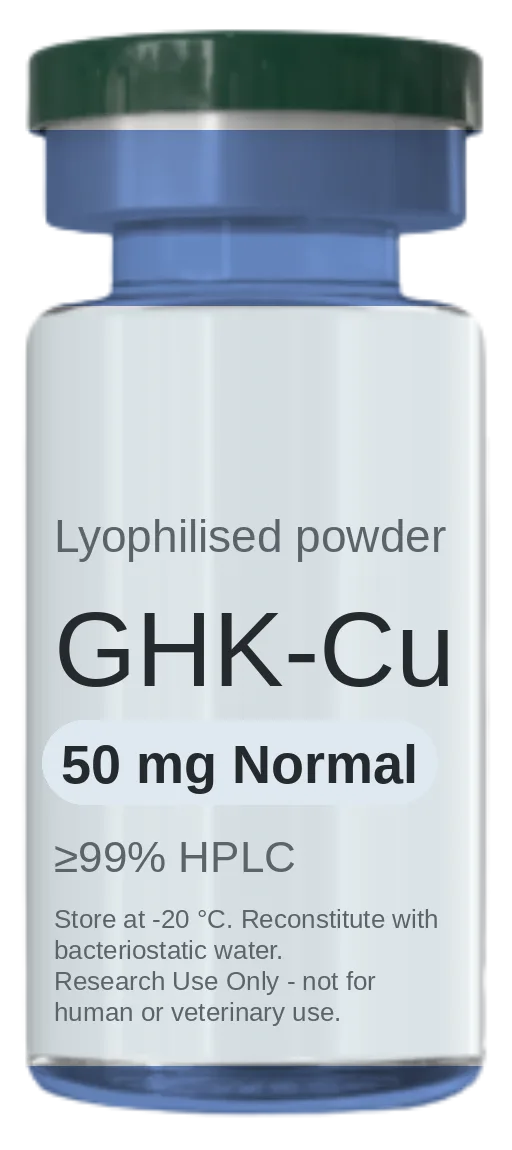
GHK-Cu (Copper Peptide)
Copper-binding tripeptide studied in extracellular matrix and dermal research models.
- Purity:
- ≥99% HPLC
- Sizes available:
- 50 mg Normal – 50 mg Plus
BPC-157 + TB-500
BPC-157 and TB-500 in a single vial — the pairing most studied together in tissue-repair research.
- Purity:
- ≥99% HPLC
- Sizes available:
- 5 mg + 5 mg
The consultation
One intake that settles goals, history and contraindications alongside compound, quantity, documentation and route — reviewed by a physician before anything ships.
More notes
-
Retatrutide vs. Tirzepatide: Differences
Retatrutide adds a third receptor that tirzepatide doesn't activate — here's how the two differ in structure, mechanism, and published research.
-
NAD+ vs Selank: What's the Difference?
NAD+ is a cellular coenzyme; Selank is a synthetic peptide derived from tuftsin. Structure, mechanism, and what each one is studied for.
-
Peptide Customs Clearance Cost in Argentina
What determines customs clearance cost for a research peptide shipment to Argentina, and what documentation PeptoClinic prepares for it.