
Note
MOTS-c or NAD+: What's the Difference
MOTS-c and NAD+ are studied through different mitochondrial pathways; here's what each line of research actually measures.
MOTS-c and NAD+ sit in different lines of research: MOTS-c is a peptide encoded by mitochondrial DNA that is studied for its role in signaling between the mitochondria and the nucleus of the cell, while NAD+ is a coenzyme involved in hundreds of oxidation-reduction reactions and studied mainly for its age-related decline inside the cell. They are not interchangeable and they don't compete for the same pathway — they show up together in search results because both appear in the literature on mitochondrial metabolism and cellular aging, but the mechanism each one is investigated for is different.
What MOTS-c is and what it's studied for
MOTS-c (Mitochondrial Open Reading Frame of the 12S rRNA type-c) is a 16-amino-acid peptide discovered encoded inside mitochondrial DNA, not nuclear DNA like most peptides in this catalogue. That difference in origin is what makes it a distinct object of study: it's one of the few molecules the mitochondria produce on its own to communicate with the rest of the cell.
The published literature on MOTS-c describes it as a regulator of the metabolic stress response. Research models link it to the AMPK pathway, the one the cell activates when it needs to adjust its energy output, and to nuclear translocation under stress conditions, where it appears to influence the expression of metabolism-related genes. It's studied alongside other markers of the mitochondria-nucleus axis, and its full specification sheet — including the purity of the analyzed batch — is on the MOTS-c catalogue page for Argentina.
What NAD+ is and why it comes up in the same searches
NAD+ (nicotinamide adenine dinucleotide) is not a peptide: it's a coenzyme present in every living cell, acting as an electron carrier in cellular respiration and as a substrate for enzymes such as sirtuins and PARPs. It's one of the most studied molecules in classical biochemistry, and it moved back to the center of the research conversation in recent years because intracellular NAD+ levels measurably drop with age across several animal models.
That decline is what puts NAD+ next to MOTS-c in so many searches: both are studied within the broader frame of mitochondrial aging, but one is a signaling peptide and the other is a biochemical cofactor that participates directly in metabolic reactions. The catalogue entry for NAD+, with its own batch specification, sits separately in the product list for exactly that reason — it's not classed with the peptides.
The core distinction, in one sentence
MOTS-c is a signaling molecule: it carries information from the mitochondria to other parts of the cell. NAD+ is a metabolic substrate: it's a consumable that enzymes use to catalyze concrete reactions in energy production and cellular repair. One reports, the other supplies. That distinction runs through almost all of the literature that compares the two molecules, and it's why many research designs study them together rather than as alternatives.
How each one gets studied in a lab setting
In an experimental design, MOTS-c is typically analyzed by measuring its endogenous concentration or by administering it exogenously in cell cultures or animal models, to observe effects on oxidative stress markers, AMPK activation, or mitochondrial gene expression. NAD+ is studied differently: because raising intracellular levels by administering the molecule directly is limited by its low cell permeability, much of the research instead works with precursors — nicotinamide mononucleotide (NMN) or nicotinamide riboside (NR) — and measures the resulting NAD+ with dedicated biochemical assays.
That has a practical consequence for any lab sourcing the material: MOTS-c arrives as a lyophilized peptide ready for the protocol it's used in, while NAD+ can be sourced as the molecule itself or, depending on the study design, as one of its precursors. Before deciding what to order it's worth being clear on which pathway is actually being evaluated, because measuring the direct effect of the coenzyme is not the same question as measuring a precursor's capacity to replenish it.
What to check on a batch of either one before use
As with any research peptide, the first thing to check on a batch isn't the product page — it's the certificate of analysis. In PeptoClinic's catalogue, the most recent MOTS-c batch was analyzed by Janoshik Analytical at 99.669% purity by HPLC — the lowest figure published across the available reports, and the one worth citing instead of the best batch on file. The full report is on the quality page, where every published certificate is listed, not just the strongest numbers.
For NAD+, or for any coenzyme sourced as a research reagent, the standard is the same: ask for the certificate of analysis for the specific batch, not a generic technical sheet for the compound. A purity report with no laboratory address and no batch number doesn't let anyone verify anything, and that's exactly the difference between a supplier that documents its material and one that only asserts it.
Why they turn up together in research designs
It's common to see experimental designs where MOTS-c and NAD+ (or its precursors) are studied in parallel, because the two pathways converge on the same territory: mitochondrial function and its relationship to cellular energy metabolism. A protocol might evaluate whether administering MOTS-c changes intracellular NAD+ levels, or whether a cell's NAD+ status shapes its response to MOTS-c. That convergence is why so many searches frame them as competitors, when in the literature they function more like two variables of the same system.
If the research interest is mitochondrial metabolism more broadly, it's worth checking the full catalogue of research peptides, where other compounds studied in the context of cellular longevity are frequently cited alongside these two.
How the material is shipped
PeptoClinic quotes and ships research material as laboratory reference material, with the import documentation prepared for that category across every destination it serves. Shipping doesn't change by compound: the shipping page covers the process, and every order is quoted individually based on quantity, purity specification, and destination — there's no published price list.
Research use only — not for human or veterinary use
Everything described in this article is material supplied exclusively for laboratory research (Research Use Only). Neither compound — MOTS-c nor NAD+ — is approved, evaluated, or intended for human or veterinary consumption, diagnosis, or treatment of any condition. This is not a medication, a supplement, or a food product, and no statement in this article has been evaluated by the FDA, ANMAT, or any equivalent regulatory body.
Frequently asked questions
Do MOTS-c and NAD+ do the same thing?
No. MOTS-c is a signaling peptide encoded by mitochondrial DNA that is studied for its role regulating the metabolic stress response and communication between the mitochondria and the nucleus. NAD+ is a coenzyme that participates directly as a substrate in energy production and cellular repair reactions. One transmits information, the other is a biochemical input consumed by enzymes.
Why do they show up in the same search so often?
Because both are studied within the same field — mitochondrial metabolism and its relationship to cellular aging — and several experimental designs evaluate them in parallel or in combination. That makes them appear together in the literature and in forums, even though they aren't substitutes for one another.
Can NAD+ be administered directly in a research design?
It depends on the protocol. The molecule has low cell permeability, so much of the research instead works with precursors like NMN or NR and measures the resulting intracellular NAD+ with dedicated biochemical assays, rather than administering the coenzyme directly.
How is the purity of a MOTS-c batch verified?
By checking the certificate of analysis (COA) issued by the laboratory that ran the assay, with the batch number and the HPLC specification. The most recent report in PeptoClinic's catalogue for MOTS-c is published in full on the [quality page](/en/quality/).
Is MOTS-c available in pen format, or only as a vial?
In PeptoClinic's catalogue, MOTS-c is available as lyophilized powder in a vial. A pen format has been announced but is not yet enabled for orders.
Is there a version of NAD+ that performs better in a research design?
That depends on the objective of the protocol, not on a general recommendation: some designs need to measure the coenzyme directly, while others evaluate a precursor's capacity to raise it. The choice comes down to which variable the study is trying to isolate.
Can MOTS-c and NAD+ be shipped to Argentina as research material?
Yes, both are quoted and shipped to Argentina as laboratory reference material, with the import documentation prepared for that category. The process is detailed on the [shipping page](/en/shipping/).
Are these compounds approved for human use?
No. All material described here is supplied exclusively for laboratory research. Neither compound is approved or intended for human or veterinary consumption, and no claim in this content has been evaluated by the FDA, ANMAT, or an equivalent regulatory body.
Compounds mentioned
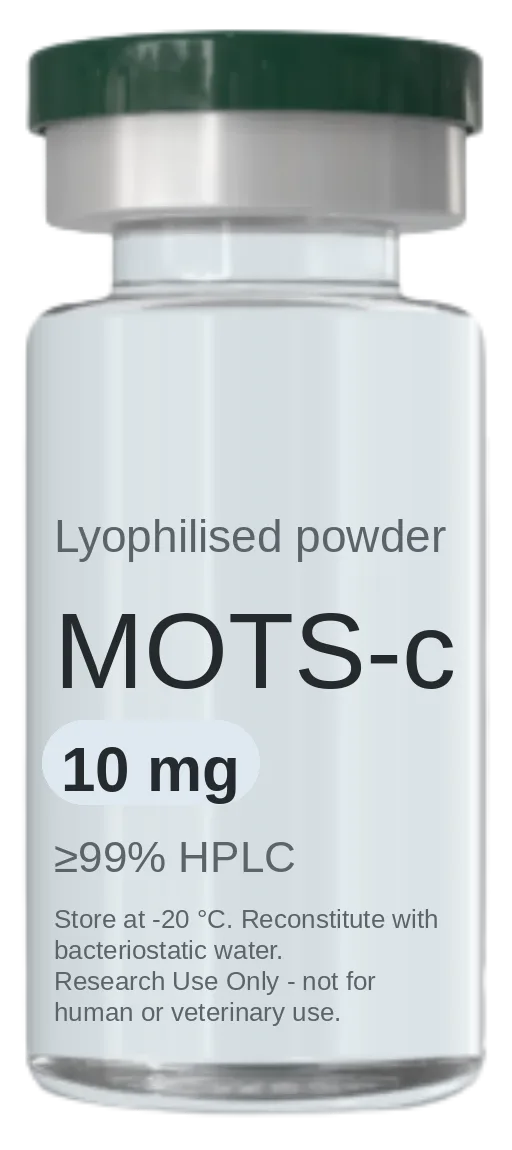
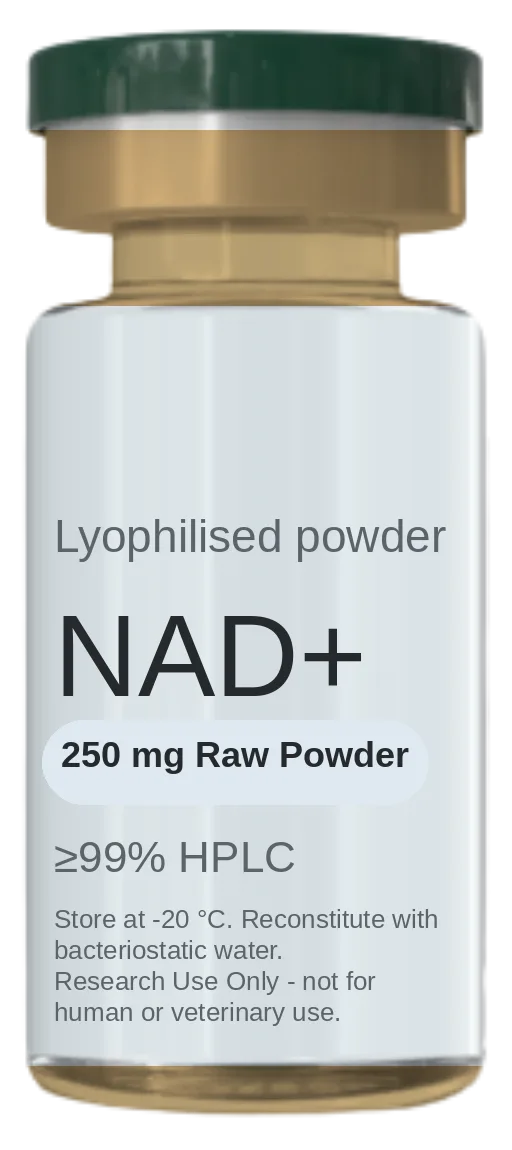
NAD+ (Nicotinamide Adenine Dinucleotide)
Essential redox cofactor central to cellular metabolism and sirtuin research.
- Purity:
- ≥99% HPLC
- Sizes available:
- 250 mg Raw Powder – 300 mg
The consultation
One intake that settles goals, history and contraindications alongside compound, quantity, documentation and route — reviewed by a physician before anything ships.
More notes
-
Tesamorelin vs Sermorelin: The Difference
Tesamorelin and sermorelin are both GHRH analogs, but not the same molecule. Here's the structural difference and what the studies on each measure.
-
Peptide Supplier vs. Reseller: What Differs
The real difference is whether someone can name the lab that tested a batch and show the report — or only promise it's pure.
-
Ipamorelin vs Sermorelin: Key Differences
Ipamorelin and sermorelin are research peptides with different structures and mechanisms: what the published literature reports on each.