
Note
What Is Tesamorelin: The GHRH Peptide
Tesamorelin is a synthetic 44-amino-acid GHRH analogue. PeptoClinic explains the published science and how to quote it as a research reagent.
Tesamorelin is a synthetic 44-amino-acid peptide that acts as an analogue of human growth hormone-releasing hormone (GHRH). It binds to the GHRH-R receptor in the anterior pituitary gland and triggers pulsatile secretion of growth hormone (GH). The feature that distinguishes tesamorelin from endogenous GHRH is a chemical modification at the amino terminus: a trans-3-hexenoic acid group conjugated to the initial tyrosine residue. That modification extends the molecule's plasma half-life well beyond the seconds that native GHRH survives in circulation.
Why the structural modification matters
The hypothalamus releases GHRH in pulses to drive GH secretion from the anterior pituitary. Native GHRH is fragile in plasma. Circulating peptidases — dipeptidyl peptidase IV (DPP-IV) in particular — cleave the N-terminal dipeptide (Tyr-Ala) within seconds of release. That fragility makes native GHRH difficult to use as a research reagent in protocols requiring sustained stimulation of the GH axis. Even in study designs where repeated injection is feasible, the rapid degradation means that effective exposure windows are narrow and dose-response relationships are hard to characterise cleanly.
Tesamorelin resolves that through the trans-3-hexenoic acid group conjugated to the initial tyrosine. The unsaturated aliphatic chain creates steric hindrance that blocks DPP-IV's preferred cleavage site. The 44-amino-acid sequence downstream from that conjugation is unchanged, so the molecule retains full agonist activity at GHRH-R. The result is a selective analogue with a half-life measured in minutes rather than seconds, with the same mechanism of action as human GHRH and a more tractable pharmacokinetic profile for research use.
That structural difference also separates tesamorelin from other GH secretagogues used in research. Ipamorelin acts on the ghrelin receptor (GHSR-1a), not on GHRH-R, and carries its own selectivity profile. Other GHRH analogues — sermorelin, which corresponds to the 1-29 fragment of the full GHRH sequence, and the CJC-1295 analogue — have their own structural modifications and pharmacokinetic profiles. The published literature treats them as distinct reagents, not interchangeable within a single research protocol. A study designed around tesamorelin's receptor kinetics and half-life cannot substitute sermorelin without altering what is being measured.
What the published literature investigates
The body of published research on tesamorelin has two main chapters, alongside several smaller exploratory lines.
The larger chapter concerns HIV-associated lipodystrophy. In that population, prolonged antiretroviral therapy frequently produces visceral abdominal fat accumulation that is metabolically active and associated with cardiovascular risk markers. Phase III multicentre trials evaluated tesamorelin's effect on visceral fat area measured by computed tomography; the primary results were published in The New England Journal of Medicine and reported statistically significant reductions versus placebo. Published evidence on tesamorelin and lipodystrophy is indexed on PubMed. On the basis of that evidence body, the US Food and Drug Administration approved tesamorelin — commercialised under the name Egrifta — in 2010 for that specific indication. The approval is circumscribed to that defined clinical context and does not extend to other uses.
The second chapter of research examines the GH/IGF-1 axis and cognitive function. Studies published in JAMA Neurology and in Psychoneuroendocrinology measured markers of executive function and working memory in adults with relative GH deficiency who received tesamorelin. Results across those studies are mixed and the field remains active. Literature on tesamorelin and cognition is available on PubMed. The mechanistic hypothesis underlying that line of investigation is that IGF-1, whose hepatic production is stimulated by GH, plays a role in neuronal maintenance; the studies test whether a GHRH analogue can shift that axis enough to produce measurable cognitive endpoints. Whether it can, and in which populations, remains an open question.
A third line of published work measured tesamorelin's impact on glucose and lipid metabolism. GH axis activation has documented effects on insulin sensitivity — GH is counter-regulatory to insulin — and several trials recorded fasting glucose, glycated haemoglobin and IGF-1 as secondary endpoints alongside body composition measures. Those studies were not designed to evaluate the molecule in healthy individuals without the clinical condition being studied; the metabolic data they generated reflects a specific patient population.
Beyond those three fronts, there are exploratory studies using tesamorelin as a tool to investigate the GH/IGF-1 axis in ageing models and in contexts of relative GH deficiency not associated with HIV. Most of the questions in that line remain open, and the trials published to date do not support firm conclusions about populations other than those actually studied.
How the reagent is supplied
Tesamorelin vials for research are supplied as lyophilised powder sealed under vacuum. That format is the industry standard for research peptides: it preserves molecular integrity during shipping and extends the reagent's shelf life before the vial is opened. Reconstitution and subsequent handling fall within the receiving laboratory's protocol.
PeptoClinic supplies tesamorelin as a research reagent to Argentina and to other destinations in the region. The process is a written quote on consultation: there is no published price. Each shipment includes the lot analysis documentation together with storage instructions for the laboratory. The declared purity standard for PeptoClinic catalogue reagents is ≥99% HPLC, verified by analysis from an independent external laboratory. Lot reports can be reviewed at the quality page before requesting a quote.
Shipments to Argentine destinations are prepared with customs documentation corresponding to laboratory reference material. Researchers with questions about what accompanies a lot — the analysis report, the certificate of identity, the storage conditions — can raise those before placing a quote request. PeptoClinic's technical team reviews the compound, purity specification, quantity, batch documentation and customs route as part of each consultation.
Strictly for laboratory research
All material PeptoClinic supplies — including tesamorelin — is classified Research Use Only (RUO): in vitro and laboratory research exclusively. Tesamorelin is not approved by any Argentine, US or equivalent health authority as a medicine available over the counter or by prescription outside the specific licensed indication.
PeptoClinic is not a pharmacy, not a clinic, and does not provide medical guidance of any kind. Inquiries requesting information about administration in persons, dosing or clinical protocols are declined. Material is quoted and supplied for research use only.
Frequently asked questions
What does Research Use Only mean for tesamorelin?
The RUO classification means the compound is supplied exclusively for in vitro and laboratory research. It is not approved or intended for human or veterinary consumption, for diagnosis, or for treatment of any condition. PeptoClinic supplies the material solely within that framework and declines inquiries requesting information about any other use.
How many amino acids does tesamorelin have, and what distinguishes it from native GHRH?
Tesamorelin has 44 amino acids, the same length as the complete human GHRH 1-44 sequence. The structural difference is at the N-terminus: the trans-3-hexenoic acid group conjugated to the initial tyrosine blocks DPP-IV's preferred cleavage site and extends the plasma half-life without altering agonist activity at the GHRH-R receptor.
How does tesamorelin differ from CJC-1295?
[CJC-1295](/en/product/cjc-1295-no-dac/) is also a GHRH analogue, but with amino acid substitutions at specific positions in the sequence that reduce enzymatic degradation through a different structural mechanism than tesamorelin's N-terminal conjugation. The published literature treats them as reagents with independent pharmacokinetic profiles, not interchangeable within the same experimental design.
What is the difference between tesamorelin and sermorelin?
[Sermorelin](/en/product/sermorelin/) corresponds to the GHRH 1-29 fragment — the minimum fragment retaining full agonist activity at the GHRH-R receptor. Tesamorelin retains all 44 amino acids of the complete GHRH sequence plus the N-terminal modification that extends its half-life. Both act at the same receptor, but they are structurally distinct molecules and the literature does not assume equivalence between their observed effects.
In what form is tesamorelin shipped as a research reagent?
As lyophilised powder sealed in a vial under vacuum. The lyophilisate is stable at controlled room temperature during shipping. Long-term storage and handling after reconstitution depend on the receiving laboratory's protocol.
Does PeptoClinic ship tesamorelin to Argentina?
PeptoClinic supplies tesamorelin as a laboratory reference material to destinations in Argentina. The order is handled through a personalised quote — there is no published price — and the shipment includes customs documentation corresponding to laboratory reference material. Material is not dispatched for use in persons.
Is tesamorelin the same as growth hormone?
No. Tesamorelin is the peptide that signals the pituitary to release growth hormone; it is not GH itself. It acts at the GHRH-R receptors in the anterior pituitary, and how much GH the body secretes in response depends on its own feedback mechanisms. Tesamorelin and GH are distinct molecules with distinct roles within the hypothalamic-pituitary axis.
What documentation ships with each lot of tesamorelin?
Each lot includes the results of purity and identity analysis conducted by an independent external laboratory. For lots in the current catalogue, analyses were performed by Janoshik Analytical. The corresponding reports are available for public review on the site's quality page before a quote is placed.
Compounds mentioned
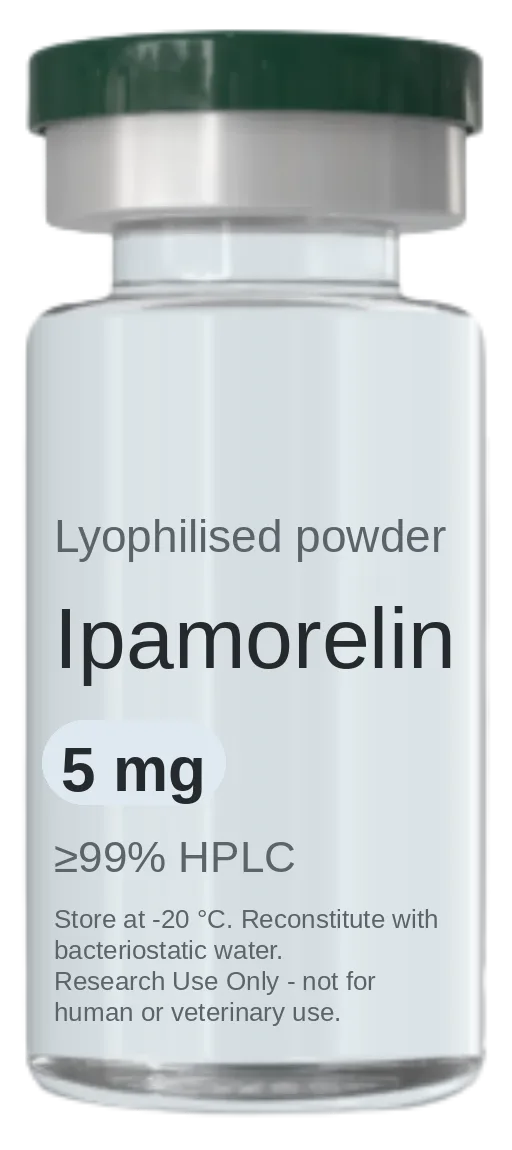
Ipamorelin
Selective ghrelin receptor (GHS-R1a) agonist pentapeptide.
- Purity:
- ≥99% HPLC
- Sizes available:
- 5 mg – 20 mg
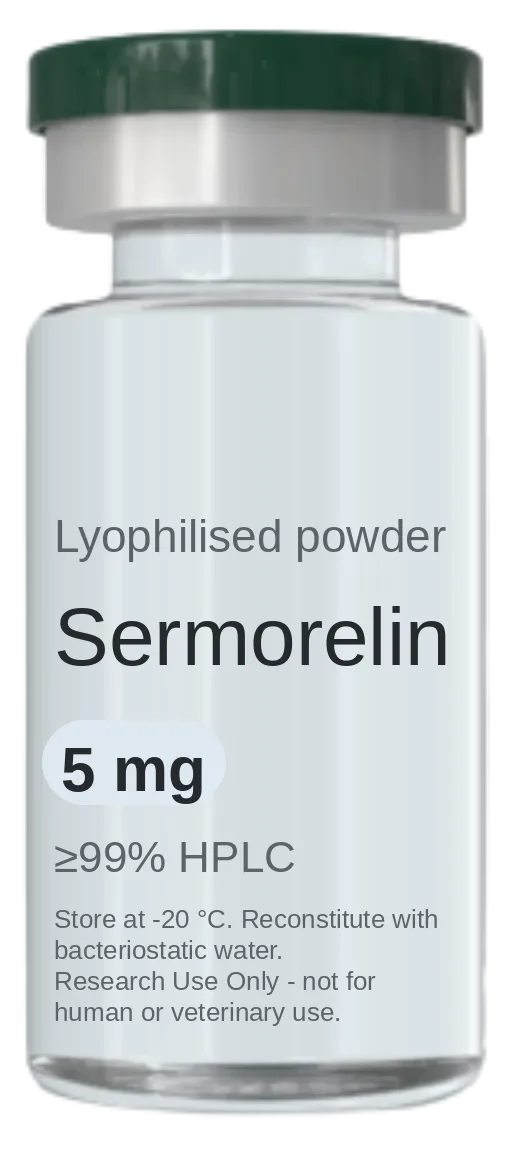
Sermorelin
Growth hormone-releasing hormone analogue used in endocrine signalling research.
- Purity:
- ≥99% HPLC
- Sizes available:
- 5 mg – 20 mg
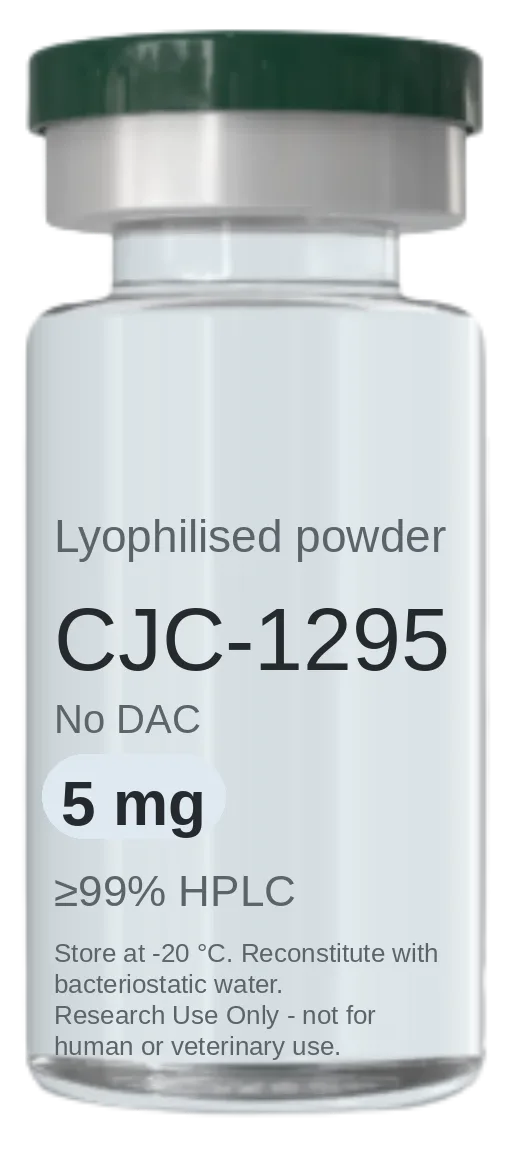
CJC-1295 (sin DAC)
Modified GRF(1-29) tetrasubstituted analogue without drug affinity complex.
- Purity:
- ≥99% HPLC
- Sizes available:
- 5 mg – 20 mg
The consultation
One intake that settles goals, history and contraindications alongside compound, quantity, documentation and route — reviewed by a physician before anything ships.
More notes
-
Thymosin Alpha 1 vs Selank: How They Differ
Thymosin Alpha 1 and Selank sit in different research families—one studied in immunomodulation, the other in the anxiolytic-cognitive axis.
-
Temporary Import Regime & Peptides
Temporary import covers goods that leave the country again; a research peptide shipment stays and gets used up.
-
Retatrutide vs GHK-Cu: What's the Difference
Retatrutide and GHK-Cu are different molecules studied for different reasons. Here's what each investigates and what documentation backs a batch.