
Note
Acetylation and Amidation in Peptide Termini
What Ac- at the start and -NH2 at the end of a peptide sequence mean, why they are applied, and how they change compound stability.
Acetylation and amidation are synthesis modifications that cap the ends of a peptide chain. N-terminal acetylation adds an acetyl group to the start of the sequence; in standard notation it appears as Ac- before the first amino acid. C-terminal amidation replaces the carboxyl group at the end with an amide group; it is written as -NH2 after the last amino acid. Both eliminate the ionizable charges at the termini and, according to peptide synthesis literature, reduce susceptibility to the exopeptidases that degrade peptides from the chain ends inward.
The two ends of a peptide chain
Every amino acid chain has two poles. The N-terminus is where the chain begins: a free amino group (-NH2) is exposed. The C-terminus is where it ends: a free carboxyl group (-COOH) is exposed. In an aqueous environment with dissolved salts, both groups ionize — the amino group tends to carry a positive charge, the carboxyl group a negative one.
Those charges have practical consequences. The free termini are the recognition sites for proteolytic enzymes that degrade peptides from the outside in: aminopeptidases act on the free N-terminus, and carboxypeptidases act on the free C-terminus. Both enzyme classes are present in serum, tissue, and intestine. A peptide with unprotected termini can have a short half-life when exposed to those environments, because the enzymes find an immediately available substrate. Blocking the termini removes the anchor point those enzymes depend on.
Solid-phase chemical synthesis permits either or both modifications to be incorporated before the peptide is cleaved from the resin support.
What N-terminal acetylation does
N-terminal acetylation is the addition of an acetyl group (CH3CO-) to the nitrogen of the first amino acid in the chain. This converts the free amino group into an acetamide group, eliminating the positive charge at that end. Aminopeptidases require a free alpha-amino group to anchor the substrate in their active site; once that group is blocked by the acetyl moiety, the enzyme no longer recognizes the terminus as a valid substrate.
This modification is not an artifact of synthetic chemistry. Proteomics studies published over the past two decades show that between 80 and 90 percent of mature human proteins are N-terminally acetylated in vivo, catalyzed by a class of enzymes called N-acetyltransferases (NATs) co- or post-translationally. The relevant literature is indexed in PubMed for anyone tracing primary sources. Chemical synthesis reproduces that state through a controlled acetylation reaction carried out directly on the solid support.
In sequence notation, Ac- in front of the first amino acid indicates that terminus is acetylated in the batch.
What C-terminal amidation does
C-terminal amidation replaces the -COOH group of the last amino acid with an amide group (-CONH2). The negative charge at the C-terminus disappears, and carboxypeptidases lose the carboxylate anchor they need to begin degrading the chain from that end.
This modification also has a biological counterpart. Many bioactive peptides identified in mammalian tissue carry a C-terminal amide: oxytocin, vasopressin, gastrin, and amylin are examples documented in the literature for decades. In vivo, the modification is catalyzed by PAM (peptidylglycine alpha-amidating monooxygenase), whose mechanism is described in studies indexed in PubMed. In synthetic chemistry, it is achieved by selecting a resin type that releases an amide group when the protecting groups are removed at the end of synthesis.
The notation -NH2 at the end of a sequence — or the suffix -amide — indicates the C-terminus was amidated during synthesis.
Reading the notation on a compound datasheet
A peptide carrying both modifications is written:
Ac-[amino acid sequence]-NH2
The prefix marks the acetylated N-terminus; the suffix marks the amidated C-terminus. A peptide without either modification appears as H-[sequence]-OH, where H- represents the free amino group and -OH the free carboxyl. If only one modification is present, the notation reflects that: Ac-[sequence]-OH has a blocked N-terminus but a free C-terminus; H-[sequence]-NH2 has an amidated C-terminus but a free N-terminus.
The mass difference between an unmodified peptide and one carrying both modifications is measurable by mass spectrometry. The acetyl group adds exactly 42.04 Da. Replacing the carboxyl hydroxyl with an amide group adjusts the mass by -0.98 Da. A certificate of analysis that includes a mass spectrometry reading allows verification that the declared modifications are present in a specific batch: if the measured mass matches the theoretical mass for the modified sequence, the compound identity is confirmed for that lot. The documentation included with each batch from PeptoClinic Research Supply is described in the quality section.
Catalogue compounds carrying these modifications
Several compounds in the PeptoClinic catalogue are synthesized with one or both terminal modifications.
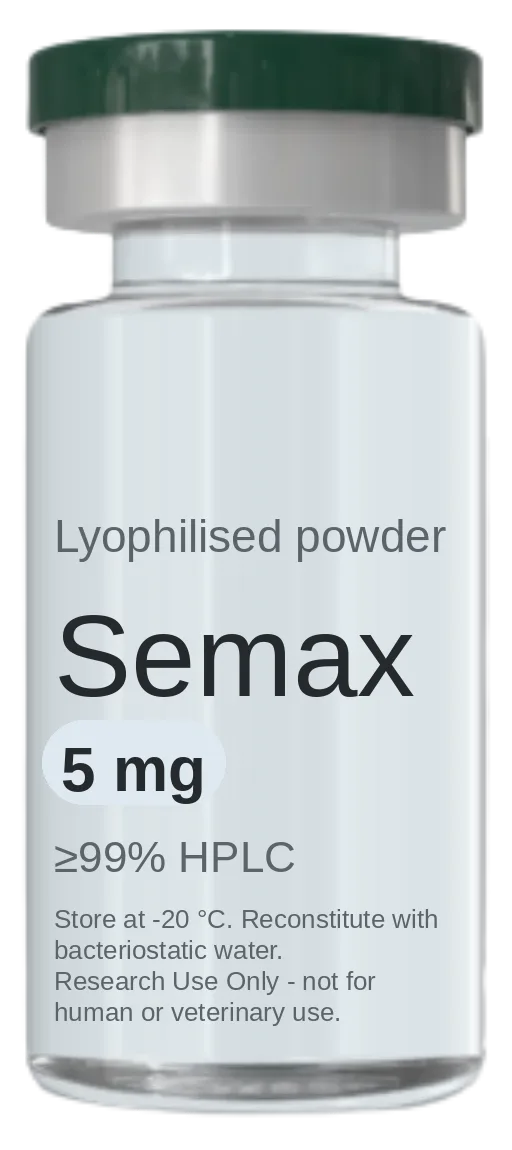
Semax — the heptapeptide Met-Glu-His-Phe-Pro-Gly-Pro — carries both. Its published formula is Ac-Met-Glu-His-Phe-Pro-Gly-Pro-NH2: N-terminally acetylated and C-terminally amidated. Both modifications are part of the chemical identity of the compound; changing either produces a different molecule.
Ipamorelin carries C-terminal amidation; the sequence ends in -NH2 and that is stated in the batch identity specification. Sermorelin, the synthetic analogue of the first 29 amino acids of human GHRH, also carries a C-terminal amide according to its published sequence in the literature.
If the reference used to design an experiment specifies a compound with Ac- and -NH2, that is the compound to request. A batch of the same core sequence without those modifications is a chemically distinct compound, and results from one are not directly comparable to results from the other.
For laboratory research only
All material supplied by PeptoClinic Research Supply is intended exclusively for laboratory research (Research Use Only, RUO): in vitro assays and preclinical studies. No compound in the catalogue has been approved for use in humans or animals by any regulatory authority. PeptoClinic Research Supply is not a pharmacy, does not manufacture medicines, and does not provide guidance on administration. Shipping conditions to Argentina and other served destinations, along with the quote process, are available on the shipping page.
Frequently asked questions
Are acetylation and amidation artificial modifications or do they also occur in nature?
Both occur in nature. Between 80 and 90 percent of mature human proteins are N-terminally acetylated in vivo, and several bioactive peptides identified in mammalian tissue — including oxytocin, vasopressin, gastrin, and amylin — carry C-terminal amidation. Chemical synthesis reproduces those modifications in a controlled and quantifiable way.
How does a certificate of analysis confirm that the modifications are present?
The certificate includes a molecular mass measured by mass spectrometry. The theoretical mass of a peptide carrying Ac- is 42.04 Da higher than the unmodified version; amidation adjusts the mass by -0.98 Da. If the measured mass matches the theoretical mass for the sequence with the declared modifications, those modifications are confirmed present in that specific batch.
Does a peptide without terminal modifications have lower purity?
No. HPLC purity measures what fraction of the material in the vial corresponds to the declared compound, and that is independent of whether the compound carries terminal modifications or not. A peptide without Ac- or -NH2 can have exactly the same HPLC purity as one with both modifications: they are distinct molecular properties.
Can the same core sequence be ordered with and without terminal modifications?
It depends on the compound. Some, like Semax, are defined in the published literature with their modifications as part of the identity — there is no published unmodified variant. Others have documented unmodified variants. When requesting a quote, the exact sequence including terminal modifications must be specified, and the technical team confirms availability.
Is the peptide salt form (TFA, acetate) related to N-terminal acetylation?
They are not the same thing. The salt form refers to the counter-ion accompanying the peptide in the vial — trifluoroacetate and acetate are the most common — and can be changed without altering the peptide chain. N-terminal acetylation is a covalent modification that is part of the compound's sequence. A certificate of analysis specifies both separately.
Is C-terminal amidation the same as an ammonium salt?
No. Amidation is a covalent modification of the C-terminus: the amide group is bonded directly to the carbon of the last amino acid and does not dissociate in solution. An ammonium salt is a counter-ion that accompanies the peptide in the vial and is not part of the peptide chain. A certificate of analysis distinguishes the two clearly.
Are two peptides with the same core sequence but different terminal modifications the same compound?
No. The chemical identity of a peptide includes its termini. A peptide carrying Ac- and -NH2 has a different molecular mass and a different charge profile than the same core sequence without those modifications, and may behave differently in an assay. If a bibliographic reference specifies the modified version, that is the version to request.
Where can I find the certificates of analysis for available batches?
Certificates of analysis are published in the [quality section of the PeptoClinic site](/en/quality/). Each certificate includes the laboratory task number, the date of analysis, the HPLC purity measurement, and mass spectrometry data confirming the identity of the specific batch.
Compounds mentioned
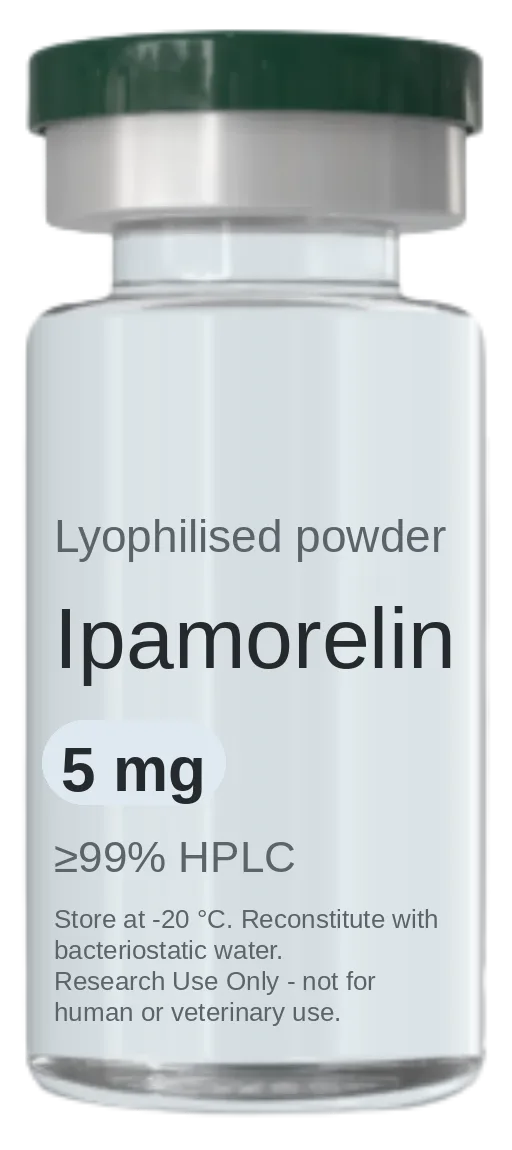
Ipamorelin
Selective ghrelin receptor (GHS-R1a) agonist pentapeptide.
- Purity:
- ≥99% HPLC
- Sizes available:
- 5 mg – 20 mg
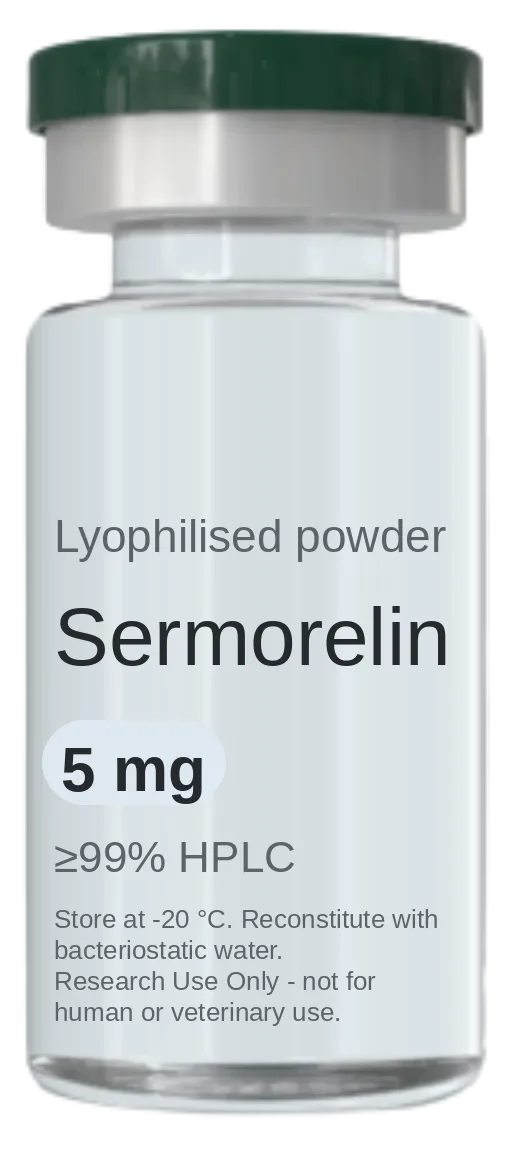
Sermorelin
Growth hormone-releasing hormone analogue used in endocrine signalling research.
- Purity:
- ≥99% HPLC
- Sizes available:
- 5 mg – 20 mg
The consultation
One intake that settles goals, history and contraindications alongside compound, quantity, documentation and route — reviewed by a physician before anything ships.
More notes
-
No Certificate of Analysis, No Peptides
What it means when a research peptide supplier can't produce the batch-specific certificate of analysis, and why that gap alone is disqualifying.
-
Bonded Warehouse Deadline Before Abandonment
Argentine customs gives importers roughly 90 days to clear research peptides from bonded storage before the lot is declared abandoned.
-
What Is Argentina's Statistics Fee?
Argentina's statistics fee adds to the cost of importing a research peptide: what it taxes, how it's calculated, and what paperwork matters.