
Note
How to Calculate Peptide Concentration
The concentration of a reconstituted peptide depends on actual vial content from the certificate of analysis, not the nominal label figure.
The concentration of a reconstituted peptide is calculated by dividing the actual peptide mass — in milligrams — by the volume of diluent added — in millilitres. The result is a concentration in mg/mL. That is the arithmetic. What makes the calculation demanding in practice is not the division itself but confirming that the starting mass is correct: the actual peptide content of a vial almost never matches the number printed on its label.
Why vial content differs from the label
A lyophilised peptide vial carries a nominal quantity on its label — the mass weighed before freeze-drying. That nominal figure is not the same as the mass of active peptide present in the resulting powder.
Two factors account for the difference.
The first is counter-ion weight. Most synthetic peptides are produced as salts — acetate or trifluoroacetate (TFA) — and the counter-ion contributes to the total weight of the powder. An HPLC analysis reports the main peak area percentage against the full chromatogram; everything else — counter-ion, residual moisture, minor impurities — is included in the weighed mass but is not peptide.
The second is residual moisture. Lyophilisation removes most water but not all of it. Depending on the process, a small fraction remains trapped in the powder.
Combined, these factors mean the actual peptide mass in a vial can differ from the nominal label by ten to thirty percent, depending on the compound and the lot.
A certificate of analysis resolves this directly. A properly issued certificate reports the actual content: how many milligrams of peptide are present in the vial after correcting for counter-ion and moisture, as quantified by HPLC. In the Retatrutide lot that Janoshik Analytical analysed on 13 April 2026 (Task 136921), a vial labelled 10 mg contained 11.96 mg of actual peptide. In the MOTS-c lot analysed the same day (Task 136923), the actual content was 11.31 mg against the same nominal label. Using the label figure rather than the certificate figure introduces a systematic error of fifteen to twenty percent in every calculation that follows.
Reading the content figure from the certificate
In a peptide synthesis certificate of analysis, two fields feed the concentration calculation.
HPLC purity: the percentage of the main peak area in the chromatogram. This describes how clean the sample is. It is not, by itself, the peptide mass present in the vial.
Content: the actual mass of peptide in the analysed sample, corrected for purity, counter-ion and moisture. This is the number that enters the concentration calculation directly.
When a certificate reports purity but does not give a separate content figure, one additional step is required: multiply the total weighed mass of the vial by the purity percentage expressed as a decimal.
Actual mass = total vial mass × (purity / 100)
If a vial weighs 10.8 mg and purity is 97.4 %, the actual peptide mass is 10.8 × 0.974 = 10.52 mg.
The lot certificates for compounds available from PeptoClinic are published in the quality section, together with verification links to Janoshik Analytical for those reports that carry a working public URL.
Step-by-step calculation
Step 1. Obtain the actual peptide mass from the certificate. If the certificate provides a "Content" field directly, that figure is the mass. If it gives only total mass and purity percentage, apply the correction above.
Step 2. Set the diluent volume. In laboratory research, this depends on the concentration range the assay requires and on the precision of the pipettes available for handling small volumes accurately.
Step 3. Calculate the concentration.
Concentration (mg/mL) = actual mass (mg) / diluent volume (mL)
A vial containing 11.96 mg of Retatrutide reconstituted in 2 mL of diluent yields a stock concentration of 5.98 mg/mL.
Step 4. Convert units if the assay protocol requires them.
The conversion between mg/mL and µg/µL is direct: the numerical value is identical, because 1 mg/mL equals 1 µg/µL.
To convert to nmol/mL:
Concentration (nmol/mL) = concentration (mg/mL) × 1000 / MW (g/mol)
The molecular weight (MW) of each peptide appears in its certificate of analysis and in the product data in the catalogue. For Retatrutide, whose MW is approximately 4,541 g/mol, a 5.98 mg/mL solution is approximately 5.98 × 1000 / 4541 ≈ 1.32 nmol/mL. For BPC-157 (MW ≈ 1,419 g/mol), a 1 mg/mL solution is approximately 1000 / 1419 ≈ 0.70 nmol/mL. Molecular weight data are available on the individual product pages for Retatrutide and BPC-157.
Working dilutions from stock
Once the stock solution is prepared and its concentration calculated, most assay protocols require working solutions at lower concentrations. The dilution equation is:
C₁ × V₁ = C₂ × V₂
where C₁ and V₁ are the concentration and volume of the starting solution, and C₂ and V₂ are the target concentration and volume of the final solution.
To prepare 1 mL of a 0.1 mg/mL working solution from a 5 mg/mL stock:
V₁ = (C₂ × V₂) / C₁ = (0.1 mg/mL × 1 mL) / 5 mg/mL = 0.02 mL = 20 µL
Take 20 µL of the stock and bring to 1 mL with fresh diluent.
When the assay requires concentrations spanning several orders of magnitude, serial dilutions are the standard laboratory approach: each step dilutes the product of the previous one by a fixed factor. A 1:10 serial dilution repeated four times generates concentrations at 1, 0.1, 0.01, 0.001 and 0.0001 of the original stock — the format most commonly used for dose-response curves in in vitro assays.
Diluents used in peptide research
The choice of diluent affects both peptide solubility and the stability of the reconstituted solution. The most commonly used options in laboratory research are:
- Bacteriostatic water (BAC water): sterile water containing a bacteriostatic agent — typically benzyl alcohol or benzethonium chloride. It inhibits bacterial growth in the reconstituted solution and is the standard diluent for most lyophilised peptides. PeptoClinic stocks USP-grade bacteriostatic water; details are on the BAC water product page.
- Water for injection (WFI): highly purified water without preservatives. Used when the bacteriostatic agent may interfere with a specific assay.
- Normal saline (0.9 % NaCl): for peptides requiring an isotonic environment in the assay system.
- Dilute acetic acid (0.1–1 %): for basic peptides with poor solubility in neutral water, common in arginine- or lysine-rich sequences.
Some peptides with low aqueous solubility require an initial dissolution step in a water-miscible organic solvent — DMSO is frequently used — before final dilution into the aqueous assay medium. That step depends on the physicochemical properties of the specific compound and the requirements of the protocol.
For laboratory research only
All material supplied by PeptoClinic is for Research Use Only (RUO): in vitro and laboratory research applications exclusively. None of it is approved or intended for human or veterinary consumption, diagnosis or treatment. No regulatory authority — the FDA, ANMAT or any equivalent — has evaluated these compounds for clinical or veterinary use. PeptoClinic is not a pharmacy, a clinic, or a source of administration or dosing guidance. The full catalogue of compounds available for shipment is listed on the Argentina page for researchers in that destination.
Frequently asked questions
Why does the actual peptide content in a vial differ from its label?
The label weight is the nominal quantity weighed before lyophilisation. The resulting powder contains the peptide plus the counter-ions of the salt form — acetate or TFA — and residual moisture. HPLC analysis quantifies only the peptide peak and produces the corrected figure that should be used as the starting mass in any concentration calculation.
Which field on the certificate of analysis should I use?
Use the "Content" field, which reports the actual peptide mass in the analysed sample after correcting for purity, counter-ion and moisture. If the certificate provides only purity, multiply the total vial mass by the purity percentage expressed as a decimal to obtain the actual peptide mass.
Why does a Retatrutide vial labelled 10 mg contain 11.96 mg according to the certificate?
The Janoshik Analytical report from 13 April 2026 (Task 136921) found 11.96 mg of actual peptide in that vial. The difference reflects normal variation in the weighing and lyophilisation process. Using 10 mg from the label instead would introduce a systematic underestimate of approximately 16 % in the stock concentration, compounding into every dilution prepared from that vial.
How do I convert a concentration from mg/mL to nmol/mL?
Divide the concentration in mg/mL by the molecular weight of the peptide in kDa and multiply by 1000, or equivalently: nmol/mL = (mg/mL × 1000) / MW (g/mol). The molecular weight for each compound is given in its certificate of analysis and on its product page in the catalogue.
Do freeze-thaw cycles affect the calculated concentration?
The concentration as a ratio of mass to volume does not change with freezing itself. What repeated freeze-thaw cycles can reduce is peptide integrity through partial degradation, which lowers the amount of active peptide in solution over time without affecting the arithmetic of the initial calculation. Standard laboratory practice is to prepare single-use aliquots before freezing, minimising the number of cycles any given portion undergoes.
What is a serial dilution and when is it used in peptide assays?
A serial dilution is a sequence of dilutions in which each step uses the product of the previous one, applying a constant factor. It is the standard method when an assay requires concentrations spanning several orders of magnitude. A 1:10 serial dilution repeated four times yields concentrations in the ratio 1 : 0.1 : 0.01 : 0.001 : 0.0001 relative to the starting stock — a format common in concentration-response curves in in vitro experiments.
What diluent is appropriate when a peptide has poor aqueous solubility?
For basic peptides, dilute acetic acid at 0.1–1 % typically improves solubility. For peptides with a high proportion of hydrophobic residues, an initial dissolution step in a water-miscible organic solvent such as DMSO followed by dilution into the aqueous assay medium is often required. The compound's supplier can advise on specific solubility conditions for a given peptide based on its sequence and physicochemical properties.
How do I verify that PeptoClinic's certificates of analysis are authentic?
The lot certificates for published compounds are available in the [quality section of the PeptoClinic site](/en/quality/). Two of the four carry a working direct verification link to the Janoshik Analytical database. The other two include the Task number of the analysis, which the laboratory can cross-reference upon direct inquiry.
Compounds mentioned
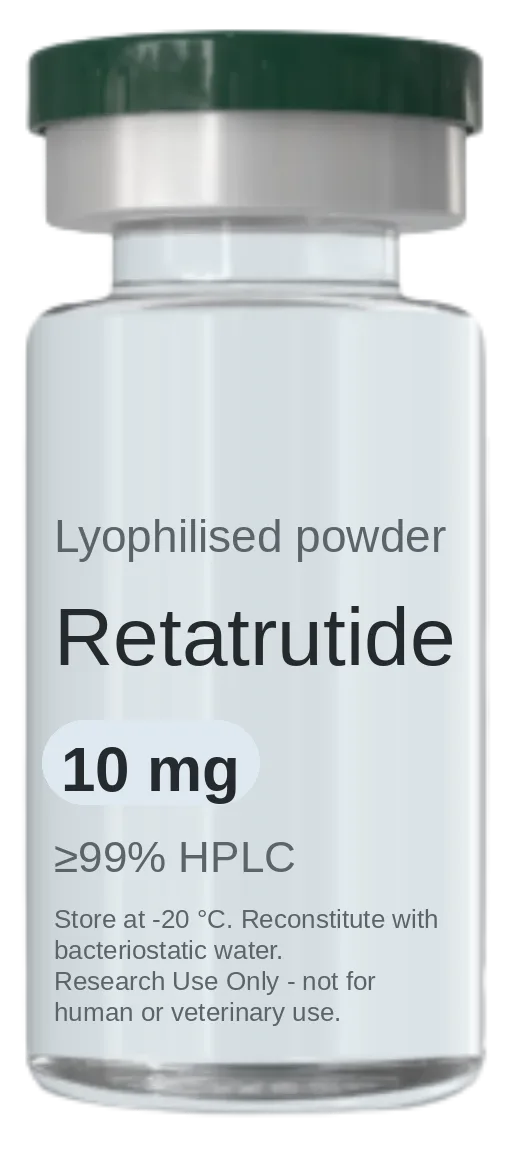
Retatrutide
Triple-agonist metabolic research peptide targeting GLP-1, GIP and glucagon receptors.
- Purity:
- ≥99% HPLC
- Sizes available:
- 10 mg
BPC-157 + TB-500
BPC-157 and TB-500 in a single vial — the pairing most studied together in tissue-repair research.
- Purity:
- ≥99% HPLC
- Sizes available:
- 5 mg + 5 mg
The consultation
One intake that settles goals, history and contraindications alongside compound, quantity, documentation and route — reviewed by a physician before anything ships.
More notes
-
Retatrutide or Semaglutide: Key Differences
Retatrutide is a triple GLP-1/GIP/glucagon agonist; semaglutide activates only GLP-1. How the research literature compares them.
-
Peptide Consigned to a Company in Argentina
What changes at Argentine customs when a research peptide is consigned to a company instead of an individual, and what paperwork ships with it.
-
Retatrutide vs. Tirzepatide: Differences
Retatrutide adds a third receptor that tirzepatide doesn't activate — here's how the two differ in structure, mechanism, and published research.