
Note
Is PT-141 the Same as Vyleesi?
By the PeptoClinic editorial team · Medically reviewed by Dr. Emily Parker
PT-141 and Vyleesi both contain bremelanotide. Here's what's different: one received FDA approval, one didn't, and why that matters when buying it.
PT-141 and Vyleesi contain the same active molecule, bremelanotide. That's where the overlap ends: Vyleesi is a prescription drug that received FDA approval for a specific condition, while PT-141 sold as a research compound is not that product, is not approved for any use, and carries none of the manufacturing or dispensing requirements that come with a prescription medication.
PT-141 vs. Vyleesi, side by side
| Aspect | PT-141 (research peptide) | Vyleesi |
|---|---|---|
| Active molecule | Bremelanotide | Bremelanotide — the same molecule |
| FDA status | Not approved by the FDA | Received FDA approval |
| Approved indication | None | Acquired hypoactive sexual desire disorder in premenopausal women, based on two phase 3 trials (Kingsberg et al., Obstet Gynecol 2019) |
| Receptor class | Melanocortin receptor agonist | Melanocortin receptor agonist |
| Form sold | Lyophilized powder in a sealed vial | Fixed-dose prescription product |
| How it's obtained | Through a reviewed consultation at a supplier's catalog | By prescription from a licensed clinician |
| Clinical evidence behind the product | None generated independently for the research vial | The two phase 3 trials cited above |
What is PT-141, exactly?
PT-141 is the laboratory name for bremelanotide, a synthetic peptide studied as a melanocortin receptor agonist. When it's listed in a research catalog, it's sold as the bare molecule: a vial of lyophilized powder, without a brand, a dosing device, or a package insert. That's the form in which most peptide suppliers, including PeptoClinic's catalog, carry it.
What is Vyleesi?
Vyleesi is the brand name under which bremelanotide received FDA approval, specifically for acquired hypoactive sexual desire disorder in premenopausal women. The approval rests on two phase 3 trials that evaluated the compound in that population (Kingsberg et al., Obstet Gynecol 2019). Vyleesi is a finished pharmaceutical product: it comes with a specific formulation, a delivery device, manufacturing controls, a label, and post-approval monitoring, none of which exist for a compound sold as research material.
So is PT-141 "the same" as Vyleesi?
Chemically, the molecule is identical. As products, they are not interchangeable, and this is the distinction worth sitting with rather than collapsing into a yes-or-no answer:
- The molecule (bremelanotide) is the same substance whether it's in a Vyleesi auto-injector or a research vial.
- The product is different. Vyleesi went through the FDA's approval process for one specific indication, with clinical trial data, manufacturing oversight, and a package insert that covers that use. A vial of PT-141 sold for research has none of that behind it — no approval, no package insert, no indication.
- The regulatory standing is different, too. Vyleesi is a prescription medication. PT-141 as sold in research catalogs is not a prescription drug and is not marketed as one.
This same gap — one molecule, two very different regulatory lives — shows up across the peptide catalog, not just with bremelanotide. Tirzepatide is the molecule behind Zepbound, which received FDA approval for chronic weight management in 2023 after trials showing substantial weight reduction (FDA, 2023). Tesamorelin is the molecule behind Egrifta, approved after trials in people with HIV and excess abdominal fat (Falutz et al., NEJM 2007). In each case, the branded, approved drug and the research-grade vial of the same molecule are not the same product, even though a chemist would describe them with the same structure.
Is PT-141 legal to buy in the United States?
Bremelanotide itself is not a controlled substance. What distinguishes PT-141 from Vyleesi legally is that Vyleesi went through FDA review for a defined use and PT-141, sold as a research peptide, did not. Buying the research compound is not the same transaction as filling a prescription, and it doesn't carry the clinical backing, labeling, or physician-directed use that comes with Vyleesi. PeptoClinic's material for this and every other compound in the catalog is reviewed through a consultation before it ships, and purity is confirmed against a lab report rather than against a pharmacy standard, which is a different kind of assurance than FDA approval provides. Current catalog pricing is listed on the pricing page.
Why does a supplier sell the same molecule as an approved drug?
Because the chemistry research on a peptide usually predates — and continues alongside — any branded product built on it. Bremelanotide was studied in multiple trial populations before and after Vyleesi's approval, and the molecule itself remains a subject of ongoing pharmacology research independent of that one approved indication. A research supplier sells the compound for that research interest; it does not sell, substitute for, or claim equivalence to the approved drug.

Medical review
Dr. Emily Parker

Reviews every consultation as it comes in
Frequently asked questions
Is PT-141 just bremelanotide under a different name?
Yes. PT-141 is the laboratory designation researchers and suppliers use for the peptide bremelanotide; it's the same chemical entity, just not sold as a finished pharmaceutical product.
Why would a research catalog list a molecule that already has an approved drug built on it?
Because the compound itself is still a subject of pharmacology research independent of any one product. The existence of Vyleesi doesn't close off bremelanotide as a research molecule; it simply means one specific formulation and indication went through FDA review.
Does PT-141 carry the same clinical trial data as Vyleesi?
No. The two phase 3 trials cited for Vyleesi's approval were conducted on the finished pharmaceutical product in a defined patient population ([Kingsberg et al., Obstet Gynecol 2019](https://pubmed.ncbi.nlm.nih.gov/31599840/)). A vial of PT-141 sold as research material doesn't carry that trial data as proof of anything about itself; the data belongs to the approved drug and the population it was studied in.
Is PT-141 approved by the FDA for any use?
No. Only Vyleesi, the branded formulation of bremelanotide, received FDA approval, and only for acquired hypoactive sexual desire disorder in premenopausal women. PT-141 as sold through a research catalog is not approved for that or any other use.
What's the difference between PT-141 and Melanotan II?
They're different molecules in the same melanocortin receptor family. PeptoClinic lists them as separate catalog entries because they are not interchangeable compounds, even though both act on related receptors.
Can men purchase PT-141?
Vyleesi's FDA approval is specific to premenopausal women with a diagnosed condition. That's a statement about what the approved drug is indicated for, not a statement about who can obtain a research compound through a consultation; the two questions — approved indication versus research availability — are separate.
Is every batch of PT-141 tested before it ships?
PeptoClinic publishes lab purity reports for catalog compounds and reviews consultations before anything ships; details on testing are on the [quality page](/en/quality/).
Does PeptoClinic sell Vyleesi?
No. PeptoClinic's [catalog](/en/catalog/) lists bremelanotide as a research compound, PT-141. Vyleesi is a separate, branded prescription product dispensed through a pharmacy, not something sold here.
Compounds mentioned
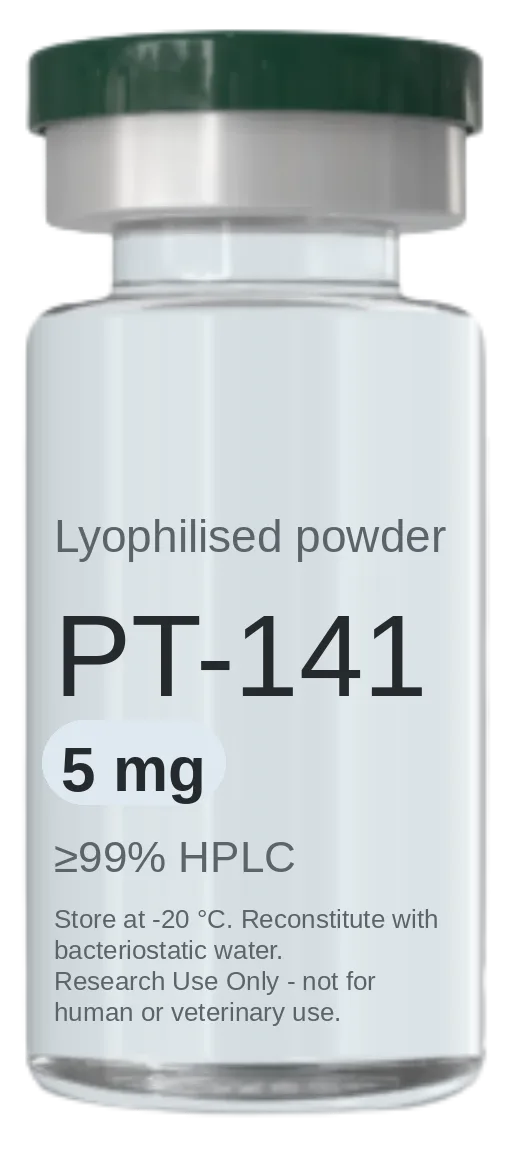
PT-141 (Bremelanotide)
Melanocortin receptor agonist studied in central nervous system signalling.
- Purity:
- ≥99% HPLC
- Sizes available:
- 5 mg – 10 mg
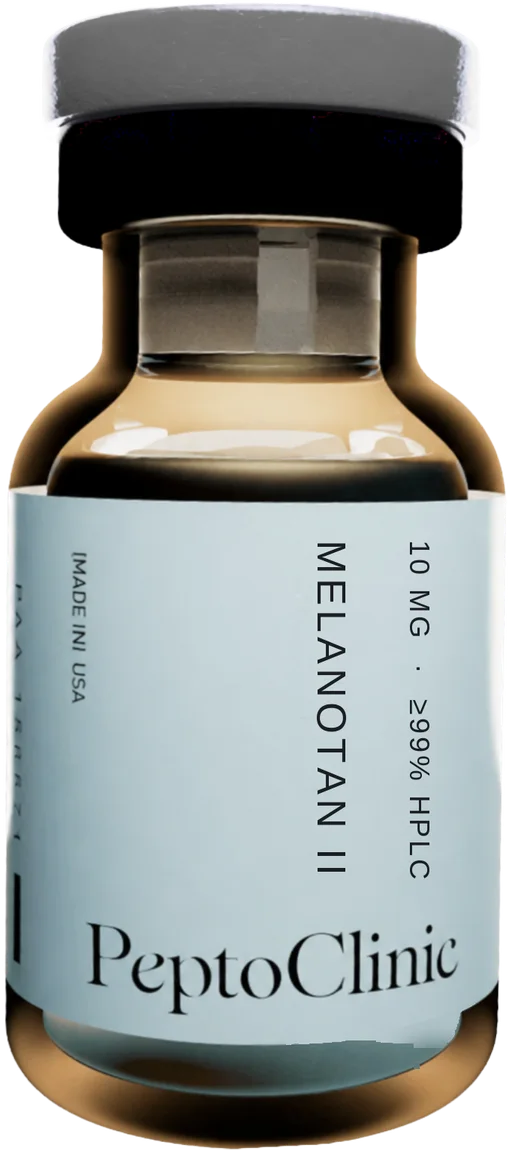
Melanotan II
Cyclic α-MSH analogue that activates several melanocortin receptors.
- Purity:
- ≥99% HPLC
- Sizes available:
- 10 mg
The consultation
One intake that settles goals, history and contraindications alongside compound, quantity, documentation and route — reviewed by a physician before anything ships.
More notes
-
Mod GRF 1-29 and CJC-1295: Are They the Same?
Mod GRF 1-29 is the same compound as CJC-1295 without DAC. CJC-1295 with DAC is a different molecule. Here is how to tell them apart.
-
What Is an Endotoxin Test in Peptides
An endotoxin test measures bacterial LPS in a peptide sample. What the LAL assay detects and how to read EU/mg values on a certificate of analysis.
-
Bacteriostatic Water vs. Sterile Water
The difference between bacteriostatic and sterile water: preservatives, multi-dose vials, and assay compatibility.
-
Acetylation and Amidation in Peptide Termini
What Ac- at the start and -NH2 at the end of a peptide sequence mean, why they are applied, and how they change compound stability.
-
Racemization in Peptide Synthesis
Racemization converts L-amino acids to their D-form during synthesis, altering peptide structure and compromising experimental reproducibility.