
Note
Mod GRF 1-29 and CJC-1295: Are They the Same?
Mod GRF 1-29 is the same compound as CJC-1295 without DAC. CJC-1295 with DAC is a different molecule. Here is how to tell them apart.
Mod GRF 1-29 and CJC-1295 without DAC are the same compound. CJC-1295 with DAC is a different molecule. The confusion arises because the research supply market uses "CJC-1295" to name both, often without any clarification. The distinction comes down to one structural feature: the DAC, or Drug Affinity Complex, and whether it is present in the peptide.
What Mod GRF 1-29 Is
Mod GRF 1-29, also written Modified GRF 1-29, is a modified version of the first 29 amino acids of human GHRH — growth hormone-releasing hormone. The modification consists of four amino acid substitutions at specific positions in the chain. Those substitutions are designed to improve the peptide's stability against enzymatic degradation, compared to the original GHRH(1-29) fragment.
The result is a short-acting analog. Studies in animal models measure plasma clearance in minutes after administration. That positions it as a brief-acting peptide within the family of GHRH analogs investigated in laboratory settings.
In supplier catalogues for research materials, Mod GRF 1-29 and CJC-1295 without DAC are the same product. Both names coexist because the research literature adopted "Modified GRF 1-29" while the market took "CJC-1295 without DAC" as a direct synonym.
What CJC-1295 Is
CJC-1295 was developed by ConjuChem Biotechnologies. The compound incorporates a technology called the Drug Affinity Complex (DAC): a chemical moiety that covalently bonds to serum albumin, the most abundant protein in plasma.
That bond converts the peptide into a circulating reservoir. Studies by ConjuChem in phase I and II trials — including the work by Teichman and colleagues published in the Journal of Clinical Endocrinology & Metabolism — recorded sustained elevations of GH and IGF-1 over several days from a single subcutaneous dose in healthy adults. The measured half-life in those studies exceeded six days.
CJC-1295 with DAC is, from a chemical standpoint, a different compound from Mod GRF 1-29. Both share the 29-amino-acid base, but the DAC distinguishes them in both structure and pharmacokinetic behavior.
The Practical Difference: The DAC
The distinction between the two compounds reduces to one fact: does it have the DAC or not?
- Without DAC: the peptide clears rapidly from plasma, with a half-life measured in minutes. This is what is sold as Mod GRF 1-29 or CJC-1295 without DAC.
- With DAC: albumin binding extends the half-life to days. This is what ConjuChem named CJC-1295.
What creates confusion is that many suppliers sell the compound without DAC under the name "CJC-1295," omitting the "without DAC" or "no DAC" qualifier. When the catalogue does not clarify, it is not possible to know which compound is being supplied without reading the certificate of analysis or the lot data sheet.
A supplier that does not distinguish the two molecules by name and in documentation does not provide transparency about what it supplies. In research settings that matters: protocols designed for CJC-1295 with DAC are not applicable to the compound without DAC, and vice versa.
How to Identify Which Compound Is Which in Documentation
A certificate of analysis issued by an independent laboratory should state the compound's IUPAC name or the full amino acid sequence with the modifications applied. If the compound is Mod GRF 1-29 or CJC-1295 without DAC, the material description will contain no reference to the Drug Affinity Complex. If it is CJC-1295 with DAC, the DAC moiety appears named in the documentation.
The name of the laboratory that issued the report, the task number of the analysis, and the date of the analysis are the three pieces of information that allow independent verification of the material's identity. Janoshik Analytical is one of the laboratories that publishes its reports with a verifiable task number. The current lot reports are available on PeptoClinic's quality page.
If a supplier does not provide a CoA issued by an external laboratory with an identifiable task number, there is no way to confirm what compound the vial contains.
Alternative Names in the Literature
The proliferation of names for the same compound is characteristic of synthetic peptide research, where commercial nomenclature, the original molecule name, and research aliases coexist without standardization.
For the compound without DAC, the most common names are:
- Mod GRF 1-29
- Modified GRF 1-29
- CJC-1295 without DAC / CJC-1295 no DAC
- Tetrasubstituted GRF (1-29)
For the compound with DAC:
- CJC-1295
- CJC-1295 with DAC
- CJC-1295 DAC
The presence of the word "DAC" is the clearest marker. Its absence does not guarantee the compound is the without-DAC version — explicit confirmation in the lot documentation is still required.
Relationship to Other GHRH Analogs
The GHRH analog family includes several compounds with distinct sequences and pharmacological profiles. Sermorelin is the GHRH(1-29) fragment without the four substitutions characteristic of Mod GRF 1-29, giving it an even shorter half-life. Tesamorelin is another GHRH analog that holds FDA approval for a specific human indication, which places it in a different regulatory category.
Ipamorelin is not a GHRH analog but a selective ghrelin receptor agonist. It acts on a different receptor but converges on GH secretion. It is frequently studied in preclinical research alongside GHRH analogs because it acts on a distinct pathway within the same axis.
The choice between GHRH analogs for a research protocol depends on the pharmacokinetic profile the experimental design requires, not on the equivalence between commercial names.
Research Material: Regulatory Framing
PeptoClinic supplies CJC-1295 without DAC strictly for laboratory research use (Research Use Only, RUO): in vitro and preclinical models.
None of these compounds hold approval from the FDA, ANMAT, or any equivalent regulatory authority for human or veterinary use. PeptoClinic is not a pharmacy, a clinic, or a source of guidance on administration, dosing, or protocols for people. Requests of that nature fall outside the scope of this company's services.
Material is quoted with its lot certificate of analysis issued by an external laboratory and with customs documentation for import as laboratory reference material. Available destinations and the quotation process are on the shipping page.
Frequently asked questions
Are Mod GRF 1-29 and CJC-1295 exactly the same compound?
Yes and no, depending on which compound is called "CJC-1295." Mod GRF 1-29 and CJC-1295 without DAC are the same molecule. CJC-1295 with DAC is a different molecule: it shares the 29-amino-acid base but incorporates an additional moiety that substantially alters its pharmacokinetics, extending the half-life from minutes to days.
What is the DAC?
DAC stands for Drug Affinity Complex. It is a chemical moiety covalently bonded to the peptide that allows it to bind to serum albumin in plasma. That binding extends the compound's half-life from minutes to days, completely altering its release profile compared to the peptide without DAC.
Why do so many suppliers call the without-DAC compound "CJC-1295"?
It is a convention that became established in the research supply market without standardization. The original name, CJC-1295, referred to the compound with DAC developed by ConjuChem. Over time the market adopted "CJC-1295 without DAC" for the compound without the DAC, and then many suppliers dropped the qualifier entirely. A supplier that does not distinguish the two in its documentation makes it impossible to verify which compound is being supplied without reading each lot's certificate of analysis.
What do I look for in a certificate of analysis to confirm which compound it is?
The IUPAC name or the full amino acid sequence with the modifications described. If the report includes a reference to the Drug Affinity Complex or to DAC in the compound description, it is CJC-1295 with DAC. If the sequence corresponds to the 29 amino acids of GHRH with the four characteristic substitutions and no mention of the DAC, it is Mod GRF 1-29. The task number of the analysis and the name of the issuing laboratory allow independent verification of the report.
Do the published clinical studies on CJC-1295 apply to Mod GRF 1-29?
Not directly. The published clinical studies evaluated CJC-1295 with DAC, which has a half-life of days. Mod GRF 1-29 has a half-life measured in minutes. Results recorded under one protocol are not extrapolable to the other without specific evidence for the without-DAC compound.
What is the difference between Mod GRF 1-29 and sermorelin?
Both are analogs based on the GHRH(1-29) fragment, but they have different sequences. Sermorelin is that fragment without additional modifications. Mod GRF 1-29 incorporates four amino acid substitutions intended to improve the peptide's stability against enzymatic degradation. Those structural differences produce distinct half-lives and stability profiles in the preclinical literature.
Does PeptoClinic supply CJC-1295 without DAC for research?
Yes. PeptoClinic quotes CJC-1295 without DAC for laboratory research, with a lot certificate of analysis issued by an external laboratory and customs documentation for import as laboratory reference material. Quotation requests can be submitted to [email protected].
Where can I see the certificates of analysis for current lots?
The current lot reports from Janoshik Analytical, with verifiable task numbers, are published on [PeptoClinic's quality page](/en/quality/). Each report states the compound analyzed, the purity found, and the date of the analysis.
Compounds mentioned
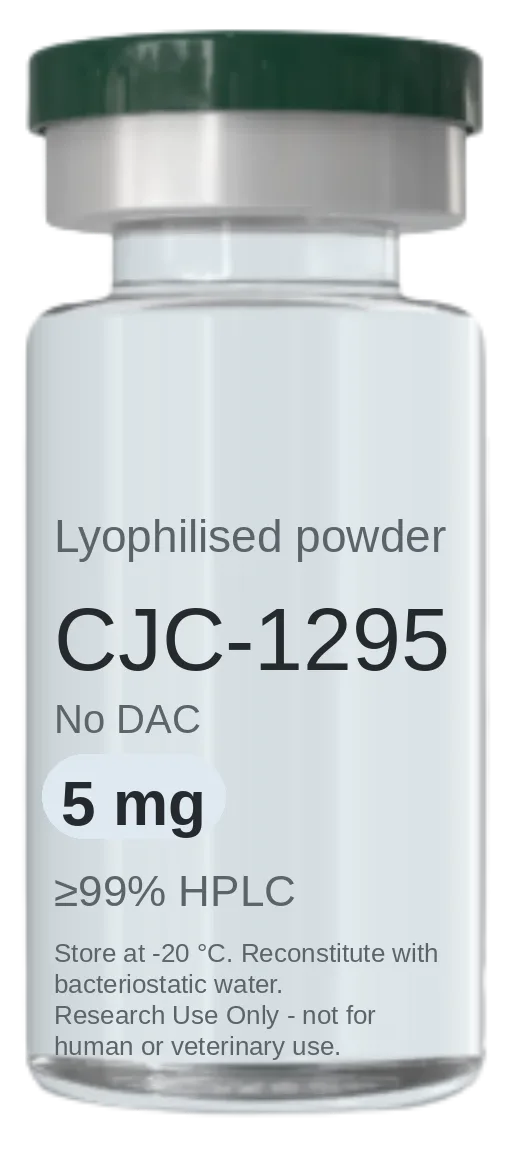
CJC-1295 (sin DAC)
Modified GRF(1-29) tetrasubstituted analogue without drug affinity complex.
- Purity:
- ≥99% HPLC
- Sizes available:
- 5 mg – 20 mg
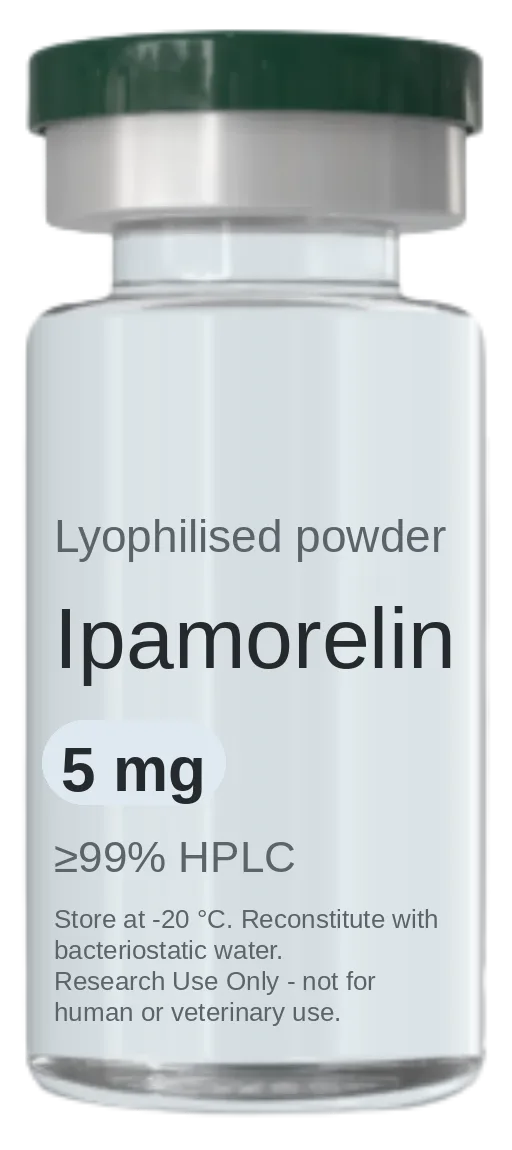
Ipamorelin
Selective ghrelin receptor (GHS-R1a) agonist pentapeptide.
- Purity:
- ≥99% HPLC
- Sizes available:
- 5 mg – 20 mg
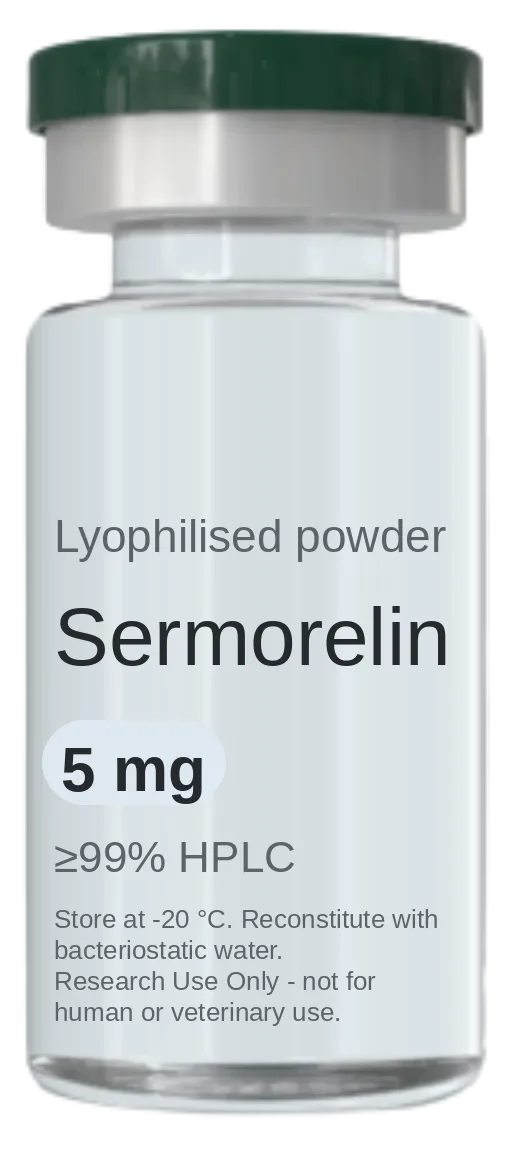
Sermorelin
Growth hormone-releasing hormone analogue used in endocrine signalling research.
- Purity:
- ≥99% HPLC
- Sizes available:
- 5 mg – 20 mg
The consultation
One intake that settles goals, history and contraindications alongside compound, quantity, documentation and route — reviewed by a physician before anything ships.
More notes
-
Tesamorelin vs Sermorelin: The Difference
Tesamorelin and sermorelin are both GHRH analogs, but not the same molecule. Here's the structural difference and what the studies on each measure.
-
Peptide Supplier vs. Reseller: What Differs
The real difference is whether someone can name the lab that tested a batch and show the report — or only promise it's pure.
-
MOTS-c or NAD+: What's the Difference
MOTS-c and NAD+ are studied through different mitochondrial pathways; here's what each line of research actually measures.