
Note
Mass Spectrometry vs HPLC in Peptides
HPLC measures peptide purity; mass spectrometry confirms identity. What to look for in a certificate of analysis.
HPLC and mass spectrometry answer different questions about the same peptide. HPLC measures what fraction of the sample is the compound of interest: the result is a purity percentage. Mass spectrometry determines whether that compound carries the expected molecular mass: the result is an identity confirmation. A certificate of analysis that includes both provides information neither technique can supply on its own.
What HPLC measures
High-performance liquid chromatography separates the components of a sample by passing them through a column with a stationary phase. For peptides, the standard variant is reversed-phase HPLC (RP-HPLC): the column retains more hydrophobic molecules preferentially, and a gradient of organic solvents elutes them in order of increasing polarity. An ultraviolet detector set to 214–220 nm records absorbance as components pass through; at that wavelength, the amide bond absorbs, and the amide bond is present in every peptide.
The output is a chromatogram: a series of peaks at different retention times. The area under the main peak divided by the total peak area gives purity as a percentage. If that peak accounts for 99.7% of total area, the sample is reported as 99.7% pure by HPLC.
What the chromatogram cannot do is identify the other peaks. They may be synthesis fragments, peptides with incompletely removed side-chain protecting groups, oxidation products, or sequence isomers. HPLC says how much of something other than the main peak is present; it does not say what that something is.
What mass spectrometry measures
Mass spectrometry ionizes the molecules in the sample and separates them by their mass-to-charge ratio (m/z). For peptides, the most commonly used ionization method is electrospray ionization (ESI): the solution passes through a capillary at high voltage, charged droplets form, the solvent evaporates, and gas-phase ions remain for the detector to record.
A peptide with a molecular mass of 4,500 Da appears in the spectrum as several ions: [M+H]⁺ at m/z 4,501, [M+2H]²⁺ at m/z 2,251, and so on. If those values match the calculated values for the declared sequence, identity is confirmed. If they do not, there is an identity problem — even if HPLC reported 99% purity.
The practical consequence: a sample can be 99% homogeneous and still be 99% of the wrong compound. Mass spectrometry catches that; HPLC alone does not.
Why synthesized peptides present this problem
Solid-phase peptide synthesis (SPPS) builds a peptide amino acid by amino acid. Each coupling step has a yield that does not reach 100%. In a 30-residue peptide, a coupling efficiency of 99% per step produces an accumulation of errors that generates measurable impurities at the end of the synthesis. The most common ones:
- Deletion sequences — peptides missing one or more residues
- Products with side-chain protecting groups not fully removed during cleavage
- Oxidation of sensitive residues such as methionine or tryptophan
- Dimerization from unwanted disulfide or amide bond formation
Some of those impurities have chromatographic properties very close to the target peptide and co-elute with it, inflating the purity figure reported by HPLC. Others have the same molecular mass as the target but a different sequence — they are sequence isomers, detectable only by a second fragmentation stage (MS/MS). These are exactly the cases where a certificate showing only HPLC gives an incomplete picture.
That is why reference analytical laboratories combine both techniques. The certificates of analysis published by PeptoClinic include an RP-HPLC chromatogram with the area percentage and a mass spectrum with the observed mass set against the theoretical mass.
LC-MS: both techniques in series
Liquid chromatography coupled to mass spectrometry (LC-MS) runs both analyses in series: the peptide is separated on the HPLC column and the eluate passes directly into the mass spectrometer. The result assigns a mass to every chromatographic peak. It does not only indicate how much of each component is present — it identifies what each component is.
LC-MS/MS adds a second fragmentation stage. The peptide ion is broken apart inside the instrument and the fragments are recorded separately, allowing the amino acid sequence to be reconstructed residue by residue. This is the most complete structural confirmation available for synthesized peptides and is the technique pharmaceutical laboratories use to validate reference materials.
For a researcher receiving a peptide: a COA with only HPLC confirms purity but not identity. A COA with HPLC and a mass spectrum confirms both. LC-MS/MS is the highest level of characterization available for this class of material.
How to read a certificate of analysis
When reviewing a COA for a research peptide, look for these four elements:
- RP-HPLC chromatogram with the area percentage of the main peak stated as a number, not only visible in the graph.
- Mass spectrum with the observed mass and the calculated mass for the declared sequence. The difference should not exceed 0.5 Da for peptides below 5,000 Da.
- Name of the analytical laboratory, independent from the supplier.
- Task number or verification access on the laboratory's own website.
Janoshik Analytical, an independent laboratory in the Czech Republic, publishes its reports at janoshik.com with a task number that anyone can look up. Task 136921 corresponds to the analysis of retatrutide from the PeptoClinic catalogue: 99.893% purity by HPLC and an observed molecular mass consistent with the declared sequence, analysed on April 13, 2026. Task 136923 corresponds to MOTS-c: 99.669%, same date.
A COA without an identifiable laboratory or a verifiable task number has no independent backing, regardless of the percentage it declares.
What HPLC and mass spectrometry do not cover
Neither HPLC nor mass spectrometry detect bacterial endotoxins. The standard assay for that is the LAL test (Limulus Amebocyte Lysate), which measures lipopolysaccharide at picogram-level concentrations. Neither technique confirms the absence of residual synthesis solvents; that requires gas chromatography (GC) or nuclear magnetic resonance (NMR). Neither measures water content, which affects the actual concentration of compound in a lyophilized powder.
A report that includes HPLC for purity, a mass spectrum for identity, and an LAL test for endotoxins covers the three questions most relevant to experimental work. Each technique answers exactly what it measured and nothing more. PubMed collects the methodological literature on analytical characterization of synthetic peptides for those who want to go deeper on the methods described here.
This material is for laboratory research
PeptoClinic supplies research peptides strictly for Research Use Only (RUO): in vitro and laboratory use. The material is not approved for human or veterinary use. It is not a medicine, a supplement, or a food, and it has not been evaluated by any regulatory authority, including the FDA or ANMAT. Requests for administration protocols in people are outside PeptoClinic's scope.
The analytical techniques described in this post are methods for characterizing research material, not clinical diagnostic tools. The PeptoClinic catalogue lists the compounds available for quotation, and shipping conditions are described on the shipping page.
Frequently asked questions
What is the practical difference between HPLC and mass spectrometry?
HPLC measures what percentage of the sample is the main compound, using the proportion of chromatographic peak area. Mass spectrometry measures the molecular mass of the compound to confirm it matches the declared sequence. They are complementary tools: the first answers how much, the second answers what.
Can HPLC report a falsely high purity?
Yes. If an impurity co-elutes with the main peptide — exits the column at the same retention time — the two peaks overlap and the area attributed to the main peak is overestimated. This happens when the solvent gradient is not optimized for that specific peptide, or when the impurity has physicochemical properties very close to those of the target.
What does "area purity" mean on a COA?
Area purity is the fraction of total chromatogram area that belongs to the main peak, expressed as a percentage. It is not gravimetric purity (% w/w), which would require a calibrated reference standard of known concentration. For research peptides, the industry standard is to report area purity, which is the most reproducible figure across instruments. That is the figure Janoshik Analytical reports for all PeptoClinic lots.
What is electrospray ionization (ESI)?
ESI is a soft ionization technique that transfers the molecule to the gas phase without fragmenting it. That allows the intact peptide to be recorded with its actual mass. The other widely used alternative is MALDI-TOF, also valid for peptides, but ESI couples more readily to an inline HPLC system, making it the standard configuration for LC-MS in quality control laboratories.
What is the difference between LC-MS and LC-MS/MS?
LC-MS couples chromatographic separation to a single stage of mass spectrometry: it records the masses of the components eluting from the column. LC-MS/MS adds a second stage in which a selected ion is fragmented; the resulting fragment ions allow the amino acid sequence to be reconstructed residue by residue. For a standard COA covering purity and identity, LC-MS is sufficient. LC-MS/MS is used when the full sequence needs confirmation or when sequence isomers need to be distinguished from one another.
How do I verify that a COA corresponds to the lot I received?
The laboratory task number must appear on the COA and be searchable on the analytical laboratory's website. For lots documented by PeptoClinic, the Janoshik Analytical task number is published and can be verified directly at janoshik.com. A COA with no verifiable task number, or whose task number leads to no record at the laboratory, cannot be treated as independent evidence of the declared purity.
What technique confirms the absence of endotoxins?
Neither HPLC nor mass spectrometry detect bacterial endotoxins. The standard assay is the LAL test (Limulus Amebocyte Lysate), which measures lipopolysaccharide concentration at picograms per milliliter. For peptides used in cell cultures or animal models, the endotoxin level is a critical parameter independent of chromatographic purity, and it requires its own dedicated report.
Why does the mass spectrum show multiple peaks for one compound?
Under ESI conditions, a single peptide molecule generates several ions by picking up different numbers of protons during ionization. A peptide carrying two protons appears at half the m/z of the same peptide carrying one proton. These are called charge states, and their presence is expected and consistent with a correctly identified compound. Reporting software calculates the neutral mass from each charge state; all charge states should converge to the same neutral mass for a pure, correctly identified peptide.
Compounds mentioned
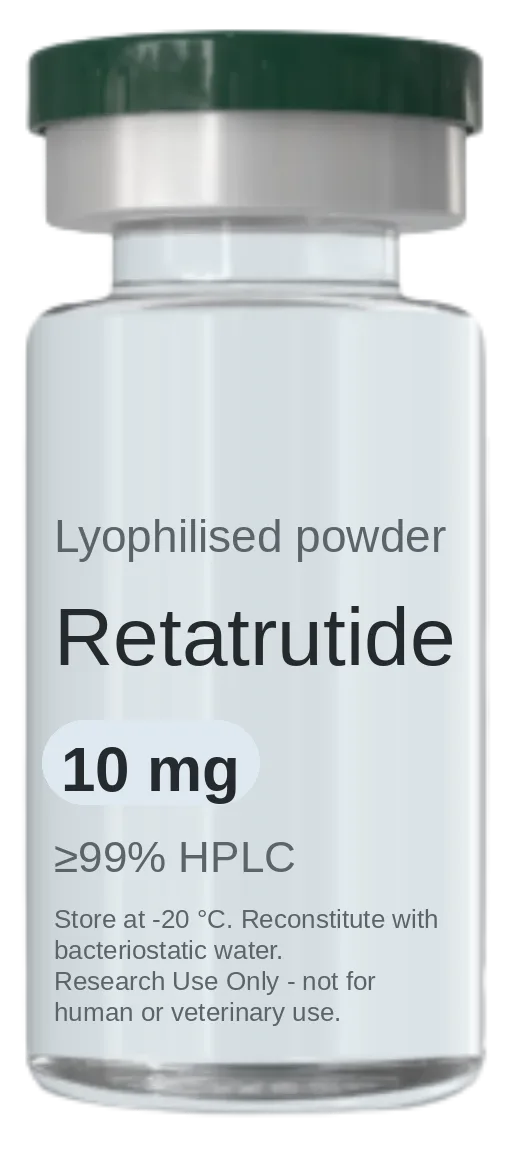
Retatrutide
Triple-agonist metabolic research peptide targeting GLP-1, GIP and glucagon receptors.
- Purity:
- ≥99% HPLC
- Sizes available:
- 10 mg
BPC-157 + TB-500
BPC-157 and TB-500 in a single vial — the pairing most studied together in tissue-repair research.
- Purity:
- ≥99% HPLC
- Sizes available:
- 5 mg + 5 mg
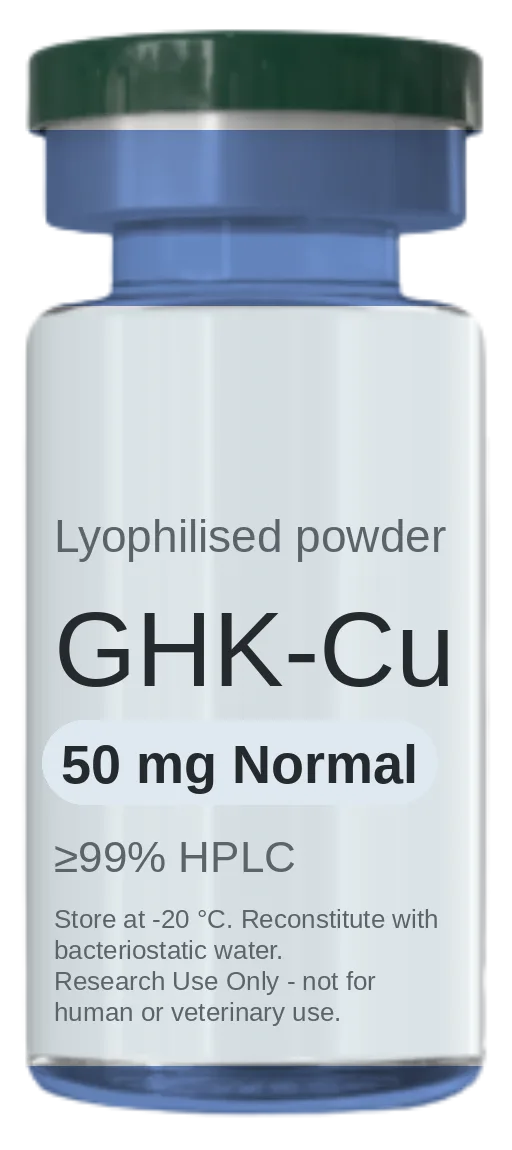
GHK-Cu (Copper Peptide)
Copper-binding tripeptide studied in extracellular matrix and dermal research models.
- Purity:
- ≥99% HPLC
- Sizes available:
- 50 mg Normal – 50 mg Plus
The consultation
One intake that settles goals, history and contraindications alongside compound, quantity, documentation and route — reviewed by a physician before anything ships.
More notes
-
Temporary Import Regime & Peptides
Temporary import covers goods that leave the country again; a research peptide shipment stays and gets used up.
-
Retatrutide vs GHK-Cu: What's the Difference
Retatrutide and GHK-Cu are different molecules studied for different reasons. Here's what each investigates and what documentation backs a batch.
-
Invoiced vs. Unbilled Peptide Suppliers
What changes when a research peptide supplier invoices the transaction versus one that takes payment and leaves no paper trail.