
Note
MOTS-c vs CJC-1295: What's the Difference
MOTS-c and CJC-1295 are research peptides with different mechanisms — one works in the mitochondria, the other in the GH axis.
MOTS-c and CJC-1295 are two research peptides that share neither structure nor mechanism: MOTS-c is a peptide encoded by mitochondrial DNA that is studied in relation to cellular metabolism, while CJC-1295 is a synthetic analog of growth hormone-releasing hormone (GHRH) studied within the growth hormone / IGF-1 axis. The fact that both show up in the same search has more to do with them circulating in the same body of research on metabolism and aging than with any shared function.
What is MOTS-c
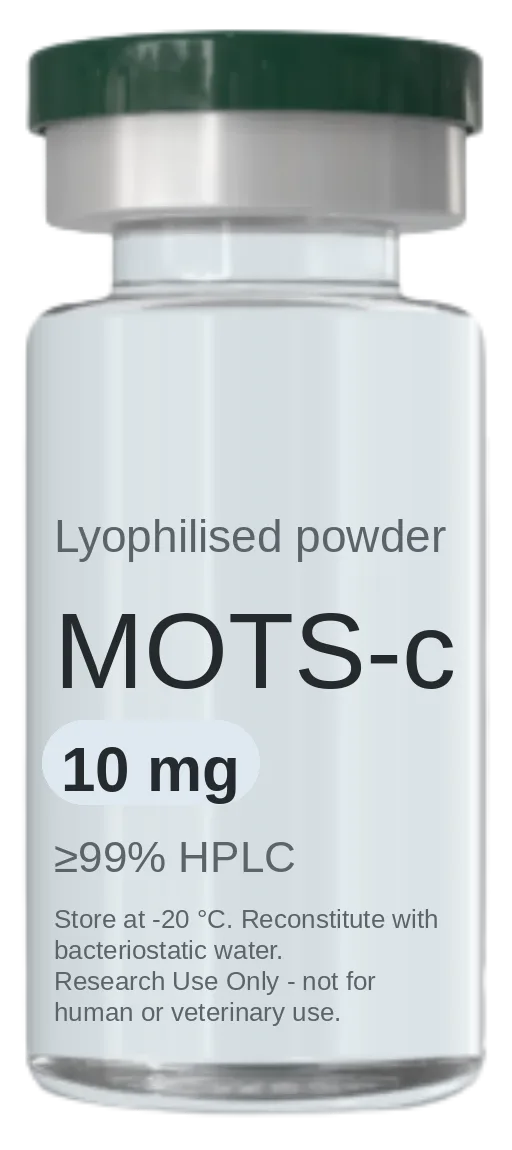
MOTS-c (Mitochondrial Open Reading Frame of the 12S rRNA-c) is a peptide encoded by mitochondrial DNA itself, not by nuclear DNA. That is the underlying structural difference: most peptides in a research catalog — CJC-1295 included — are synthetic sequences designed in a lab to mimic or modify an existing hormone. MOTS-c, by contrast, is a sequence the organism already produces from the mitochondria, and the literature studies it as a signal that communicates the cell's metabolic state to the nucleus.
Published research on MOTS-c concentrates on metabolic regulation pathways: AMPK activation, insulin sensitivity in cell and animal models, and the response to metabolic stress. In that sense it belongs to the "mitochondrial" family of peptides, and papers tend to compare it to other mitochondria-derived signals rather than to hormones of the GH axis.
The lot of MOTS-c that PeptoClinic supplies was analyzed by Janoshik Analytical on April 13, 2026 (task report 136923), with 11.31 mg of content and a purity of 99.669%. That report is available for review, and it is the kind of document that determines whether a research peptide is traceable at all.
For researchers evaluating sourcing specifically into Argentina, the MOTS-c for Argentina page has the shipping and documentation detail for that route.
What is CJC-1295
CJC-1295 is a GHRH analog — GHRH being the hormone that, under normal conditions, stimulates the pituitary to release growth hormone. Two versions exist and they should not be confused: the "with DAC" version (Drug Affinity Complex), designed to bind serum albumin and extend its presence in the organism over days, and the without-DAC version — the one PeptoClinic carries — which does not include that complex and behaves much closer to endogenous GHRH, with a short activity window.
Research on CJC-1295 (no DAC) sits within the growth hormone / IGF-1 axis, and the literature typically studies it alongside peptides from the GHRP or GH-secretagogue family, such as ipamorelin or sermorelin, because both groups act on different receptors of the same axis. That is why forums and papers mention them together: not because they do the same thing, but because they are complementary pieces of the same hormonal pathway.
For sourcing CJC-1295 no DAC into Argentina, the documentation and shipping route is detailed at CJC-1295 no DAC for Argentina.
The core difference, in one sentence
MOTS-c is a mitochondrial signal studied for cellular metabolism; CJC-1295 is a GHRH analog studied for the growth hormone axis.
These are two distinct biological pathways, two distinct peptide classes, and two distinct bodies of literature. They are not interchangeable as research subjects, and they do not answer the same research question.
What they have in common (the little that overlaps)
- Both arrive at PeptoClinic as lyophilized powder in a vial, with no cold chain involved, because lyophilized powder is stable at room temperature for weeks. The detail of how each order travels is on the shipping page.
- Both are held to the same catalog purity standard: 99% or higher by HPLC. The quality page explains how to read a laboratory report and what that figure actually means.
- Both get mentioned frequently in the same conversation about longevity and metabolism, even though they act on different points of the organism.
- Neither one is a growth hormone itself: CJC-1295 is studied for stimulating its release in the relevant model, and MOTS-c is not involved in the GH axis at all.
Why they show up in the same search
Demand for information on MOTS-c and CJC-1295 tends to come from the same kind of reader: someone reading about peptides linked to metabolism, body composition and aging, who runs into both names in the same articles or third-party research protocols. That raises the question of whether they are the same thing, or whether one can substitute for the other as a research subject. It cannot: the research question each one answers is different, and mixing them in an experimental design without understanding that difference invalidates whatever conclusion is drawn from it.
Anyone evaluating sourcing for a research program that uses peptides across different classes can review the full catalog and compare technical specifications before requesting a quote.
For laboratory research only — not for human or veterinary use
MOTS-c and CJC-1295 are supplied strictly for research use (Research Use Only). They are not medicines, supplements or foods. They are not approved for human or veterinary consumption, diagnosis or treatment, and no regulatory body — not the FDA, not ANMAT, not any equivalent authority — has evaluated the claims made about them in the scientific literature. PeptoClinic is not a pharmacy, a clinic or a telehealth provider, does not write or fill prescriptions, and does not provide dosing, administration or protocol guidance; that kind of request is always declined, whether it concerns MOTS-c, CJC-1295 or any other compound in the catalog.
Anyone who wants to understand the framework PeptoClinic operates under within Argentina can review the sourcing for Argentina page.
Frequently asked questions
Can MOTS-c and CJC-1295 be used to study the same thing?
No. MOTS-c is studied within mitochondrial signaling and cellular metabolism, while CJC-1295 is studied within the GHRH / growth hormone / IGF-1 axis. These are two different biological pathways and they answer two different research questions.
Why does CJC-1295 have a "with DAC" and a "without DAC" version?
The with-DAC version includes a complex (Drug Affinity Complex) that binds serum albumin and extends its presence in the organism over several days. The without-DAC version, which is the one in PeptoClinic's catalog, does not include that complex and behaves closer to the GHRH the body naturally produces, with a much shorter activity window.
Is MOTS-c a growth hormone?
No. MOTS-c has no role in the growth hormone axis. It is a peptide encoded by mitochondrial DNA that the literature studies in relation to metabolic regulation, AMPK activation and insulin sensitivity in cell and animal models.
Why does CJC-1295 show up alongside ipamorelin or sermorelin in papers?
Because they are peptides that act on different receptors within the same hormonal axis, and research designs often combine them as complementary pieces of that pathway. Sharing an axis does not mean sharing a mechanism.
What purity does the MOTS-c that PeptoClinic supplies have?
The lot was analyzed by Janoshik Analytical on April 13, 2026 (task report 136923), with 11.31 mg of content and a purity of 99.669%. The full report is available for review as batch documentation.
Do both peptides travel in a cold chain?
No. Both are shipped as lyophilized powder in a sealed vial with desiccant, protected from light, and that format is stable at room temperature for weeks, so it requires no coolant, dry ice or temperature logger during shipping.
Can MOTS-c and CJC-1295 be quoted in the same order?
Yes. Since they are independent compounds within the same catalog, each quote is evaluated by compound, purity specification, quantity and batch documentation, and nothing prevents including both in a single inquiry.
Does this content serve as a usage guide?
No. It describes what the scientific literature investigates about each compound, but it is not a dosing, administration or protocol guide. The material is supplied exclusively for research and is not approved for human or veterinary use.
Compounds mentioned
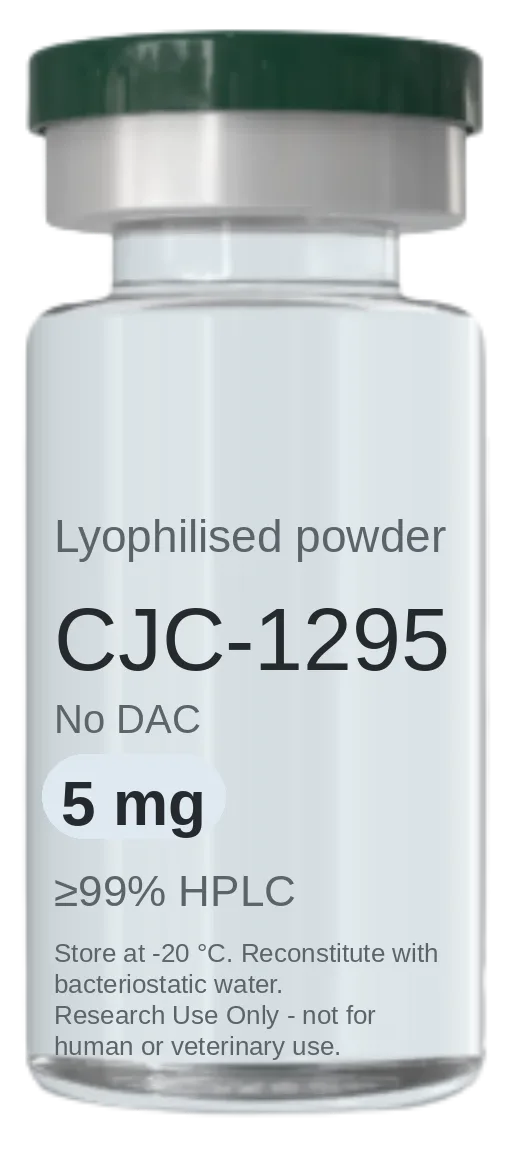
CJC-1295 (sin DAC)
Modified GRF(1-29) tetrasubstituted analogue without drug affinity complex.
- Purity:
- ≥99% HPLC
- Sizes available:
- 5 mg – 20 mg
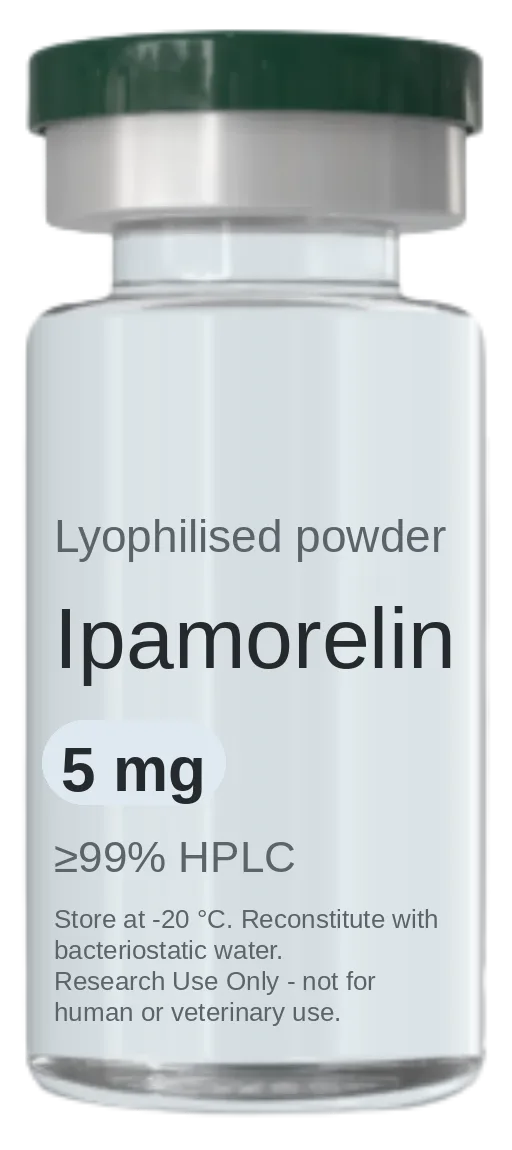
Ipamorelin
Selective ghrelin receptor (GHS-R1a) agonist pentapeptide.
- Purity:
- ≥99% HPLC
- Sizes available:
- 5 mg – 20 mg
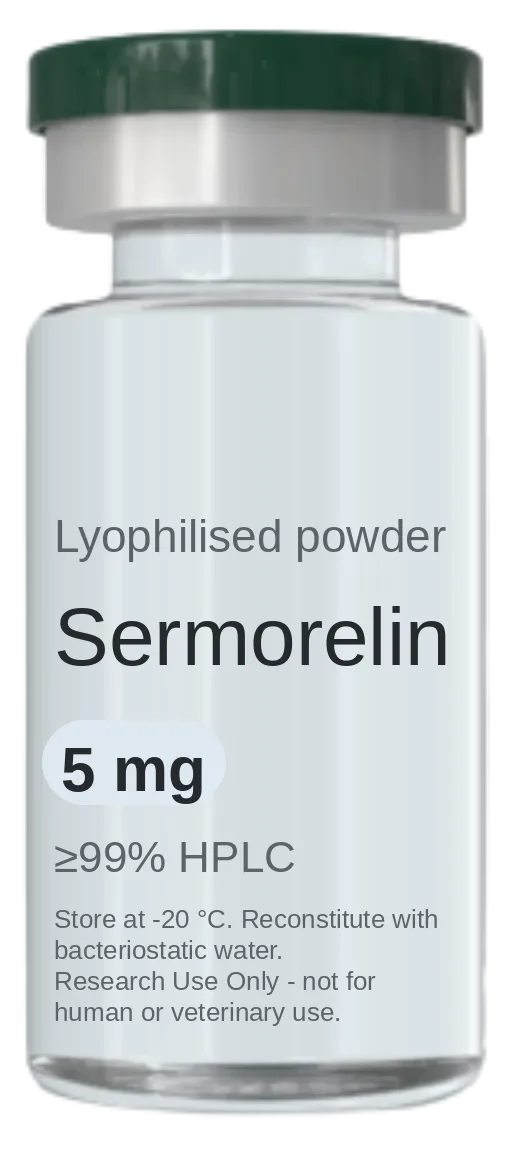
Sermorelin
Growth hormone-releasing hormone analogue used in endocrine signalling research.
- Purity:
- ≥99% HPLC
- Sizes available:
- 5 mg – 20 mg
The consultation
One intake that settles goals, history and contraindications alongside compound, quantity, documentation and route — reviewed by a physician before anything ships.
More notes
-
Peptide Shipments to Argentina: Annual Limit
What Argentina's postal shipment regime says about how many research peptide packages you can receive per year.
-
Retatrutide vs Epithalon: Key Differences
Retatrutide and Epithalon are research peptides from different classes, studied in different fields. Here's how they differ.
-
ANMAT Delay on Customs-Held Peptide
What happens if ANMAT delays its answer on a research peptide held at Argentine customs, and what you can do while you wait.