
Note
Retatrutide vs. Tesamorelin: What's Different
Retatrutide and tesamorelin target different receptors and different research questions — here's what the documentation shows.
Retatrutide and tesamorelin are studied in the literature for different reasons, through different mechanisms, and they share no structural relationship. Retatrutide is a triple agonist that activates GLP-1, GIP and glucagon receptors, and is investigated in metabolic research. Tesamorelin is a growth hormone-releasing hormone (GHRH) analog, investigated along the GH/IGF-1 axis. The two compounds keep showing up in the same searches about body composition, but they point at separate biological systems.
What retatrutide is and what the literature investigates
Retatrutide is a long-chain peptide designed as a triple agonist: it binds GLP-1 (glucagon-like peptide-1), GIP (glucose-dependent insulinotropic polypeptide) and glucagon receptors. Published research on the compound concentrates on metabolic models, examining how simultaneous activation of those three receptors modulates energy expenditure and signaling related to lipid and glucose metabolism.
It's a large molecule within the research-peptide catalogue, and that size shapes how it's handled in the lab: it requires careful reconstitution and appropriate storage, covered in detail on the storage and shipping page.
What tesamorelin is and what the literature investigates
Tesamorelin is a synthetic GHRH analog — the hormone that, in the body, stimulates growth hormone release from the pituitary. Unlike retatrutide, it does not act on incretin-family receptors: its target is the GHRH receptor, and the published research on the compound centers on the GH/IGF-1 axis and how that signaling relates to processes associated with visceral adipose tissue distribution.
Structurally, it's a shorter peptide than retatrutide, with a distinct amino acid sequence and no functional overlap with incretin receptors.
The mechanism difference, in one line
Retatrutide activates three distinct metabolic receptors (GLP-1, GIP and glucagon) to study energy expenditure; tesamorelin activates a single receptor (GHRH) to study the growth hormone axis. These molecules don't compete for the same molecular target and don't trigger the same signaling cascade, so asking "which one is stronger" doesn't have a biological answer — they measure different phenomena.
Size and molecular family
Retatrutide belongs to the family of GLP-1-derived peptides, related to other incretin agonists studied in the same research space. Tesamorelin belongs to the family of GHRH analogs, with no structural relationship to that class.
Receptor and signaling pathway
GLP-1, GIP and glucagon are G protein-coupled receptors involved in energy metabolism from the digestive tract and pancreas. The GHRH receptor sits in the pituitary, and its activation triggers the synthesis and release of growth hormone, which then acts via IGF-1 in the liver and other tissues. These are two separate hormonal axes.
Documentation: what each one's lab report shows
One of the first things a researcher checks before purchasing any lot is the certificate of analysis (COA). The retatrutide lot analyzed by Janoshik Analytical (task 136921, 10 mg label) reported a purity of 99.893% by HPLC, with 11.96 mg of measured content.
For the rest of the catalogue, including tesamorelin, the purity standard maintained is ≥99% HPLC, verifiable through the certificate of analysis that accompanies each lot — the same standard used to document every research peptide at PeptoClinic. How to read a COA, which columns to check, and what to ask for when a report doesn't include a verification link is explained on the quality and documentation page.
The lowest-purity lot published so far in the catalogue came in at 99.669%. That's the real floor, not the best number available to show.
Which type of research each one gets chosen for
The choice between retatrutide and tesamorelin depends on which biological axis is at the center of the research protocol:
- An experimental design centered on energy expenditure, incretin signaling, or lipid and glucose metabolism works with retatrutide.
- A design centered on the GH/IGF-1 axis, pituitary physiology, or the relationship between growth hormone and adipose tissue distribution works with tesamorelin.
They aren't interchangeable, and they aren't complementary in the sense of "one reinforces the other" — they're tools for different research questions. The literature indexed on PubMed for retatrutide and the body of work available on tesamorelin correspond to separate evidence bases, each with experimental designs specific to its own mechanism.
Research use only
Retatrutide and tesamorelin are supplied strictly for laboratory research (Research Use Only). Neither is approved for human or veterinary use, nor for the diagnosis or treatment of any condition. Nothing in this article should be read as guidance for use in people or animals: it describes what the scientific literature investigates about each molecule, not an administration protocol.
Shipping to Argentina
Tesamorelin, like retatrutide, is quoted for research destinations in Argentina with customs documentation prepared as laboratory reference material. The material travels lyophilized, with no cold chain: what protects the vial is the seal and the desiccant, not refrigeration. The full catalogue, with the rest of the peptides available for quoting, is on the catalogue page.
Frequently asked questions
¿Se puede comparar la potencia de retatrutide y tesamorelina?
No de forma directa: activan receptores distintos y disparan vías de señalización distintas, así que no existe una escala común de "potencia" entre ambos. La literatura los evalúa con variables experimentales propias de cada mecanismo.
¿Cuál de los dos tiene una historia de investigación más larga?
Tesamorelina es un análogo de GHRH con una trayectoria de investigación más extensa que retatrutide, que pertenece a una generación más reciente de agonistas múltiples sobre receptores de incretinas.
¿Los dos cuentan con certificado de análisis?
Todo el catálogo se documenta con un estándar de pureza de ≥99% HPLC verificable por certificado de análisis. Retatrutide tiene un reporte público de Janoshik Analytical con el resultado numérico detallado; para cualquier lote, el certificado correspondiente se entrega junto con la cotización.
¿Qué diferencia de familia molecular hay entre los dos péptidos?
Retatrutide pertenece a la familia de péptidos derivados del GLP-1, con acción sobre tres receptores de incretinas y glucagón. Tesamorelina pertenece a la familia de análogos de GHRH, sin relación estructural con esa familia.
¿Se pueden pedir ambos en la misma cotización?
Sí, una solicitud de cotización puede incluir varios compuestos del catálogo a la vez; cada uno se documenta y despacha según su propia ficha técnica.
¿Por qué aparecen juntos en tantas búsquedas si son tan distintos?
Porque ambos se asocian en la búsqueda a investigación sobre composición corporal, aunque por vías biológicas separadas: uno por el eje de incretinas y glucagón, el otro por el eje GH/IGF-1. Esa cercanía en el interés de búsqueda no refleja cercanía mecanística.
¿El envío a la Argentina es el mismo para los dos compuestos?
Sí, ambos se cotizan para destinos argentinos con la misma documentación de aduana como material de referencia de laboratorio, y el mismo formato de despacho: vial liofilizado, sin cadena de frío.
¿Existe una versión en pluma para alguno de los dos?
El formato en pluma está anunciado pero todavía no es un ítem que se pueda cotizar; por ahora el formato disponible para ambos péptidos es vial con polvo liofilizado.
Compounds mentioned
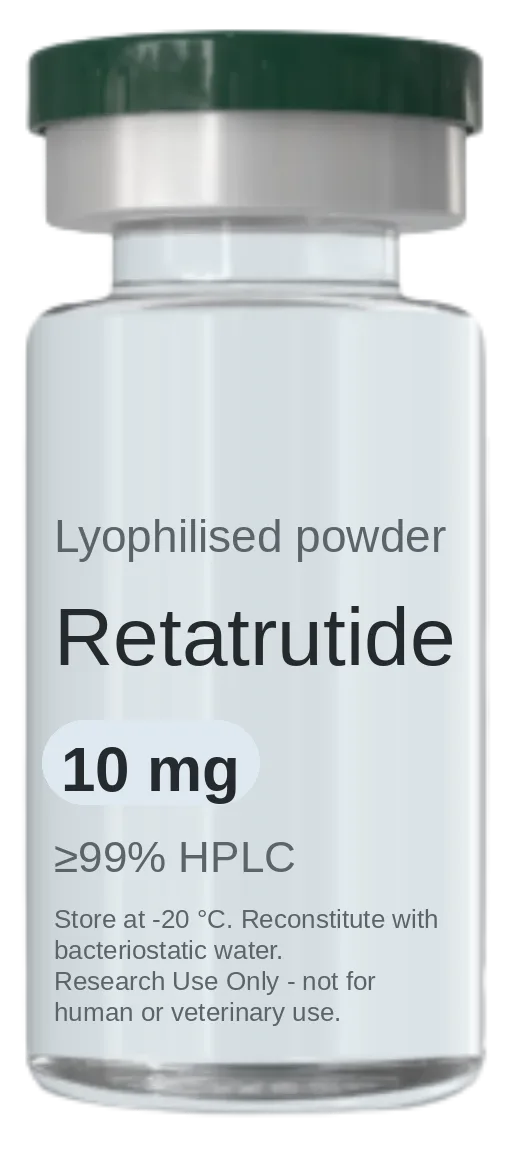
Retatrutide
Triple-agonist metabolic research peptide targeting GLP-1, GIP and glucagon receptors.
- Purity:
- ≥99% HPLC
- Sizes available:
- 10 mg
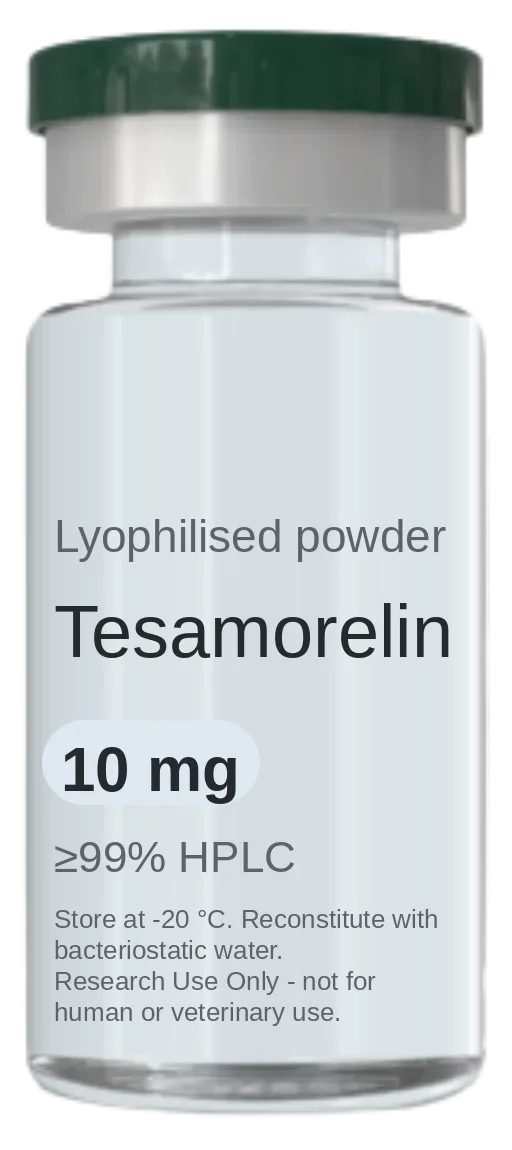
Tesamorelin
Stabilised GHRH(1-44) analogue studied in adipose tissue distribution research.
- Purity:
- ≥99% HPLC
- Sizes available:
- 10 mg – 20 mg
BPC-157 + TB-500
BPC-157 and TB-500 in a single vial — the pairing most studied together in tissue-repair research.
- Purity:
- ≥99% HPLC
- Sizes available:
- 5 mg + 5 mg
The consultation
One intake that settles goals, history and contraindications alongside compound, quantity, documentation and route — reviewed by a physician before anything ships.
More notes
-
KPV vs. Selank: What's the Difference
KPV is an anti-inflammatory tripeptide; Selank is a nootropic peptide. We compare origin, research focus and documentation for each.
-
Can You Ship Peptides as a "Sample"?
Why declaring a paid research peptide shipment as a duty-free commercial sample is invalid in Argentina, and what paperwork works instead.
-
Semax vs LL-37: What's the Difference
Semax is a synthetic heptapeptide; LL-37 is a human cathelicidin. Different origin, structure and research field, side by side.