
Note
Thymosin Alpha 1: What Is It?
By the PeptoClinic editorial team · Medically reviewed by Dr. Emily Parker
Thymosin alpha 1 is a 28-amino-acid thymic peptide studied for immune modulation. Not approved by the FDA; here's what the research shows.
Thymosin alpha 1 (often written Tα1) is a 28-amino-acid peptide first isolated from calf thymus tissue, where it was identified as the active fragment of a larger precursor called prothymosin alpha. It is studied in immunology research for its role in modulating T-cell activity and the body's interferon response, which is why it shows up in the literature far more than it shows up in a pharmacy.
Where the peptide comes from
The thymus gland, sitting behind the breastbone, is where T-cells mature before they circulate through the rest of the immune system. Prothymosin alpha is produced inside thymic cells, and thymosin alpha 1 is the biologically active segment that researchers have isolated and studied as a standalone molecule. Because it originates from an endogenous thymic protein rather than being a synthetic analog of a hormone, it is classified in the literature as a thymic peptide, in the same broad category as thymosin beta-4 and thymopoietin, but with a distinct amino-acid sequence and a distinct research focus.
A 2025 review in the International Journal of Molecular Sciences by Simonova et al. covers how thymosin alpha 1 is positioned in aging research specifically: the thymus gland shrinks with age (a process called thymic involution), and the review summarizes studies looking at whether restoring thymosin alpha 1 signaling affects the decline in T-cell output that comes with that shrinkage. The review also catalogs the molecule's documented interactions with innate immune receptors, including toll-like receptors, which is one of the proposed mechanisms for its effect on interferon production.
What the research actually studies
The research literature on thymosin alpha 1 clusters around three areas:
- Immune modulation. Laboratory studies have measured its effect on T-cell maturation, cytokine signaling, and dendritic cell activity.
- Immunosenescence. The age-related decline in immune function is a repeated theme in the papers Simonova et al. reviewed, with thymosin alpha 1 studied as one candidate for understanding why older immune systems respond differently to pathogens.
- Interferon response. Several of the studies summarized in that review look at thymosin alpha 1's interaction with interferon-alpha pathways, a mechanism that has made it a subject of research interest in virology contexts internationally.
None of that research describes a consumer product, a dose, or a protocol — it describes mechanism and association, measured in cell cultures and animal models, with some clinical research conducted outside the United States. Readers researching the molecule should treat each finding as attributed to the study that produced it, not as a guarantee about what it will do in a person.
Is thymosin alpha 1 approved by the FDA?
No compound on PeptoClinic's catalog is approved by the FDA, and thymosin alpha 1 is no exception. More specifically, thymosin is named on the FDA's list of bulk drug substances that compounding pharmacies may not use because of possible safety risks — the same list that covers BPC-157, ipamorelin, and several other peptides sold as research material. That listing is the clearest answer to "is this legal to sell": it is not an approved drug, pharmacies are barred from compounding it into a prescription product, and it is not a controlled substance. That is a regulatory fact, not legal advice, and it does not change based on which supplier is selling it.
It's worth being precise about what thymosin alpha 1 is not, because the FDA's approval list is full of peptide drugs with similar-sounding names. Tesamorelin, for example, received FDA approval as Egrifta, for excess abdominal fat in people with HIV-associated lipodystrophy. Thymosin alpha 1 has no equivalent brand-name approval in the United States. PeptoClinic's vial of thymosin alpha 1 is research material, sourced and verified the same way as the rest of the catalog, and it is not a substitute for an approved drug.
How PeptoClinic verifies what's in the vial
Every batch PeptoClinic sells is analyzed by an independent laboratory, Janoshik Analytical, and the lowest purity figure published across PeptoClinic's current reports is 99.669%, found on a MOTS-c batch — that's the number to check a claim against, not the best result in the file. The thymosin alpha 1 product page carries the same verification approach as the rest of the catalog: a lab report a reader can look up, not a badge. If a reader is comparing thymosin alpha 1 against another thymic peptide, like a pinealon or epitalon vial, the same standard applies to both — a certificate of analysis they can check, not a claim they have to trust.
Anyone deciding between research peptides will eventually want to see what each one costs; that information lives on the pricing page rather than in this post, because a number quoted here goes stale the moment a batch changes.

Medical review
Dr. Emily Parker

Reviews every consultation as it comes in
Frequently asked questions
What is thymosin alpha 1 made of?
It is a 28-amino-acid peptide, the active fragment of a larger thymic protein called prothymosin alpha. It is not a synthetic hormone analog; its sequence is derived from a molecule the thymus gland produces naturally.
Is thymosin alpha 1 the same as thymosin beta-4 or TB-500?
No. They share the word "thymosin" and a thymic origin, but they are different peptides with different amino-acid sequences studied for different mechanisms. Thymosin alpha 1 research centers on T-cell and interferon signaling, while thymosin beta-4 and its fragment TB-500 are studied in the context of tissue repair.
Why is thymosin alpha 1 studied in aging research?
Because the thymus gland shrinks with age, a process the research literature calls thymic involution, and that shrinkage is linked to a decline in T-cell output. [Simonova et al., 2025](https://pubmed.ncbi.nlm.nih.gov/41373628/) reviews the studies that have examined whether thymosin alpha 1 signaling plays a role in that decline, which is why the molecule shows up repeatedly in immunosenescence research.
Has thymosin alpha 1 received FDA approval?
No. It has not received FDA approval for any indication, and it is named on the [FDA's list of bulk drug substances that present possible safety risks when compounded](https://www.fda.gov/drugs/human-drug-compounding/certain-bulk-drug-substances-use-compounding-may-present-significant-safety-risks). That listing means pharmacies are barred from compounding it into a prescription product in the United States.
How is thymosin alpha 1 different from an approved thymic or immune drug?
There is no FDA-approved brand-name drug built directly on thymosin alpha 1 the way Egrifta is built on tesamorelin or Zepbound is built on tirzepatide. The research on thymosin alpha 1 remains at the laboratory and clinical-study stage rather than the approved-product stage in the United States.
What lab verifies PeptoClinic's thymosin alpha 1?
Janoshik Analytical, an independent laboratory, tests each batch PeptoClinic sells. The report is published rather than summarized, so a buyer can check the actual purity figure for the batch instead of taking a marketing claim at face value.
Does thymosin alpha 1 affect the immune system directly in a person who takes it?
That question is outside what this page answers. The studies summarized by [Simonova et al.](https://pubmed.ncbi.nlm.nih.gov/41373628/) describe mechanism and association in laboratory and clinical research settings; this page reports what the literature studies, not outcomes for an individual.
Where can I compare thymosin alpha 1 to other peptides in the catalog?
The [catalog page](/en/catalog/) lists every compound PeptoClinic carries with its own product page and lab verification, and the [pricing page](/en/pricing/) shows current costs by product.
Compounds mentioned
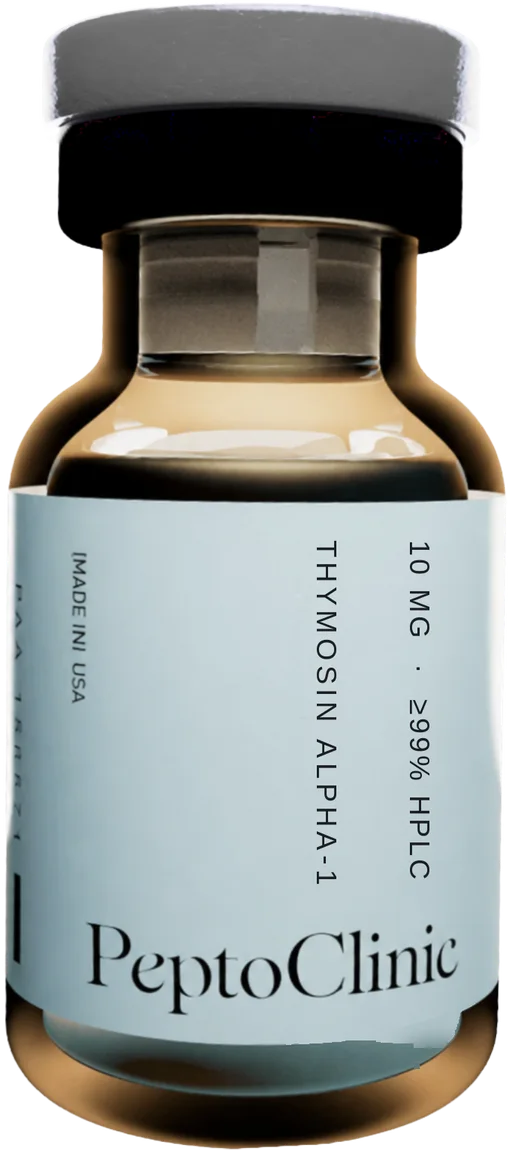
Thymosin Alpha-1
28-amino-acid thymic peptide studied as an immune modulator; synthetic form thymalfasin.
- Purity:
- ≥99% HPLC
- Sizes available:
- 10 mg
The consultation
One intake that settles goals, history and contraindications alongside compound, quantity, documentation and route — reviewed by a physician before anything ships.
More notes
-
Humanin vs Epitalon: What Differs
Humanin and Epitalon differ in origin, size and research focus. A look at what each line of published literature actually studies.
-
Humanin: the mitochondrial DNA peptide
Humanin is a 21-amino-acid peptide encoded in mitochondrial DNA, investigated for neuroprotection, metabolism, and aging biology.
-
Thymosin Alpha 1: What It Is and How It Acts
A 28-amino-acid peptide derived from the thymus, studied for its effects on T cells and innate immunity. What the published literature reports.
-
Selank: What It Is and What Science Shows
Selank is a synthetic heptapeptide derived from tuftsin. Its structure, origin, and what the published literature studies about it.
-
SS-31 (Elamipretide): What Is It?
SS-31, also called elamipretide, is a mitochondria-targeted peptide now approved as Forzinity for Barth syndrome. Here's the mechanism and status.