Note
HPLC Purity on a Peptide COA, Explained
By the PeptoClinic editorial team · Medically reviewed by Dr. Emily Parker
What the HPLC purity percentage on a peptide certificate of analysis actually measures, and how to verify it against the lot you received.
The HPLC purity percentage on a certificate of analysis tells you what fraction of the material in the vial is the peptide named on the label, and what fraction is something else — an incomplete synthesis fragment, a residual salt, moisture, or a different peptide entirely. It is not a marketing claim and it is not a one-time rating for "the product": it is a laboratory measurement of one specific manufacturing lot, tied to a report number and a date.
What HPLC actually measures
HPLC stands for high-performance liquid chromatography. A dissolved sample of the peptide is pushed under pressure through a column packed with material that retains each component differently, mostly according to how hydrophobic it is. The amino acid hydrophobicity scale described by Kyte and Doolittle in 1982, still the standard reference in the field, is what determines how long each fragment stays on the column before it elutes. A detector at the outlet records how much material comes through over time, producing a chromatogram made of peaks — each peak is a distinct compound, and the area under it is proportional to how much of that compound is present.
If the synthesis went well, the largest peak corresponds to the labeled peptide. Purity is that peak's area divided by the total area of every peak detected. A certificate reading 99.7% means the remaining 0.3% of detected material is something else — typically a leftover from the chemical synthesis process, not microbial contamination.
What a certificate of analysis actually shows
A peptide certificate of analysis (COA) normally lists the compound name, a lot number, the date of testing, the labeled content in milligrams, the actual measured content, and the HPLC purity percentage. These are figures for one specific manufacturing lot, not a general statement about "the product line."
As a concrete reference point: the independent lab Janoshik Analytical tested a retatrutide lot labeled at 10 mg on 2026-04-13 and reported 11.96 mg of actual content at 99.893% HPLC purity. The same day it tested a MOTS-c lot and reported 11.31 mg of content at 99.669% purity. That 99.669% figure is the lowest purity value published across PeptoClinic's reports so far, and it is the one worth citing if someone asks "what's the real floor," rather than quoting the best number on file.
Both of those are sold research peptides. PeptoClinic's catalog page for retatrutide and for MOTS-c link to the underlying reports.
Does an HPLC number stand on its own?
HPLC purity answers one question: how much of the detected material is the main peptide peak versus other substances absorbing at the same wavelength. It does not confirm exact molecular weight — that typically takes mass spectrometry — and it does not say how much residual water or salt is left in the lyophilized powder, which is measured separately. A complete report combines more than one method: the milligram content figure comes from the sample's absorbance, converted using a molar absorption coefficient specific to that peptide's amino acid composition, as described by Pace and colleagues in 1995. Two lots with the identical HPLC purity percentage can report different real milligram counts if their sequences differ, because the two numbers come from different measurements, not from one being derived from the other.
Put plainly: HPLC purity tells you how clean the main peak is. Milligram content tells you how much of that peak you have. A report worth reading shows both figures, not just the percentage. That is one of the first things to check on PeptoClinic's quality page before buying from any supplier.
How to verify a certificate belongs to the lot in hand
A certificate with no way to check it is, in practice, just an image file. What makes it checkable is that the laboratory that signed it runs a public system for looking up a report by lot number or report key, independent of the seller. Janoshik Analytical publishes each report under its own identifier — task numbers 136921 and 136923 in the examples above — searchable directly on the lab's own site, with no need to trust a screenshot forwarded by a vendor.
Two simple questions separate a real certificate from a decorative one: does the laboratory that signed it exist as a named, independently reachable organization, or is it just a logo someone drew? And does the lot number on the certificate match the one printed on the vial that actually arrived? If the answer to either is "I don't know," the certificate is not doing its job.
Does 99% purity mean "approved for human use"?
No. HPLC purity measures the chemical composition of the vial's contents relative to other chemical species — it does not evaluate sterility, does not test for endotoxins, and carries no regulatory meaning. None of the compounds in PeptoClinic's catalog, including retatrutide, MOTS-c, GHK-Cu, or BPC-157, is approved by the FDA. Retatrutide specifically is in phase 3 clinical development for obesity and type 2 diabetes, per Jastreboff and colleagues, New England Journal of Medicine, 2026; the others have no public approval timeline. A high purity figure describes the analytical quality of that lot. It says nothing about the regulatory status of the molecule itself.
PeptoClinic is a clinic: a physician reviews each consultation before anything ships, and the certificate for the relevant lot is viewable on the product page before a reader goes any further.

Medical review
Dr. Emily Parker

Reviews every consultation as it comes in
Frequently asked questions
What happens if a certificate lists milligram content but no purity percentage?
That is an incomplete report for the purpose of judging quality. The milligram figure confirms how much material is present, but says nothing about how clean that material is relative to synthesis byproducts. Both numbers should appear together; if purity is missing, it's worth asking the supplier for the complete report before deciding.
Can HPLC purity vary between lots of the same peptide?
Yes. Every chemical synthesis run is its own process, with its own yield and its own residual impurities. That's exactly why a certificate is tied to a specific lot number and a specific test date rather than to "the product" as a general category. The same compound can come out at 99.9% purity in one lot and at a somewhat lower figure in the next.
Are 99.669% and 99.893% basically the same?
Not in terms of the impurity fraction: 99.669% means roughly double the unwanted material compared to 99.893% (0.331% versus 0.107%). Both are high figures, but they are not equivalent, which is why it makes sense to look at the exact number for the specific lot rather than relying on a rounded catalog-wide claim.
Does HPLC detect bacterial contamination or viruses?
No. HPLC separates chemical components by their physical properties; it does not detect living organisms. Sterility and microbial load are evaluated with different methods, which are not included in a standard HPLC purity report unless the certificate states so separately.
Does 99% purity mean a compound has been approved for medical use?
No, these are independent questions. Purity describes the analytical quality of a chemical synthesis lot. Drug approval is granted by a regulator — the FDA in the United States — after a complete clinical evaluation process. None of the research compounds in PeptoClinic's catalog carries that approval.
Why do some certificates include a mass spectrum alongside the HPLC result?
Because the two methods measure different things and complement each other. HPLC separates and quantifies by peak area; mass spectrometry confirms that the main peak's molecular weight matches what's expected for the labeled sequence. A peptide can produce a "clean" HPLC peak and still fail to match the expected molecular weight if the synthesis produced a variant with similar hydrophobicity.
How is the real milligram content calculated alongside purity?
The dissolved sample's absorbance is measured and converted to concentration using the molar absorption coefficient specific to that amino acid sequence, as described by [Pace and colleagues, Protein Science, 1995](https://pubmed.ncbi.nlm.nih.gov/8563639/). That's why two different peptides with identical purity percentages can report different real milligram figures against the same nominal label.
Where can I see an actual certificate of analysis before ordering?
The [quality page](/en/quality/) explains what information each report should contain, and PeptoClinic's product pages — including the ones for [GHK-Cu](/en/product/ghk-cu/) and [BPC-157](/en/product/bpc-157/) — link to the certificate for the relevant lot before any order moves forward.
Compounds mentioned
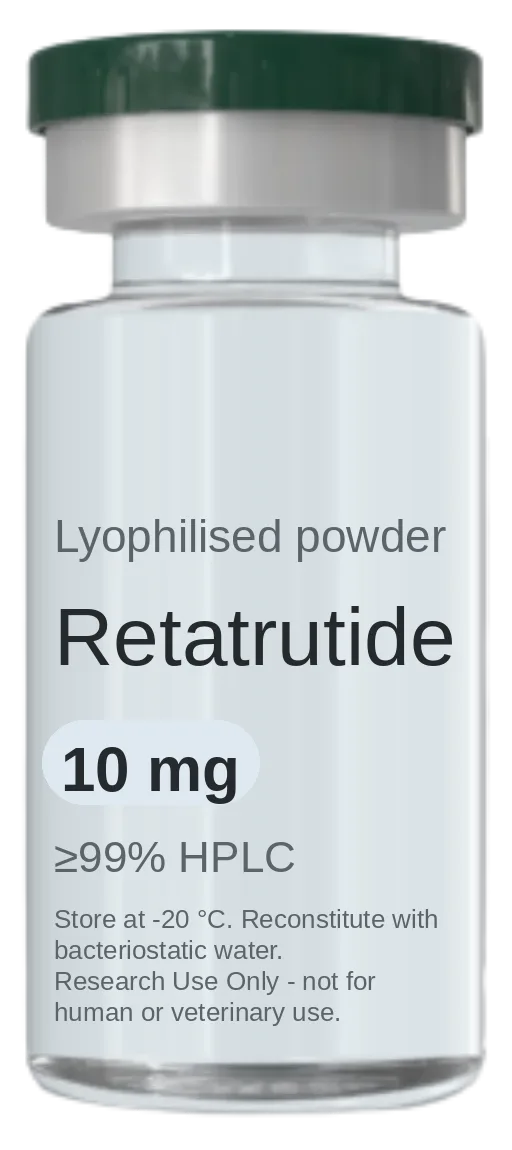
Retatrutide
Triple-agonist metabolic research peptide targeting GLP-1, GIP and glucagon receptors.
- Purity:
- ≥99% HPLC
- Sizes available:
- 10 mg
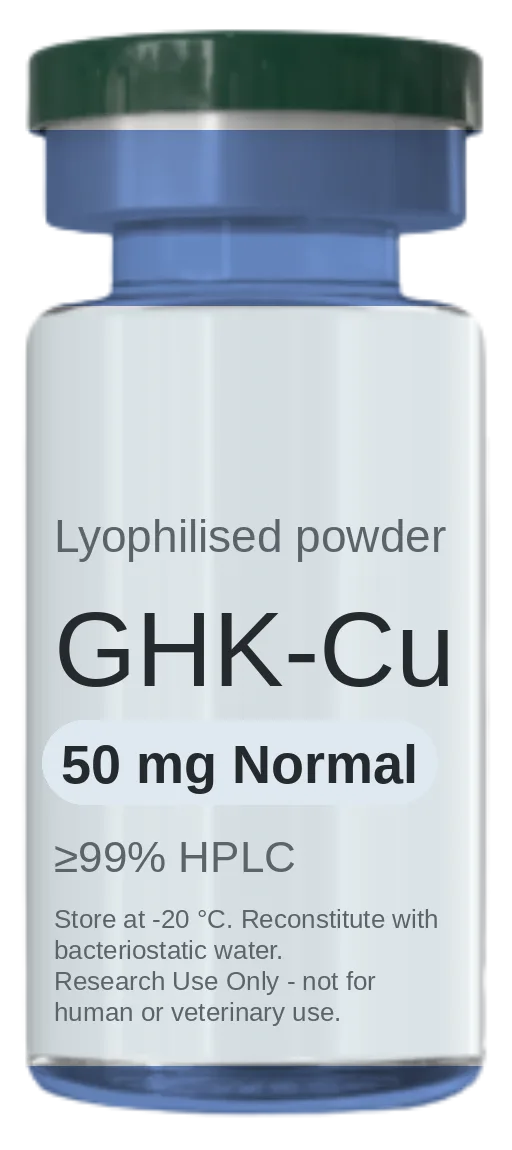
GHK-Cu (Copper Peptide)
Copper-binding tripeptide studied in extracellular matrix and dermal research models.
- Purity:
- ≥99% HPLC
- Sizes available:
- 50 mg Normal – 50 mg Plus
BPC-157 + TB-500
BPC-157 and TB-500 in a single vial — the pairing most studied together in tissue-repair research.
- Purity:
- ≥99% HPLC
- Sizes available:
- 5 mg + 5 mg
The consultation
One intake that settles goals, history and contraindications alongside compound, quantity, documentation and route — reviewed by a physician before anything ships.
More notes
-
Peptide Purity by HPLC: How It's Calculated
HPLC purity is the percentage of the main peak area over total chromatogram area. What that figure measures, what it misses, and how to read a CoA.
-
What 99% Purity Means in a Peptide
What the purity percentage in a peptide actually measures, how HPLC calculates it, and how to verify that a CoA number is real.
-
What a Peptide CoA Without Purity Data Means
A peptide CoA without a purity figure is incomplete. What that absence actually means, and what every complete batch report must include.
-
How to Read a Peptide HPLC Analysis Report
How to read a peptide HPLC certificate of analysis — area%, peak tables, chromatogram scale, and the red flags of a fabricated report.
-
Peptide Supplier vs. Reseller: What Differs
The real difference is whether someone can name the lab that tested a batch and show the report — or only promise it's pure.