
Note
Is Retatrutide FDA Approved?
By the PeptoClinic editorial team · Medically reviewed by Dr. Emily Parker
Retatrutide is in phase 3 trials and has no FDA approval yet. Here's what the trials measured and where development stands.
Retatrutide is not approved by the FDA. It remains an investigational compound, currently in phase 3 clinical trials, and no brand version exists on pharmacy shelves.
What "phase 3" actually means here
Drug development in the United States moves through a fixed sequence before the FDA will even review an application: phase 1 (safety, small groups), phase 2 (dose-finding, efficacy signals), and phase 3 (larger, longer trials meant to confirm effect and surface rarer side effects). Only after phase 3 data is submitted can the FDA approve a drug for sale.
Retatrutide's phase 2 results were published in the New England Journal of Medicine. Jastreboff et al., NEJM 2023 reported the trial in adults with obesity, and a separate phase 2 trial in type 2 diabetes was reported by Rosenstock et al., Lancet 2023. The compound has since moved into phase 3: Jastreboff et al., NEJM 2026 reports a phase 3 trial of retatrutide for obesity. Phase 3 is the stage directly before an FDA filing — it is not the same as approval, and there is no set date by which a phase 3 program finishes.
Anyone can check the current status of the ongoing trials directly at ClinicalTrials.gov, which lists each registered study, its phase, and its recruitment status. That registry is the most current source — more current than any blog post, including this one.
Why people confuse retatrutide with an approved drug
Retatrutide belongs to the same drug class as several medications the FDA has already approved. It's a triple agonist, acting on GLP-1, GIP, and glucagon receptors — one receptor more than the dual-agonist tirzepatide. Because tirzepatide is sold as Mounjaro and Zepbound, and semaglutide (a single GLP-1 agonist) is sold as Ozempic and Wegovy, people searching for retatrutide often assume it has reached the same point. It hasn't.
The mechanism comparison is worth being precise about, since the three compounds are frequently discussed together:
| Aspect | Retatrutide | Tirzepatide (approved as Mounjaro/Zepbound) |
|---|---|---|
| Receptors targeted | GLP-1, GIP, and glucagon (triple agonist) | GLP-1 and GIP (dual agonist) |
| FDA status | Not approved; phase 3 | Approved for type 2 diabetes and chronic weight management (FDA, 2023) |
| Phase 2 published data | Obesity trial (Jastreboff et al., NEJM 2023); type 2 diabetes trial (Rosenstock et al., Lancet 2023) | Weekly tirzepatide for obesity, SURMOUNT-1 (Jastreboff et al., NEJM 2022) |
| Phase 3 published data | Obesity trial reported (Jastreboff et al., NEJM 2026) | Completed; supported FDA filing |
| Brand name on the market | None | Mounjaro, Zepbound |
Being in the same drug class as an approved medication tells you something about mechanism. It tells you nothing about regulatory status — each molecule is reviewed and approved (or not) on its own trial data.
What the trials have actually measured
The phase 2 obesity trial compared different weekly doses of retatrutide against placebo over roughly a year, tracking body weight change as the primary measure. The type 2 diabetes trial tracked glycemic markers across a similar dosing range. The phase 3 obesity trial published in 2026 extends that work with a larger population and longer follow-up — the kind of data the FDA requires before it will consider an application. None of these publications are a substitute for an FDA review, and none of them constitute an approval or a safety clearance for use outside a monitored trial.
Where PeptoClinic fits into this
PeptoClinic lists retatrutide in its catalog, analyzed by Janoshik Analytical with a published purity of 99.893% for the retatrutide lot tested. That certificate speaks to the purity of the material supplied — it has no bearing on the FDA's review of the compound as a drug. PeptoClinic's retatrutide is not Mounjaro, not Zepbound, and not any approved product; it is not approved by the FDA, full stop, regardless of how the material is sourced or verified. A physician reviews each consultation before anything ships, and pricing for everything in the catalog is published at /en/pricing/.
Anyone comparing suppliers should also look at how material travels and what quality documentation is provided alongside it — a certificate of analysis is the one claim in this space that resolves to a document rather than a marketing line.

Medical review
Dr. Emily Parker

Reviews every consultation as it comes in
Frequently asked questions
Is retatrutide legal to buy in the United States?
Retatrutide is not a controlled substance, and it is not currently approved by the FDA as a drug for any indication. Its regulatory position sits in the space the FDA describes for investigational compounds still in trials — neither approved for sale as medicine nor scheduled as controlled.
Will retatrutide get FDA approved?
There's no way to know in advance. Phase 3 trial data has to be submitted and reviewed by the FDA before any approval decision, and the [ClinicalTrials.gov](https://clinicaltrials.gov/search?intr=retatrutide) registry is the place to track whether and when that filing happens.
What's the difference between retatrutide and Zepbound?
Zepbound is the brand name for tirzepatide, approved by the FDA for chronic weight management in 2023. Tirzepatide acts on two receptors (GLP-1 and GIP); retatrutide acts on three (GLP-1, GIP, and glucagon) and has not received FDA approval under any brand name.
Has retatrutide been tested on humans?
Yes. Phase 2 trials in both obesity and type 2 diabetes have been published in peer-reviewed journals ([Jastreboff et al., NEJM 2023](https://pubmed.ncbi.nlm.nih.gov/37366315/); [Rosenstock et al., Lancet 2023](https://pubmed.ncbi.nlm.nih.gov/37385280/)), and a phase 3 obesity trial has also been published ([Jastreboff et al., NEJM 2026](https://pubmed.ncbi.nlm.nih.gov/42814954/)).
Is retatrutide the same as semaglutide or tirzepatide?
No. All three are in the same broad family of metabolic peptide drugs, but they act on different combinations of receptors. Semaglutide targets GLP-1 alone (sold as Ozempic and Wegovy, per [Wilding et al., NEJM 2021](https://pubmed.ncbi.nlm.nih.gov/33567185/)), tirzepatide targets GLP-1 and GIP, and retatrutide adds a third receptor, glucagon.
Where can I check the current trial status myself?
[ClinicalTrials.gov](https://clinicaltrials.gov/search?intr=retatrutide) maintains the public registry of retatrutide trials, including phase, recruitment status, and estimated completion dates, and it's updated more frequently than any secondary source.
Does a lab purity certificate mean a compound is FDA approved?
No. A certificate of analysis, like the one Janoshik Analytical issued for the retatrutide lot PeptoClinic supplies, verifies the chemical purity of a specific batch. It has nothing to do with whether the FDA has reviewed or approved the molecule as a drug.
Is there a pen or injector version of retatrutide available?
PeptoClinic's catalog lists retatrutide as lyophilized powder in a vial. A pen format has been announced but is not currently orderable.
Compounds mentioned
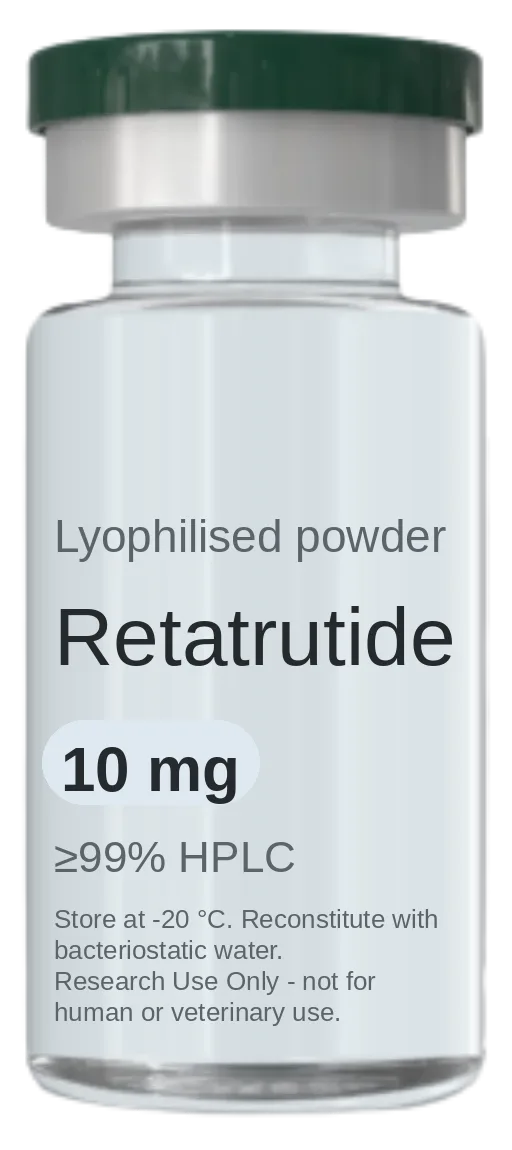
Retatrutide
Triple-agonist metabolic research peptide targeting GLP-1, GIP and glucagon receptors.
- Purity:
- ≥99% HPLC
- Sizes available:
- 10 mg
BPC-157 + TB-500
BPC-157 and TB-500 in a single vial — the pairing most studied together in tissue-repair research.
- Purity:
- ≥99% HPLC
- Sizes available:
- 5 mg + 5 mg
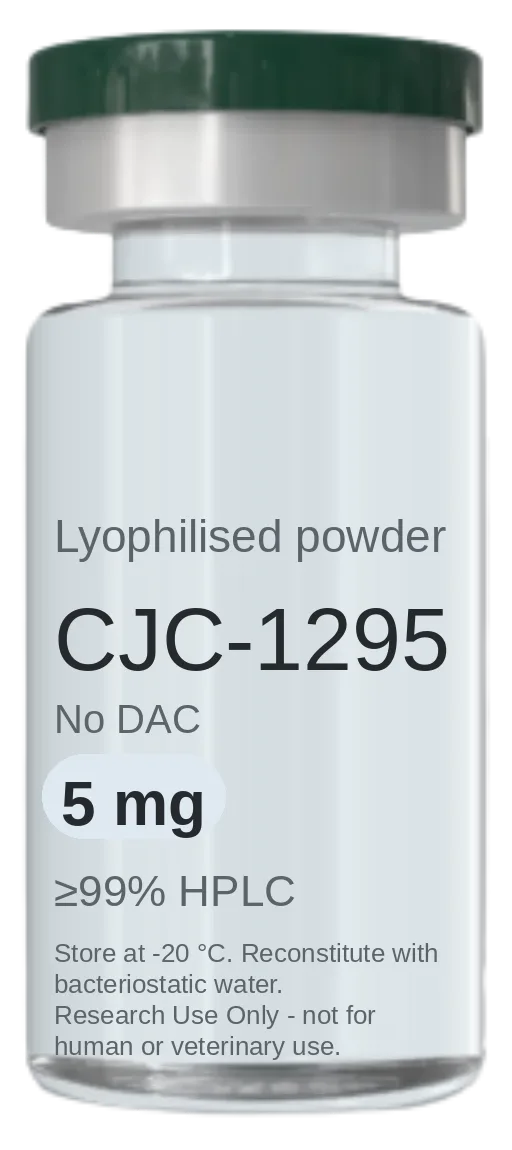
CJC-1295 (sin DAC)
Modified GRF(1-29) tetrasubstituted analogue without drug affinity complex.
- Purity:
- ≥99% HPLC
- Sizes available:
- 5 mg – 20 mg
The consultation
One intake that settles goals, history and contraindications alongside compound, quantity, documentation and route — reviewed by a physician before anything ships.
More notes
-
How to Tell If Retatrutide Is Original
The only real proof is the batch's certificate of analysis. What to check, what proves nothing, and how PeptoClinic documents it.
-
Retatrutide or Semaglutide: Key Differences
Retatrutide is a triple GLP-1/GIP/glucagon agonist; semaglutide activates only GLP-1. How the published literature compares them.
-
Retatrutide vs GHK-Cu: What's the Difference
Retatrutide and GHK-Cu are different molecules studied for different reasons. What each investigates, and what documentation backs a batch.
-
Retatrutide: The Triple Agonist Explained
What retatrutide is, which receptors it activates, and why research literature calls it a triple GLP-1/GIP/glucagon agonist.
-
HPLC Purity on a Peptide COA, Explained
What the HPLC purity percentage on a peptide certificate of analysis actually measures, and how to verify it against the lot you received.