
Note
Peptide molecular weight: how it's calculated
A peptide's molecular weight is the sum of its residue masses plus 18.02 Da. What it is, how to calculate it, and why it matters in research.
A peptide's molecular weight is the sum of the atomic masses of every atom in the molecule, expressed in daltons (Da). In practice, it is calculated by adding the residue masses of each amino acid in the chain and then adding 18.02 Da — the mass of the water molecule that completes the free amino (−NH₂) terminus and the free carboxyl (−COOH) terminus.
One dalton equals one atomic mass unit: one-twelfth the mass of a carbon-12 atom. For larger peptides the kilodalton (kDa) is used, where 1 kDa = 1,000 Da.
The molecular weight is the first figure that appears on any technical data sheet or certificate of analysis. It is also the parameter that mass spectrometry compares against the theoretical value to confirm that a compound has the declared sequence.
Amino acids as mass units
Every peptide is a chain of amino acids joined by peptide bonds. Each bond forms when the carboxyl group (−COOH) of one amino acid reacts with the amino group (−NH₂) of the next, releasing one water molecule per bond.
The 20 proteinogenic amino acids have different masses. The lowest residue mass belongs to glycine at 57.05 Da; the highest to tryptophan at 186.21 Da. That range explains why two peptides with the same number of amino acids can weigh very differently: sequence composition matters as much as chain length.
A residue mass is the free amino acid mass minus 18.02 Da — the water given up when the peptide bond forms. That figure is the practical unit for every molecular weight calculation.
The calculation
The general formula is:
MW = Σ (residue mass of each amino acid) + 18.02 Da
An equivalent form, starting from free amino acid masses:
MW = Σ (free amino acid masses) − (n − 1) × 18.02 Da
where *n* is the total number of amino acids. The (n − 1) terms represent the peptide bonds formed, each releasing a water molecule.
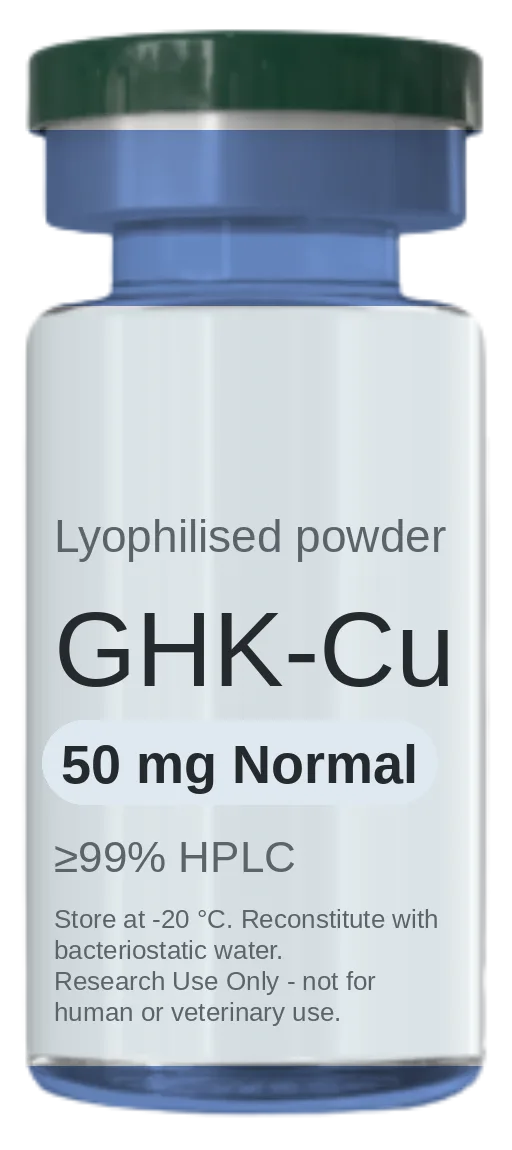
Example using the tripeptide glycine-histidine-lysine (GHK), the peptide sequence in GHK-Cu:
- Glycine (residue): 57.05 Da
- Histidine (residue): 137.14 Da
- Lysine (residue): 128.17 Da
- Sum of residues: 322.36 Da
- Plus 18.02 Da (terminal water): 340.38 Da
This figure matches the published molecular weight of the GHK tripeptide in analytical chemistry databases.
Average mass and monoisotopic mass
Laboratory reports list two versions of the molecular weight:
- Average mass: uses the average atomic weights of each element, weighted by natural isotopic abundances. This is the standard figure in general technical documentation.
- Monoisotopic mass: uses the mass of the most abundant isotope of each element (¹H, ¹²C, ¹⁴N, ¹⁶O, ³²S). High-resolution mass spectrometry reports this value because it corresponds to the most intense isotopic peak in the spectrum.
For peptides below 2,000 Da the difference between the two is less than 0.1 Da, which in many contexts is negligible. At higher masses the gap widens. A reliable technical report specifies which value it is reporting.
Molecular weights across research peptides
The range within the research peptide category is wide:
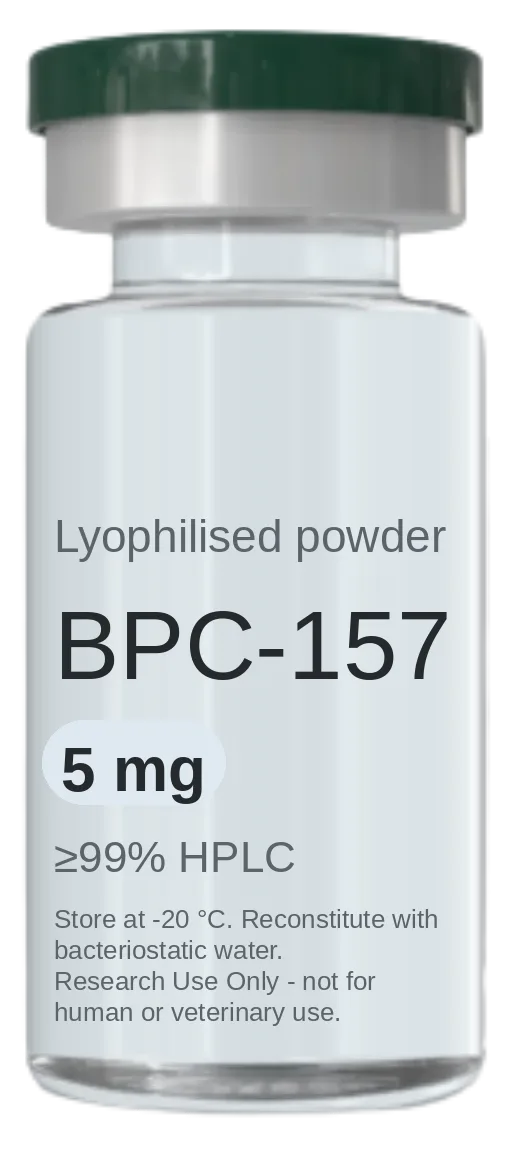
- BPC-157 is a 15-amino acid pentadecapeptide with molecular formula C₆₂H₉₈N₁₆O₂₂ and a molecular weight of 1,419.53 Da.
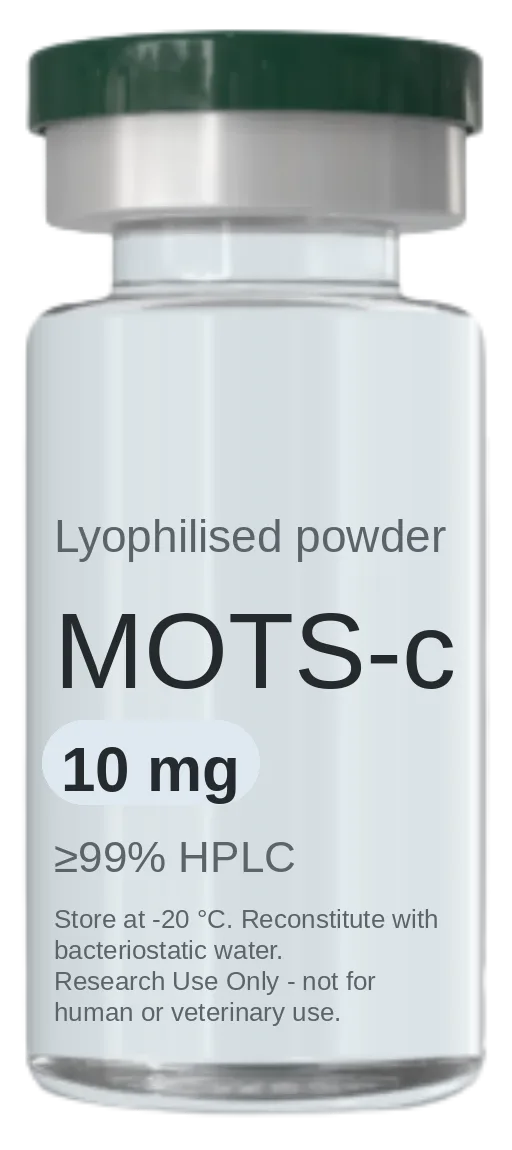
- MOTS-c has 16 amino acids with the sequence MRWQEMGYIFYPRKLR and a calculated molecular weight of 2,174.6 Da.
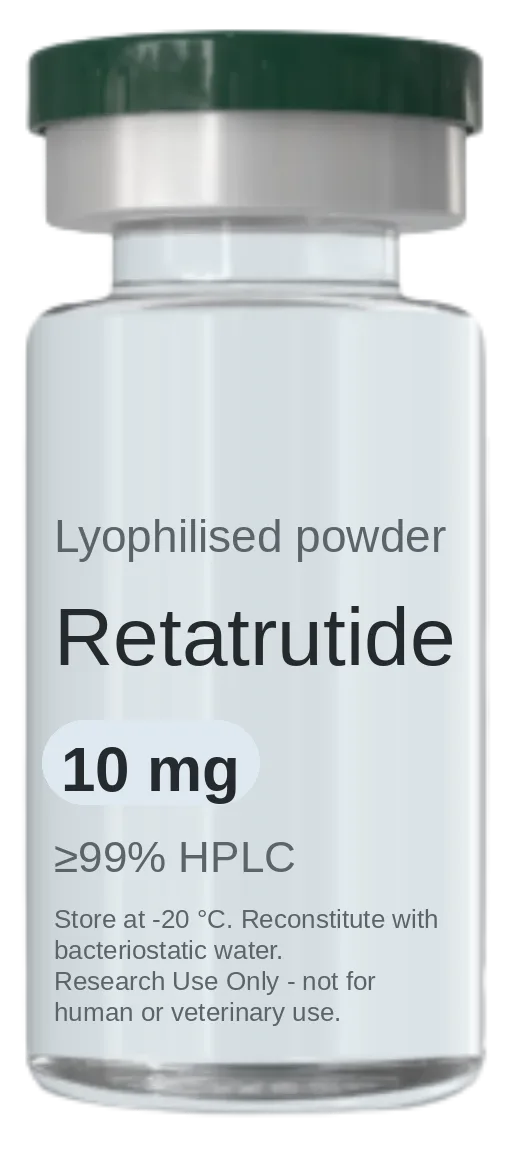
- Retatrutide is a modified 36-residue peptide whose published molecular weight exceeds 4,000 Da.
- GHK, the peptide chain in GHK-Cu, weighs 340.38 Da and is among the lowest-mass research compounds in the catalogue.
The scale difference is not only numerical. It affects solubility in different solvents, the rate of enzymatic degradation, behavior in chromatography, and the optimal approach to lyophilization and long-term storage.
Why molecular weight matters in the laboratory
In the laboratory, molecular weight converts a mass in milligrams into a number of moles. Without it, preparing a solution of defined molar concentration is not possible.
The conversion is:
moles = mass (g) / molecular weight (g/mol)
A 10 mg vial of BPC-157 contains 10 / 1,419.53 g/mol = 7.04 × 10⁻³ mmol (7.04 micromoles). That number is the starting point for any concentration calculation in a research protocol.
Beyond concentration, molecular weight is useful for:
- Confirming compound identity by mass spectrometry. A spectrum showing the [M+H]⁺ ion at the expected value is direct evidence that the sequence is correct. The literature on mass spectrometry applied to peptides is extensive and accessible on PubMed.
- Evaluating HPLC results: retention times depend on size and polarity, both connected to sequence composition.
- Identifying impurities. Molecules with masses different from the main compound appear as separate peaks in the spectrometer.
- Calculating molar-basis purity when the assay requires it.
How laboratory reports verify the mass
A certificate of analysis (COA) issued by an independent laboratory reports, among other parameters, the molecular weight found by the instrument and the HPLC purity. Agreement between the experimental value and the theoretical value calculated for the declared sequence is one of the most direct identity indicators available.
Janoshik Analytical is the laboratory that analyzed the lots available in the PeptoClinic catalogue. The quality and reports section publishes the reports with task numbers that allow direct verification on the laboratory's site. The retatrutide lot corresponding to task 136921 recorded 99.893 % purity by HPLC; the MOTS-c lot (task 136923) recorded 99.669 %. In both cases, the mass spectrometry section of each report confirms that the main peak corresponds to the expected mass for the declared sequence.
A report that shows only the theoretical mass value without the observed value is not verifying anything — it is copying the expected number.
For laboratory research only
All material that PeptoClinic quotes is Research Use Only (RUO): for in vitro and laboratory research. No compound in the catalogue is a medicine, supplement, or product approved for human or veterinary consumption. PeptoClinic holds no approvals from the FDA, ANMAT, or any equivalent regulatory authority. The content of this article describes parameters of chemical characterization. It does not constitute guidance on use in people or animals, and inquiries of that type are not handled.
Frequently asked questions
What unit is used to express a peptide's molecular weight?
The dalton (Da) or its multiple the kilodalton (kDa). When the value is expressed in g/mol, the number is identical to the figure in Da: a peptide of 1,419.53 Da has a molar mass of 1,419.53 g/mol. Short peptides like GHK weigh around 340 Da; longer modified peptides can exceed 4,000 Da.
What is the difference between molecular weight and molecular formula?
The molecular formula lists how many atoms of each element make up the molecule — for example, C₆₂H₉₈N₁₆O₂₂ for BPC-157. The molecular weight is the number that results from summing the masses of all those atoms using reference atomic weights. The formula describes composition; the molecular weight describes mass. Both appear on technical data sheets and certificates of analysis.
Why do some reports show two different mass values?
Because there are two ways to calculate it: average mass and monoisotopic mass. The first uses average atomic weights weighted by natural isotopic abundances; the second uses only the most abundant isotope of each element. For peptides below 2,000 Da the difference is typically less than 0.1 Da. A high-resolution mass spectrometry report always specifies which value it is reporting.
How can I tell if the mass found in the spectrum matches the correct peptide?
Compare the observed [M+H]⁺ value in the spectrum with the theoretical value calculated for the declared sequence. If the difference falls within the instrument's tolerance — typically under 5 ppm on high-resolution instruments — identity is confirmed. A reliable report shows the observed value, the theoretical value, and the deviation between the two.
Does molecular weight change if the peptide has modifications?
Yes. Any synthetic modification adds or removes mass from the unmodified sequence value. N-terminal acetylation adds 42.04 Da; C-terminal amidation subtracts 0.98 Da; lipid modifications or PEGylation can add hundreds or thousands of Da. The molecular weight of a modified peptide is always calculated on the full sequence including those modifications, and the COA must specify which modifications were accounted for.
What does it mean if the measured molecular weight does not match the theoretical value?
It indicates that the compound does not correspond to the declared sequence, or that impurities with different masses are present. An honest analysis reports the discrepancy, shows the observed peak, and states the difference. A certificate that shows only the expected theoretical value, without the experimental figure, is not a verification.
Where can I see the molecular weight data for the lots PeptoClinic quotes?
The quality and reports section of the PeptoClinic site publishes the Janoshik Analytical reports with task numbers for each analysis. Each report includes the mass spectrometry result alongside the HPLC purity of the lot analyzed, and can be verified directly on the laboratory's site using the task number.
Does molecular weight affect how a lyophilized peptide should be stored?
Indirectly. Lower molecular weight peptides tend to be more hygroscopic than longer chains, but stability also depends on sequence composition, the presence of reactive amino acids, and handling conditions. The general standard for lyophilized research peptides is −20 °C, protected from light and humidity, regardless of molecular weight.
Compounds mentioned
BPC-157 + TB-500
BPC-157 and TB-500 in a single vial — the pairing most studied together in tissue-repair research.
- Purity:
- ≥99% HPLC
- Sizes available:
- 5 mg + 5 mg
Retatrutide
Triple-agonist metabolic research peptide targeting GLP-1, GIP and glucagon receptors.
- Purity:
- ≥99% HPLC
- Sizes available:
- 10 mg
GHK-Cu (Copper Peptide)
Copper-binding tripeptide studied in extracellular matrix and dermal research models.
- Purity:
- ≥99% HPLC
- Sizes available:
- 50 mg Normal – 50 mg Plus
The consultation
One intake that settles goals, history and contraindications alongside compound, quantity, documentation and route — reviewed by a physician before anything ships.
More notes
-
Tesamorelin vs Sermorelin: The Difference
Tesamorelin and sermorelin are both GHRH analogs, but not the same molecule. Here's the structural difference and what the studies on each measure.
-
Peptide Supplier vs. Reseller: What Differs
The real difference is whether someone can name the lab that tested a batch and show the report — or only promise it's pure.
-
MOTS-c or NAD+: What's the Difference
MOTS-c and NAD+ are studied through different mitochondrial pathways; here's what each line of research actually measures.